
October 12, 2017
A vote for the Lusk-Rencher ticket is a vote for the CSO. Both Lusk and Rencher are currently running away from their advocacy of so-called “conservation” subdivisions, which were roundly rejected by Milton’s citizens, with over 2500 signing one or more petitions against such cluster housing. However, if elected, it is a sure bet that Lusk-Rencher will run back to their beloved CSO and once again try to force such cluster housing upon their constituents.
At their campaign websites, neither Council Member Bill Lusk nor mayoral candidate Laura Rencher mentions so-called “conservation” subdivisions or the infamous Conservation Subdivision Ordinance, or CSO. Of course, Mr. Lusk was the chief proponent on Council of the CSO and “conservation” subdivisions. And through her tax-exempt educational charity Preserve Rural Milton (PRM), Ms. Rencher was the chief political lobbyist for the CSO and conservation subdivisions. (Note: PRM’s tax-exempt status has been revoked because of failure to file required annual forms for 3 consecutive years.) Unfortunately, with their reckless and unworkable conservation subdivision proposals, the Lusk-Rencher duo dominated the city government’s land-use policy-making for nearly 2+ years. In that time, the City made very little progress on practical and effective land-use policies. And during this time, developers pursued unfettered development with reckless abandon.
With the CSO, Lusk-Rencher hijacked the city’s policy-making process, bypassing staff and the City Manager, to develop a Frankenstein ordinance that only a developer could love. And in fact, Atlanta’s two largest developer lobbyist groups did support the CSO in public comment at the City Council hearing where the CSO was denied. Lusk-Rencher’s CSO required NO conservation of buildable land . . . not one square inch. Randall Arendt, the father of the conservation subdivision, advises that a MINIMUM of 35% of buildable land be conserved in a conservation subdivision. Furthermore, Arendt explicitly advised Milton against counting unbuildable land (e.g., stream buffers) as conserved land, but was ignored. Arendt further advised that Milton’s one-acre minimums (Arendt prefers jurisdictions with larger minimum lot sizes) and lack of sewer made conservation subdivisions impractical for Milton, and again his advice was ignored
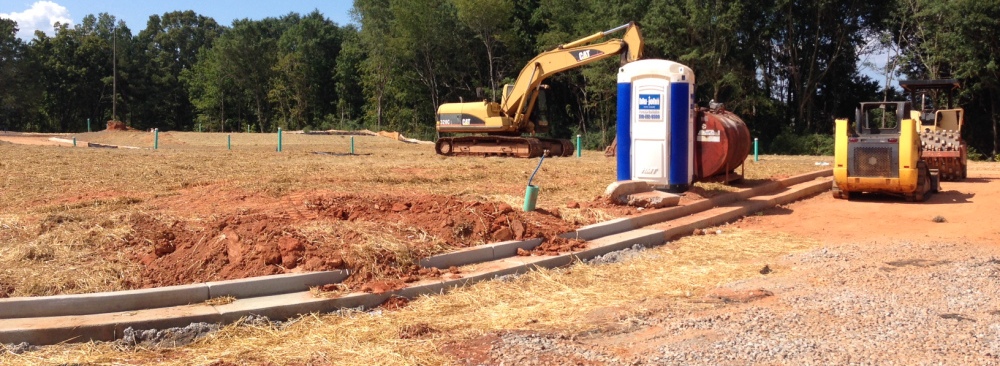
The Lusk and Rencher alliance goes further back than the CSO, stretching back to the rezoning of the land across from Cambridge High School in 2013. Both Lusk and Rencher supported the Cambridge townhouse development (although Rencher advocated for granting 2+ times density rather than 3+ times that was granted). Here is what Rencher stated in public comment (from the Council Meeting minutes):
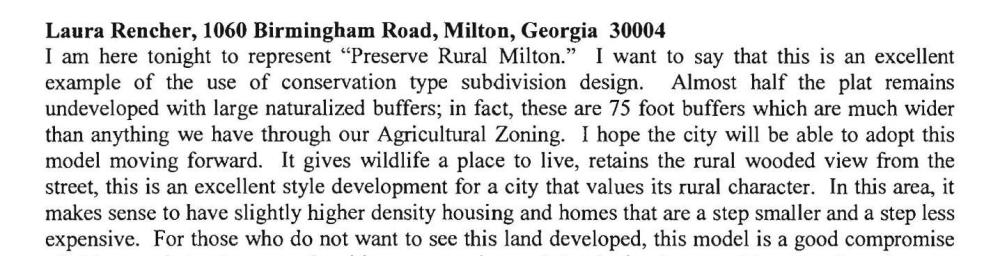
Where are the “large naturalized buffers”? Where is the “rural wooded view from the street”? Rencher claims this development to be “an excellent style development for a city that values it rural character” . . . really?
Mr. Lusk echoed Ms. Rencher’s comments.
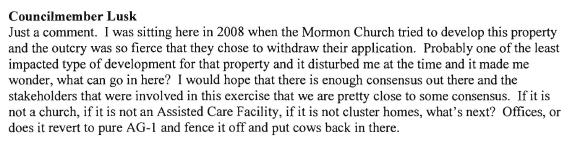
Yes, Mr. Lusk, the property’s zoning should have remained AG-1. Under AG-1 zoning, the developer would have built no more than 7 homes. Seven homes on 1 acre lots would have looked much better than the clear-cut pipe farm and retention pond that currently mar the property. The current buffers are skimpy. Where is the conserved land (i.e., 50% of the parcel) that was promised?
Of course, the most controversial battle over “conservation” cluster housing occurred with the Ebenezer rezoning in the first half of 2016. Ms. Rencher and Mr. Lusk both promoted Brightwater Homes’ development and its rezoning application. Through PRM, Ms. Rencher scheduled tours of Brightwater’s property, with Mr. Lusk co-leading tours with Brightwater’s CEO. In advocating for Brightwater’s Ebenezer rezoning ahead of the rezoning hearing, Mr. Lusk violated his duty of judicial impartiality. Mr. Lusk even sported a green polo shirt to demonstrate his solidarity with Ms. Rencher and Brightwater Homes. It is hard to wrap your mind around a City Council Member so shamelessly promoting a developer’s project.
The Ebenezer rezoning was only denied after overwhelming citizen opposition, with so many opponents attending the final City Council hearing that a holding room had to be created for the overflow crowd—a first in Milton’s history. Of course, the actual development of the Ebenezer property is proving that opponents were correct with their arguments. Rather than 48 homes being built on the 65 acres, it seems fewer than 30 will eventually be built under AG-1 zoning.
Despite strong public opposition, Mr. Lusk and Ms. Rencher continued to promote “conservation” subdivisions. In November 2016, Mr. Lusk voted against the Comprehensive Land Use Plan (CLUP) because its conservation subdivision language had been removed.
So citizens, don’t be fooled by Lusk-Rencher’s silence on “conservation” subdivisions. Lusk-Rencher still strongly favor such high density development, but realize their election prospects are slim if they publicly embrace such cluster housing. However, if Lusk and Rencher are elected, you can be sure that they will promote “conservation” subdivisions with a vengeance.
Tim Becker
 Milton Coalition