Sewer extension is the third rail in Milton politics. Council Member Rick Mohrig has voted multiple times for sewer extension in Milton. In 2023, Mohrig will finally pay the price for these votes. The subject of this post is Mohrig’s most recent vote for sewer extension where Mohrig ignored:
- strong and universal community opposition
- staff’s recommendation against extending sewer,
- the Planning Commission’s unanimous recommendation against sewer extension
- the subject property’s AG-1 designation in Milton’s Comprehensive Land Use Plan (CLUP), which had just been approved in late 2016. The CLUP committee (composed of 17 members) unanimously denied changing the land use designation (for this property) to higher density zoning.
First, some context . . .

Since Milton’s founding, land use has been the most important and most contentious issue in Milton. Miltonites love the natural beauty of their city—the horse farms, the trees, the four board fences, the historic barns—and want to preserve and protect it. One underlying reason for Milton’s beauty is its low density of homes, which has to do with Milton’s sewer system being mostly confined to Crabapple and the Highway 9-Windward-Deerfield area. Most homes in Milton have septic systems, which require percolation fields. In Milton, this means homes must be on 1+ acres of land. Unfortunately, over the years, special interests (i.e. developers) have successfully lobbied for extending sewer in Milton . . . and with sewer comes density . . . and with density comes urban problems, like traffic congestion, increased pollution, and overcrowded schools. Despite vowing never to extend sewer, quite a few council members have gone back on their word and voted for higher density rezonings that extended sewer. Rick Mohrig is one of Milton’s notorious promise-breaking, pro-sewer council members. However, because Mohrig has run unopposed in the last 3 elections, he has escaped accountability . . . until NOW. For the first time since 2011, a District 3 council race is competitive. Phil Cranmer is challenging Rick Mohrig.
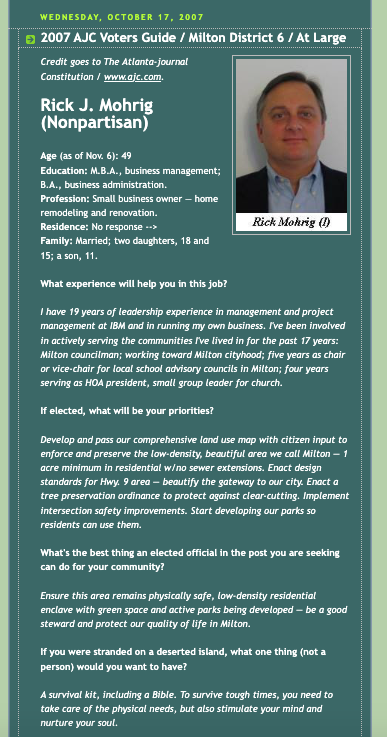
And yes, Rick Mohrig did explicitly promise never to extend sewer . . . and yes Mohrig did break his promise. In 2007, in the only competitive race of his career (which he lost) Mohrig answered a series of questions at the (now defunct) Access Milton blog. (His full response to all the questions is provided at the end of this post). When asked about his priorities, Mohrig stated “Develop and pass our comprehensive land use map with citizen input to enforce and preserve the low-density, beautiful area we call Milton – 1 acre minimum in residential w/ no sewer extensions.” See the following screenshot from the Access Milton blog:
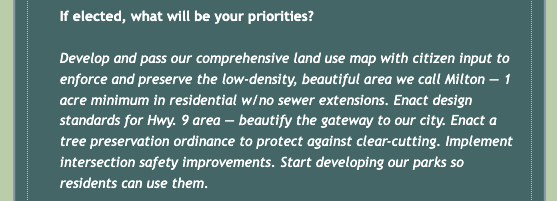
However, Mohrig has voted multiple times to extend sewer. In fact, the very last time that sewer was extended in Milton, Mohrig voted for it, breaking his promise and ignoring the Comprehensive Land Use map he vowed to “enforce.” That vote is the subject of this blog post.
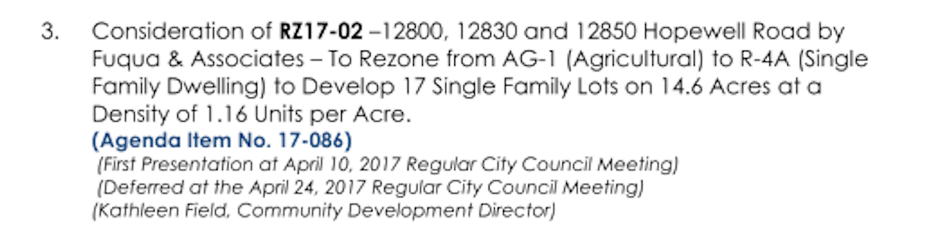
In early 2017, Fuqua & Associates applied for rezoning of a Hopewell Road property to higher density that included sewer extension. See the following screenshot from the city council review packet:
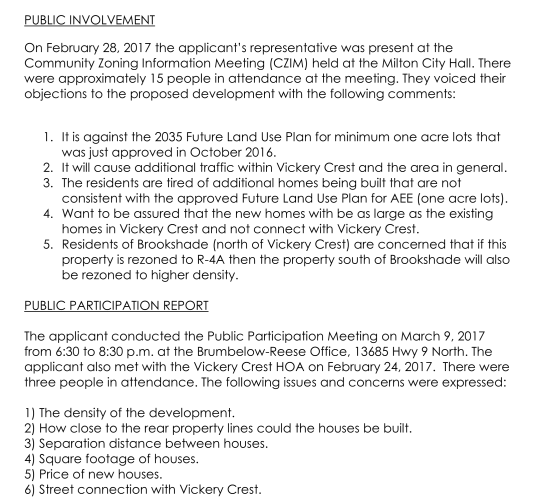
This process began with Community Zoning Information and Public Participation meetings. At these meetings, community opposition was strong and unanimous. See below screenshot from City Council’s meeting review packet:
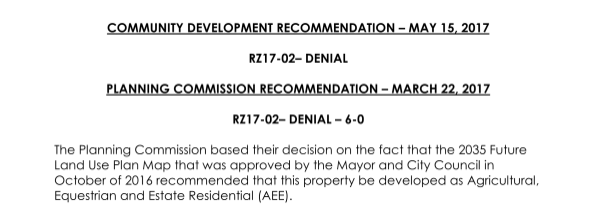
The rezoning then proceeded through the review process, including a courtesy review by the Design Review Board (with no vote), city Community Development staff review, and the Planning Commission review. Again, opposition was unanimous. Both Community Development and the Planning Commission (in a unanimous 6-0 vote) recommended denial of the rezoning and sewer extension. See below screenshot from the city council review packet:
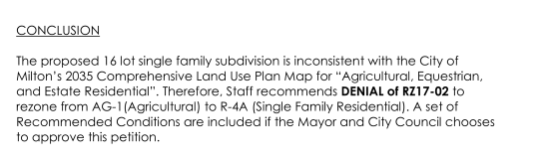
Milton’s Community Development included the following in the review packet to city council stating that the rezoning was “inconsistent with the City of Milton’s 2035 Comprehensive Land Use Plan Map for Agricultural, Equestrian, and Estate Residential.”
On May 15, 2017, the rezoning finally came before city council. Eight citizens (including myself and former council members Laura Bentley and Julie Bailey) spoke in opposition or had their opposition statements read into the record. By extending sewer, the proposed rezoning doubled the density of the property, cramming 16 homes onto a property that would have only supported 7-8 homes with septic. The hearing lasted nearly an hour and 45 minutes. The motion to approve the re-zoning and sewer extension was approved by council, with Mohrig voting for the sewer extension. Following is a photo of Mohrig meekly raising his hand to approve.

Following is a link to the video of the rezoning hearing. The hearing begins at 2:10:50 and the vote occurs around 3:53:35.
City Council Meeting: May 17, 2023
So despite strong and universal community opposition . . . and despite Community Development’s denial recommendation . . . and despite a unanimous Planning Commission denial recommendation . . . and despite being inconsistent with Milton’s land use map that Mohrig promised to uphold . . . and despite his promise never to extend sewer . . . Rick Mohrig voted to approve a rezoning and sewer extension that increased density twice what was allowed.
So my questions are very simple: Can Rick Mohrig be trusted? Will Rick Mohrig protect Milton from over-development? Will Rick Mohrig honor his oath to uphold the law? Will Rick Mohrig uphold Milton’s land use plan? The Hopewell Road rezoning demonstrates clearly that the answer to all of these questions is NO. Rick Mohrig has not and will not keep promises he makes to Milton’s voters. Period.
Advocating for Trust in Government,
Tim
Following are links to other land-use posts that have been published at the blog. There are more posts that I will eventually add to this list, so please come back.
Variances Are a Four-letter Word in the 2021 District 1 Race
District 1 Candidates Need to Make Honest, Clear, and Specific Land-Use Commitments to Citizens
Variances in Milton (Part 1): Radical Departure From Law and Historical Practice.
 Milton Coalition