

Working from the outside, using Open Records Requests (ORR), my visibility into Milton government is sometimes limited. However, due to my long and deep experience with local government since 2015, I am usually able to connect enough dots to provide readers a good sense of what is happening behind the city government curtain. However, I assume . . . and readers should also assume . . . that the real situation is usually worse (not better) than can be discerned from the outside, not unlike the tip of the proverbial iceberg. I assumed this was the case with Milton’s election initiative . . . that it was even more corrupted than it seemed . . . most of the iceberg was below the surface and unseen. And with each ORR I submit, this is confirmed . . . Milton’s elections story becomes ever more unseemly . . . more of the iceberg is revealed. Thankfully, we are finally getting a rare insider’s view of Milton’s elections project . . . and it is coming from the top executive in Milton City government: City Manager Krokoff. It is not only confirmatory but is actually worse than even I believed. I suppose Krokoff has become fed up with the “revisionist history” (his words), especially relating to the mistreatment of his staff. Read on . . .
Based (I suppose) on my investigation into the suppressed draft of the staff’s Election Feasibility Committee (EFC) report, Mayor Jamison inquired about why Council and the public were not presented with staff’s draft EFC report. (See below email from the mayor to City Manager Krokoff).
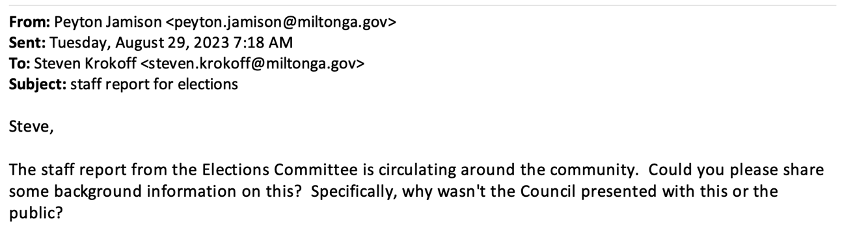
You can refer to my blog post from August 25th for more details about the withholding of this staff report and the disrespectful marginalization of staff. Click on the following link: Latest Investigation Shows Mohrig Pushed Aside City Staff and Suppressed Elections Findings . . . Violating Committee Standards . . . To Advance His Propagandistic Election Agenda
City Manager Krokoff’s response is illuminating and exposes an elections initiative more biased, more dishonest, more non-transparent, and more dysfunctional than I was able to discover through my Open Records Requests. Krokoff’s insider perspective confirms my assertions in earlier blog posts . . . and then some. Following are the main points from Krokoff’s email response (including direct excerpts in quotes):
- Staff Marginalization/Exclusion. The partisan committee members—two council members and 2 partisan activists—concluded that “the information provided by staff did not warrant inclusion.” Krokoff confirms that staff members were criticized, marginalized, and eventually entirely excluded.
- Revisionist History. The partisan committee members have created a “revisionist history” that is exposed by “simple review of meeting recordings and public comments.”
- Unsuitable/Irregular Committee Composition. “Early concerns about its composition . . . were ultimately unheeded.”
- Strong Ideological Bias. Some EFC members “entered the process with preconceived notions” such that the “endeavor seemed more like a justification exercise than a true feasibility assessment.” This was evidenced when staff “tried to present factual information but were consistently rebuffed.” There was a “reluctance to provide an unbiased assessment to city council” due to the “committee’s ideological standpoint.” For more information about the creation and operations (some secret and undocumented) of the EFC, click on the following July 16th post link: Election Interference in Milton (Part 1): The Election Feasibility Committee . . . Lack of Transparency, Expertise, and Non-Partisanship
- Poor Treatment of Staff. For staff, participation was “negative” and “distressing and demoralizing.”
- Constant Post-EFC Interference. After the EFC was disbanded, “A subset of the committee members remained steadfast in their efforts to sway council” such that they “openly challenged our differing recommendations in a harsh manner, as if it was inappropriate to disagree . . . or offer alternatives.” Refer to my blog post from July 17th for more details about continued interference from EFC members once the EFC had disbanded: Election Interference (Part 2): Backroom Tampering in Hiring and Work of Milton’s Election Consultant
- Excessive Partisan Activist Influence and Overly Compliant Council. “Strong comments from an outspoken group appeared to resonate with certain Council members” such that they “seemed ready to accept the committee’s findings without hesitation.”
- Tampering in Election Consultant Hiring. Pressure from Mohrig “escalated” so that he was “insisting that I interview his preferred candidate.” The “unsettling dialogue at Council meetings” caused “qualified candidates” to withdraw so the Vernetta Nuriddan “emerged as the sole option.” Due to the “ongoing influence of the committee . . . and disregard for staff research, I opted to involve that candidate.”
The City Manager’s assessment is damning. I appreciate his candor. Krokoff is especially credible because he does not really have a dog-in-the-fight. In fact, his inclinations likely militate against his being so direct and specific in his criticism, as such criticism certainly and uncomfortably puts him in the crosshairs of certain council members and hyper-partisans in Milton. At this point (with the EFC finally in the rearview mirror and no longer interfering), you could strongly argue he has little to gain from these revelations. (I do know that Krokoff is protective of his people, and clearly they were treated shabbily by the four partisan EFC members.)
There is a lot going on here. The summary above encapsulates the many and serious EFC issues. However, for those readers who want to delve deeper into the elections fiasco, I offer additional insights below that complete some blanks in Krokoff’s comments, clarify certain points, or else provide more detail. Following is a paragraph-by-paragraph commentary.
***************************************************************************
Krokoff confirms that the partisan staff members—two council members and 2 hyper-partisan activists—concluded that “the information provided by staff did not warrant inclusion.” Translation: Certain critical information was withheld from the public and council—for example, an excellent 7-point risk analysis and staff costs in the business case. Non-inclusion of such essential information (that did not support a partisan narrative) provides proof of the Krokoff’s assertion of bias in the four non-staff committee members. As revealed later in his email, non-staff members’ rejection of the staff draft was indicative of a long pattern of criticism, marginalization, and disrespect for the city staff committee members.
You can refer to my blog post from August 25th for more details about the withholding of this staff report and the marginalization of staff. Click on the following link. Latest Investigation Shows Mohrig Pushed Aside City Staff and Suppressed Elections Findings . . . Violating Committee Standards . . . To Advance His Propagandistic Election Agenda

Krokoff asserts there was “a revisionist history that has pervaded this process.” He states that one merely needs to review the council meeting recordings and public comments to draw this conclusion. I have watched all the council meeting videos and agree with Krokoff’s assessment. Pervaded is a strong term that I also agree with. Both Rick Mohrig and Paul Moore are still pitching a narrative that just doesn’t pass the BS test. For example, at the last council meeting, Moore again falsely asserted that the elections initiative was purely about cost savings, when the evidence clearly shows the chief drivers were election integrity (and more specifically avenging the alleged stolen 2020 presidential election) and Fulton County’s competence (or lack thereof) in administering elections.

About the committee Krokoff states “early concerns about its composition . . . were ultimately unheeded.” Krokoff is not specific about those concerns. However, these concerns are several and obvious. First, the committee was not formed according to Milton’s rules for committee formation, where each council member appoints a member. Rather, this committee was oddly comprised of 2 staff, 2 appointed members of the community, and 2 council members. Second, it is odd and (I would contend) unethical for council members to design their own elections. What is the justification for including any council members on the committee? No other city committees—past or present—have ever included council members as voting members. In fact, the City Charter prohibits council members from appointment to committees. Third, all non-staff members were strongly partisan. An elections feasibility assessment should have been a non-partisan exercise. And if not, then it should have been bipartisan, with representation from both sides of the political spectrum. Fourth, the committee members generally lacked elections expertise/experience; four members had no experience and the other two had limited experience.

Krokoff is (rightfully) highly critical of the partisan bias of the non-staff committee members, mentioning their partiality several times in his email. He states that some EFC members “entered the process with preconceived notions” such that the “endeavor seemed more like a justification exercise than a true feasibility assessment.” This was evidenced when staff “tried to present factual information but were consistently rebuffed.” There was a “reluctance to provide an unbiased assessment to city council” due to the “committee’s ideological standpoint.” This is a damning (but correct) judgment of the committee’s damn-the-truth-full-speed-ahead approach. Quite simply, the EFC’s recommendations were a forgone conclusion . . . a case of I’ve-made-up-my-mind-so-don’t-confuse-me-with-the-facts. Accordingly, the EFC meetings that were public (some were not) were purely political theatre.
For more information about the creation and conduct (some secret and undocumented) of the EFC, click on the following July 16th post link: Election Interference in Milton (Part 1): The Election Feasibility Committee . . . Lack of Transparency, Expertise, and Non-Partisanship

I understand Krokoff’s concerns about potential exorbitant Fulton County costs to administer Milton’s municipal elections, although it should be noted that FuCo’s costs were eventually estimated at $6.93 per registered voter and capped its maximum cost at $7.62 per registered voter.
Despite the shift to “prudent planning,” it did not “ease the negative experience” of a biased committee that criticized, disrespected and marginalized staff. However, given “the presence of two City Council members and two highly influential community members,” Krokoff determined he “lacked the necessary support to counter this narrative.” Citizens, this is exactly WHY the City Charter prohibits council member appointment to committees.


Krokoff references the “committee’s ideological standpoint” in the context of their continued interference in the elections design and planning. Krokoff believed that after the EFC disbanded, its partisan members would back off and allow staff to continue the committee’s work unhindered. He was wrong. After the EFC was disbanded, Krokoff states that “a subset of the committee members remained steadfast in their efforts to sway council” such that they “openly challenged our differing recommendations in a harsh manner, as if it was inappropriate to disagree . . . or offer alternatives.” Krokoff also references the undue influence of Milton’s extreme right-wing fringe, stating: “Strong comments from an outspoken group appeared to resonate with certain Council members” who “seemed ready to accept the committee’s findings without hesitation” . . . or, I might add, any reasonable scrutiny.


The interference extends to the hiring of Milton’s election consultant. Krokoff states that interference “escalated” so that Mohrig was “insisting that I interview his preferred candidate.” The other “qualified candidates withdrew due to unsettling dialogue at Council meetings,” so that Nuriddan, who did not meet “the minimum qualifications,” became the “sole option.” Krokoff felt he had no option but to hire Nuriddin . . . especially after Mohrig and Moore effectively vetoed his Krokoff’s proposal to early-hire poll managers and direct them to complete Milton’s election planning and design.
Refer to my blog post from July 17th for more details about continued interference from EFC members once the EFC has disbanded: Election Interference (Part 2): Backroom Tampering in Hiring and Work of Milton’s Election Consultant


Mr. Krokoff’s honest assessment of many (not all) aspects of the EFC confirms an elections design and planning process that was highly dysfunctional. The results were predictable: demoralized staff; vastly overestimated costs savings; a flawed and discriminatory election design; intentional omission of any risk assessment; wasted time, resources, and money; reduced and unequal voter access; poorly sourced/substantiated recommendations; lack of transparency; eroding public trust and confidence; unnecessary community acrimony; and constant partisan interference in post-EFC planning.
Advocating to Election Integrity and Voter Rights,
Tim
Note: Attached (in reverse chronological order) are Mayor Jamison’s initial email inquiry and City Manager Krokoff’s response (in its entirety). As always, I provide all source materials so you can draw your own conclusions. I have nothing to hide . . . you be the judge.
 Milton Coalition