
(Note: I have updated my earlier post to reflect refined costs that I received from a helpful citizen . . . these numbers reflect elections economics even worse than the economics in my original post.)
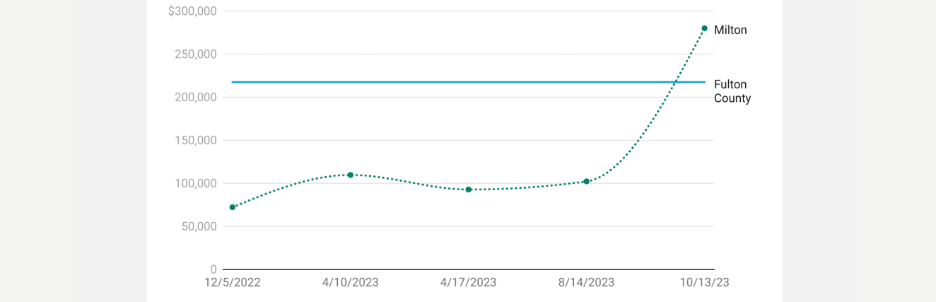
Keep the following in mind as you read this post. It is a certainty that, when all costs are considered and accurately estimated, Milton will spend nearly $470,000 on its elections . . . about $253,000 (or 117+%) more than Fulton County would have charged. Milton will spend $397,000 (or 550%) more than Election Feasibility Committee’s cost estimate! And this is for much lower service levels: fewer early voting hours; few polling locations; and no options to early vote outside Milton. This is a scandalous waste of your hard-earned tax dollars! A vote for Rick Mohrig is a vote for gross financial irresponsibility. Taxpayer-voters, read on . . .

Yesterday, the Milton Herald’s Amber Perry published an excellent analysis of Milton’s elections costs that now shows that Milton will pay more . . . much more . . . to self-run its elections than if it had paid Fulton County to run its elections. Right now, the cost exceeds FuCo’s by 29%, or $63,000+. Costs will rise a lot more. Why? First, some costs are not (yet) included. Second, the City continues to encounter issues not anticipated (or not fully appreciated) by the Elections Feasibility Committee (EFC). Following is a link to the Milton Herald article:
Milton Herald: Milton Elections Cost Now $60,000 Higher than Fulton County
For months, I have been predicting this large cost overrun. And no, I am not a financial wizard. However, I have assembled and reviewed more than my fair share of business cases . . . and written multiple articles for professional journals on this topic. I am attaching one of those articles at the bottom; Milton violated nearly every one of the fundamental tenets for creating a credible business case. It became clear to me with regards to the elections business case that “the dog would not hunt.”

And as you read the following, bear in mind that Milton is providing a much lower service level than Fulton County would have provided. So taxpayer-voters will be paying MUCH MORE FOR MUCH LESS.
- Polling locations reduced from 8 to 2 (but eventually increased to 3 after strong public outcry)
- Reduced early voting hours from both the EFC’s recommendation (206 hours) and Fulton County’s early voting (169 hours) to 149 hours. For example, Sunday voting was eliminated.
- Early voting can no longer be done outside Milton (at Milton City Hall). Previously, 40% of early voting occurred outside Milton . . . 30% of it in Alpharetta.
I watched Lisa Cauley’s presentation of the EFC’s business case in December 2022. (Cauley was a member of the EFC.) I was underwhelmed to say the least. I knew there would be enormous future problems. It was clear that costs had been underestimated or entirely excluded. Not a penny was estimated for staff costs. There was no risk analysis. We now know that city staff was pushed aside by some of the other EFC members, and the staff-developed draft of the final report was materially altered. The public was not provided any opportunities for input on the final report, which was not put to a vote by the full committee. It is unclear who exactly assembled the final business case . . . was it just Ms. Cauley? We do not know because there is scant record of how the final report was developed.
The shoddy final report is exactly what you would expect from a committee that was biased and lacking in elections (and other required) expertise. It was clear that the EFC had a simplistic view of a quite complex matter. After the EFC disbanded, those charged with planning, preparation, and execution had to deal with this complexity (e.g., myriad state rules) and its associated costs (and risks).
Readers might recall that EFC members Lisa Cauley and Rick Mohrig predicted cost savings of (over) $200,000 and $250,000, respectively. Consider these figures in light of Fulton County’s estimate of $216,565 to run Milton’s municipal elections (Source: Milton Herald). Accordingly, Mohrig’s $250,000 savings estimate is an impossibility! It would mean Milton is turning a profit of $33,500 on its elections! And Cauley’s estimate would mean elections would only cost around $16,500. Clearly, this is Voodoo Economics. Through an Open Records Request, I flushed out Cauley and Mohrig’s lack of substantiation of their highly inflated cost savings.
Further consider that the EFC estimated the 2023 elections would cost only $72,254, so the Milton Herald’s calculated costs are 288% higher (than the EFC’s estimated costs) and rising. Following is an excerpt from the EFC’s business case.
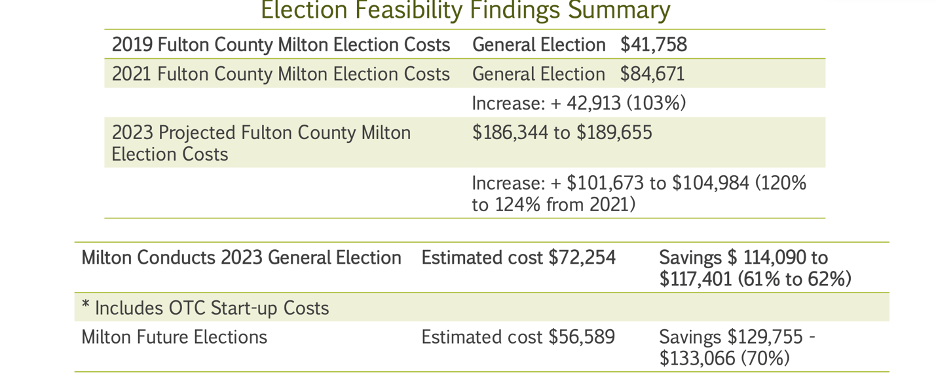
Note that FuCo’s costs for 2021 were projected to be $84,671. At the time, Paul Moore expressed outrage at this cost and cited it as a reason for his vote for Milton to run its 2021 elections. In August 2021, Moore and Mohrig were the only council members to vote FOR Milton running its 2021 municipal elections. In retrospect, FuCo’s price was a bargain. And considering how complex we now know elections to be, think about the disaster that would have ensued if Milton ran its 2021 municipal elections.
Citizens, it gets worse . . . much worse. Some large costs are not yet included in the Milton Herald’s analysis. My following assumptions are all conservative, so I suspect actual costs will be higher. Not included were:
- Staff costs for October and November (and beyond). Assuming staff will devote the same amounts of time in October and November (as they have been recently allocating) and none after November 30th, this adds another $57,000 to the cost, bringing Milton’s total elections costs to $337,000. (I believe it is reasonable to assume significant time will be spent in the aftermath of the election on clean-up, lessons learned, reporting, analysis, continuing legal matters, etc.)
- Staff time before January 1, 2023. Milton’s election initiative began in July 2021, so 18 months of staff time must be accounted for. For example, early on, staff conducted a back-of-the-envelope analysis of costs. Staff also participated in the EFC. If we assume Inglis, Lowit, and Krokoff devoted just 5% of their time (2 hours per week) over these 18 months, then a conservative estimate of total staff time is 450 hours. At a blended rate of $84.00 per hour, the additional costs come to around $38,000, so the total elections costs increase to $375,000.
- Benefits loadings for staff. This is standard practice in formulating business cases. Provision of subsidized health insurance, retirement, etc. are real costs. Conservatively, this benefits loading adds (at least) 35% to the staff costs, so that brings fully loaded staff costs to $326,000 and total elections costs to $459,000
- Additional unanticipated costs, especially additional legal costs. Unanticipated costs have been par-for-the-course and have been steadily rising. The city has three pending legal complaints at the state elections board. Very conservatively, I am adding $10,000 to arrive at $469,000 for total elections costs.
So minimally, Milton will spend $469,000 to self-run its municipal elections. And again, this cost is for much lower service levels than FuCo would have offered. So Milton will be spending:
- Infinitely more than Mohrig asserts, because his cost savings estimate of $250,000 implies Milton is turning a profit on its elections! An impossibility.
- 2900+% more than Ms. Cauley’s cost savings estimate would imply.
- 550% more than the EFC’s 2023 cost estimate.
- 117% more than Fulton County would have charged.
And Milton will be offering reduced service levels:
- 93% fewer early voting locations, as the only early voting location is at Milton City Hall. It should be noted this is inconvenient for many Milton voters, as it does not conform to Milton’s North-to-South and West-to-East traffic patterns.
- 62.5% fewer polling locations . . . reduced from 8 to 3
- 28% fewer early voting hours. This includes elimination of Sunday voting.
Note also that municipal elections occur in odd-numbered years. In even-numbered years, Milton’s elections will still be run by Fulton County. This means entirely different polling locations and significantly different voting days/hours. And if in an odd-numbered year, there is a county, state, or federal ballot initiative or race, either FuCo will run the entire election or voters will have to travel to two different locations to vote. Yes, it will be confusing.
So who is the blame? Well, there is a lot of blame to go around. However, the lion’s share of blame falls on Milton’s Election Feasibility Committee—primarily Council Members Mohrig and Moore and the two citizen appointees. As we have discovered through extensive research, these four committee members lacked expertise and were highly biased. They also marginalized staff EFC members and dismissed/discounted alternative perspectives and facts that did not fit their narrative. Accordingly, the EFC’s recommendations were poorly supported and biased (or more accurately predetermined). Council was sold a bill of goods.
The person most singly to blame for these vast cost overruns is Rick Mohrig. Milton’s elections project was his brainchild. He was the leader of a radical fringe element in Milton that was seeking revenge for what it perceived was a stolen 2020 presidential election—aided and abetted by Fulton County elections authorities. At first, cost savings were mostly a secondary concern. However, over time, as Milton’s election project became steeped in incompetence, dishonesty, non-transparency, and partisanship, Mohrig backed away from his integrity and competence arguments (for Milton self-running its elections). Mohrig began asserting that cost savings were the only driver of Milton’s elections project. What say yea now Mr. Mohrig?
Since late July, I have been pursuing Mr. Mohrig and Ms. Cauley on this issue of cost savings. I even submitted ORRs to get their substantiation of their alleged cost savings. You can hear Ms. Cauley’s cost savings projections by watching the July 24th city council meeting. She asserts “overwhelming findings on how the city would save the taxpayer what we now know is over $200,000.” Fast-forward to minute 10:00.
Mr. Mohrig has consistently asserted even higher cost savings of $250,000. However, as he often does, Mr. Mohrig has completely reversed course and is now stating there might be savings. At the recent Appen Media debate, he stated “I think we’re going to be actually saving money” as if to say cost savings were never expected but rather would be a pleasant surprise. Voters, this is an Olympic level of political double-talk and deceit. Forward to 1:21:37 in the debate video.
Video: Milton City Council Debate
It is interesting to note that nowhere at Mr. Mohrig’s campaign website, campaign Facebook page, etc. does he make the first mention of elections. This is intentional. Mr. Mohrig knows he is vulnerable on the issue of elections. What he hoped would be his signature achievement has become his signature failure. And the less it is discussed, the better. (The same can be said of ethics and accountability. Mohrig never mentions it, despite its looming presence in Milton’s government over the past 2 years.)

Voters, Milton’s elections project has been a disaster from its inception. As I have documented in 20 posts, Milton’s elections initiative has been wracked by dishonesty, non-transparency, partisanship, and incompetence. The result has been shoddy and biased election design and planning. And now we are discovering that Milton’s election initiative has wasted a lot of hard-earned tax dollars. Mr. Mohrig often and adamantly promotes his fiscal chastity, while he promiscuously wastes your hard-earned tax dollars. It is time to give Mr. Mohrig the boot.
Please forward to family, friends, and neighbors. Every Milton voter needs to understand the huge waste of tax dollars resulting from Milton’s failed election project.
Advocating For Election Integrity and Fiscal Accountability,
Tim
Note: The Milton Herald does not provide detailed calculations. I have assumed its figures and calculations are correct and have used its data and cost estimates as a starting point for my calculations and cost estimates. I have created a spreadsheet that I will clean up and format and then provide to readers for their verification and use. I will post the spreadsheet at Bits & Pieces.
I believe that my assumptions overall are conservative, meaning I believe that elections costs are even higher than I projected. However, even if my cost estimates are a bit high, the overall message is the same: 1) Milton is paying much more for its elections than it would have paid if FuCo ran its elections and 2) the EFC wildly underestimated elections costs.
 Milton Coalition