
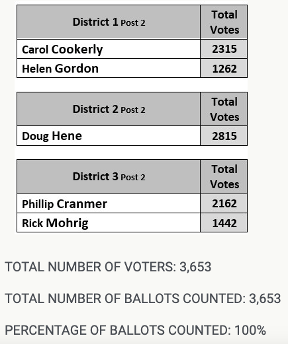
Rick Mohrig and Helen Gordon were soundly routed in Milton’s recent municipal elections. However, you must wonder if their margins of defeat might have been even larger if Milton’s election design was not so biased against District 3 voters. Conversely, you must wonder if the margin of defeat might have been smaller if council members Mohrig, Moore, and Jacobus had succeeded in denying District 3 voters a day-of polling place. Consider two statistics:
- 2 out of 3 of the (17) early voting days when District 3 votes comprised the highest proportion of total votes cast were Saturdays.
- District 3 had the lowest proportion of early votes (to total votes) at 46.5% (vs. 63.6% for District 1).
I will return to these statistics later, and hopefully Milton will conduct detailed analysis of the 2023 election statistics as it considers whether Milton should continue to conduct its municipal elections . . . and if so, what changes should be made.

Let me begin by stating that I am a staunch—but more importantly, principled—Conservative. Real Conservatives despise a rigged game . . . unlike counterfeit conservatives. Milton’s counterfeit conservatives regularly rant and rave about election integrity but continue to defend an indefensible election design and planning process that was riddled with dishonesty and lack of transparency . . . with predictable results . . . an unfair election design intended to advantage their counterfeit conservative candidates. Real Conservatives care about maximizing liberty, which means ensuring equal opportunities (and rights) for all citizens . . . most especially equal opportunity at the ballot box. If we err in one direction or another, we should err in providing more opportunity to the least advantaged in society . . . that is compassionate Conservatism. Conversely, counterfeit conservatives are motivated to create and/or perpetuate unequal opportunities for their constituencies with the aim of achieving and/or maintaining unfair advantage . . . for example, biased election designs that favor their candidates. To hell with the less fortunate in our society . . . “let them eat cake” (Marie Antoinette).
Let’s begin with a few reasonable premises. District 3 is where Milton’s least well-off voters live. All of Milton’s apartment housing is located here, along with many/most of Milton’s starter homes. District 3 is the area where two-earner and single-parent families are concentrated: first responders, teachers, nurses, tradespeople, etc. These are families who have the least time to vote . . . and for whom Milton needs to make voting easiest (or equally easy) . . . but for whom Milton has made voting most difficult. These are voters that the let-them-eat-cake Real Housewives of Milton—that regularly rant at council–don’t understand or care about.
These District 3 residents are voters that probably most took advantage of Fulton County’s early voting outside of Milton . . . voting close to their work where they could vote on their lunch hour or on their way to/from work. These are voters who previously also early voted in heavy numbers in Alpharetta, which is convenient (to SE Milton) . . . again on their way to/from work . . . or as a part of their weekend routine. These are voters that most take advantage of Sunday early voting, which Milton eliminated. (Note: When Fulton County ran Milton’s municipal elections, 40% of early voting occurred outside Milton . . . with 75% of the 40% occurring in Alpharetta.)
And let’s be honest. District 3 is where Milton’s Democrats and black & brown voters are concentrated. If the intent was to appeal to voters based on party affiliation, then you certainly want to make it difficult for District 3 voters to vote. And as we know, Mohrig’s campaign was hyper-partisan (although important issues in Milton never break along party lines). Mohrig’s counterfeit conservative canvassers touted Mohrig as “the Republican candidate” and labeled Cranmer as “the Democrat candidate.” Mohrig was promoted at an extremist right-wing media site . . . where he even participated in a video interview. And let’s truthfully talk about racial/ethnic intolerance. Even if the election design intent was not discriminatory, the outcome—reducing the black and brown vote—was clearly discriminatory . . . and therefore the design was inherently discriminatory. This is common-sense logic, except with the counterfeit conservative fringe element
So given those premises, how might one quash the opposition vote concentrated in District 3? Easy . . . make it more difficult for District 3 citizens to vote. By what means?
- Eliminate their option to early vote anywhere but in Milton and create a single early voting location that is as inconvenient as possible. And that is exactly what happened. The Milton City Hall early location makes no sense considering Milton’s traffic patterns, which would strongly suggest District 3 as the most convenient early voting location for the largest number of potential voters.
- Reduce early voting days/hours. Originally, the election feasibility committee suggested mirroring Fulton County’s days/hours . . . a total of 206 hours it was (incorrectly) calculated. However, early voting days/hours were reduced. Sunday voting was eliminated, and the eventual early voting hours totaled only 149. And of course, it was made confusing by creating inconsistent voting hours that varied from day-to-day and did not mirror Fulton County’s hours that citizens were accustomed to.
- Make all the voting locations completely different from Fulton County’s voting locations . . . sow a lot of confusion particularly in District 3’s younger and newer voters that haven’t acclimated to the pattern of different odd- and even-year voting . . . perhaps they’ll give up. Of course, a complex voting scheme makes it difficult for two-earner/single-parent families who have limited time to vote . . . what with picking up the kids from daycare, making dinner at home, etc.
- Deny District 3 voters a day-of voting location. Let’s add insult to injury. Why stop at making it most difficult for District 3 voters to early vote? Let’s make day-of voting also most difficult for these voters? And this almost happened, except for a popular revolt from average Milton citizens catalyzed by this blog (and the Milton Herald’s excellent reporting) that caused council to backtrack and add a third polling location in District 3.

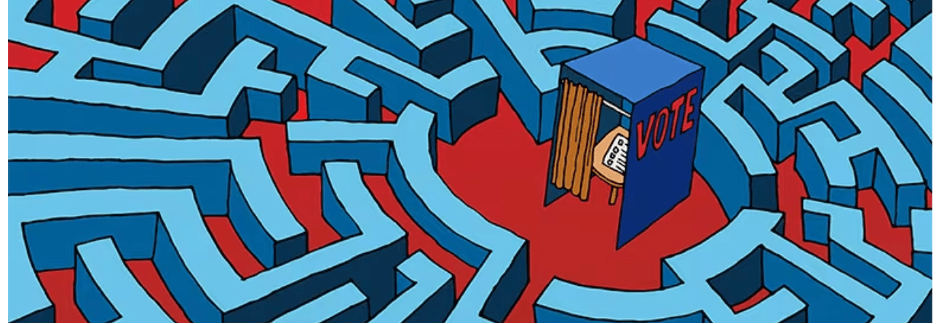
In a nutshell, Milton’s election design created a confusing voting maze for District 3 voters. More complexity and more hurdles mean fewer votes. First, cut off the most convenient methods of early voting and then make it as inconvenient to early vote as possible, by sending District 3 voters clear across Milton to an area many have never ventured . . . and create inconsistent, unfamiliar, and reduced early voting days/hours. And then on election day, again deny these District 3 voters a convenient polling place, by again sending them to unfamiliar areas of Milton where they must fight rush-hour traffic before/after work. (Fortunately, this second design element was eliminated due to overwhelming public pressure.)
Milton’s election design begs the question: how many District 3 voters did not vote because Milton made voting more difficult for them? The above statistics provide a clue. District 3 voters voted in higher proportions on Saturdays . . . clearly Sunday voting (and longer/more consistent voting hours) would have meant proportionately more District 3 votes. And District 3’s vs. District 1’s early voting compared to each district’s day-of voting strongly indicates that convenience is a critical factor . . . there was a 17+% difference between these two districts, with early votes respectively comprising only 46.5% of total District 3 votes vs. 63.6% of total District 1 votes.
Fortunately, Milton’s always-sentient voters saw through the unfair election design and voted decidedly against Mohrig and Gordon. And clearly the outcome would have been more lopsided but for Milton’s biased election design. In part, Milton’s election was a referendum on Milton’s election design. Hopefully, Milton’s new city council understands and considers this clarion message from its voters in its future decision-making about elections. We can only hope . . .
Advocating For Equal Voting Opportunity For ALL Citizens,
Tim
Note 1: This analysis was applied to Milton’s three precincts, which roughly correspond to (but do not exactly mirror) Milton’s three Districts.
Note 2: Some design elements discussed above were clearly deliberate; however, others may have been inadvertent . . . chalk it up to incompetence . . . but nevertheless these elements had the effect of reducing District 3 voting and must be analyzed/revised.
Note 3: I had intended to provide a more detailed and comprehensive analysis of the 2023 election. However, given other priorities discussed in my previous post, I won’t be publishing such an analysis anytime soon. 🙂










 Milton Coalition