Uncategorized

Reflections on Elections:  Seismic Shifts and Successful Strategies

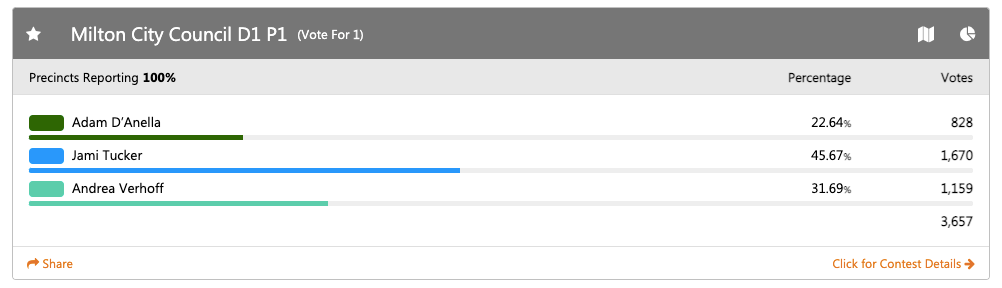
Source: Fulton County Election website

On election day, traffic to the Milton Coalition blog spiked.  It seemed that citizens were seeking perspectives on the Milton City Council District 1 election—sadly the only competitive race in Milton.  And seeing no recent comments on this race at my blog, voters reached out to me by text, phone, and email to get some sense about how to vote.  Voters expressed understandable frustration that candidate communications lacked substance and were undifferentiated.  True.  Specifics were lacking and candidates were playing it safe.  True.  Every candidate was pledging to preserve Milton’s rural heritage, to ensure public safety, and serving up various other versions of motherhood-and-apple-pie.  True.  For many voters, it seemed the District 1 race was a crap shoot.  True.  However, as I have often explained at this blog, to understand Milton politics requires 1) knowing the political back stories (and there is always a back story) and 2) relying on intuition, based on experience. 

Having been steeped in Milton politics for 2+ years, I have learned to connect seemingly random dots (Facebook likes from certain people, placement of yard signs on certain properties, comments from well-placed sources, etc.) to discern patterns.  For example, it was very clear (and not terribly surprising) to me that each of the long-battling factions in Milton had their preferred candidate, leaving one unaligned candidate.  Clearly, Jami Tucker is supported by the Lusk-Kunz (LK) faction and less clearly (but clearly enough) Adam D’Annela was favored by the Moore-Bentley-Cookerly (MBC) faction, with Andrea Verhoff the odd person out . . . perhaps not a bad place to be, if Ms. Verhoff plays her cards right. 

At the top of this blog post, I have provided the final results from Tuesday’s election (a screenshot from the Fulton County Elections website), and the 2021 election results actually speak volumes about the state of politics in Milton . . . when compared to the elections of 2017 and 2019.  In 2017, Laura Bentley secured 71+% of the vote, beating incumbent Bill Lusk; it was the biggest blow-out in Milton’s election history and the result of a superior campaign strategy and a hyper-diligent ground game.  It was the culmination of two years of hard-fought victories against existential threats to the community and the cultivation of a large cadre of passionate citizen advocates.  Paul Moore was a beneficiary of the momentum of the 2017 election, riding the Bentley wave to garner 63% of the vote in 2019.  Accordingly, viewed in the light of the previous two elections, D’Annela’s poor third-place finish (22.6%) in 2021 represents a seismic shift in Milton politics . . . a swing of nearly 50 percentage points relative to Bentley’s 2017 victory and a thorough repudiation of the status quo. 

Now I suspect some D’Annela backers will assert that Mr. D’Annela ran an anemic campaign.  And perhaps this is true, but frankly difficult to argue given the lack of differentiation among the candidates.  I would posit an alternative explanation, supported by my conversations with citizens and with long-time watchers of City politics.  I strongly believe that Tuesday’s results were a rejection of the Moore-Bentley-Cookerly (MBC) faction and a clear message from citizens that they expect much better from their elected representatives.  Our council members must mean what they say and must do what they say.  If you promise to shift power back to citizens, then DO IT (or at least try to do it).  Milton’s citizens want coherent and logical policy-making that is free of personal animosities and the influence of Special (or personal) Interests. Sadly, the 28 variances granted at Birmingham Crossroads and, worse, the abuse of process associated with these variances, were the undoing of the MBC faction.  However, it took the sordid Painted Horse saga to bring into stark relief the inherent hypocrisy and illogic of the Birmingham Crossroads decisions.  It was clear to all but the most blinkered citizens that the owners of The Painted Horse were treated unfairly in light of the preferential treatment given to the Birmingham Crossroads music venue.  And I believe it is this realization that caused voters to reject Mr. D’Annela, who unwittingly became a proxy for the status quo in Milton. 

Unfortunately, Tuesday’s results raise more questions than they answer . . . questions that appropriately addressed will lead to electoral success for Ms. Tucker or Ms. Verhoff.  For example, now that Ms. Tucker’s alignment with Lusk-Kunz and big Milton developers has become obvious, are voters willing to jump from the frying pan into the fire and give the Lusk-Kunz faction (and their Mega Developer friends) a second chance?  Should/will Ms. Tucker distance herself from the Lusk-Kunz faction?  If not, how will Ms. Tucker justify her alignment with Lusk and Kunz?  How will Ms. Tucker explain her support from Milton’s developers?  And does Ms. Tucker, a newcomer to Milton, understand the history of Milton’s politics and specifically the citizen backlash that occurred in 2015 – 2017, culminating in Ms. Bentley’s election?  Does Ms. Tucker understand citizens’ legitimate concerns about the strong influence of developers in Milton, who aggressively recruit and fund candidates that will push their agendas (e.g., liberal granting of variances) at Council?

And Ms. Verhoff has perhaps more difficult issues to navigate.  Will Ms. Verhoff realize she is the underdog and take the risks needed to win?  Will Ms. Verhoff present a true third alternative to the two factions (that have dominated politics since its Milton’s founding) or will she align with the MBC faction, in the hopes that D’Annela voters will swing to her side?   Will the latter strategy alienate much of her base who seem to desire a non-aligned candidate and a clean break with Milton’s political past?  Will she differentiate her positions with specifics or continue to play it safe?  Will Ms. Verhoff talk more about good governance and less about policy?  Will she draw a (much) starker contrast with her opponent and her opponent’s backers?

Bottomline.  Ms. Tucker has the advantage of momentum associated with a near-victory in Tuesday’s election.  Ms. Tucker’s disadvantage is her now obvious alignment with the Lusk-Kunz bloc of Milton politics and the potential continuation of the long-running, destructive battle between Milton’s factions (and the continuing influence of Special Interests each side represents).  Ms. Verhoff has the advantage of non-alignment with Milton’s traditional factions and the opportunity to present herself as a fresh, independent voice on council . . . a break with Milton’s political past.  Ms. Verhoff’s disadvantage is that she is an underdog that so far has played it safe and is a largely a cipher to citizens.  Ms. Verhoff has only a short period of time to differentiate herself from her opponent and to make a strong positive impression with voters.  And unless Ms. Verhoff distinguishes herself, Milton’s voters may play it safe and go with the leading candidate, Ms. Tucker, and the devil they know, the Lusk-Kunz faction.

My advice to both candidates is to not underestimate the intelligence and the concern of Milton’s voters.  In the past, the citizens of Milton have not shy about unceremoniously kicking dishonest, uncaring, and incompetent politicians to the curb.  Ms. Tucker and Ms. Verhoff need to both up their games.  Listen to citizens.  Respect citizens.  Be honest and straightforward.  Provide policy specifics.  Stress your commitment to the rule of law and fairness.  Emphasize accountability and competence. Lead with integrity.  Unequivocally repudiate the influence of Special Interests in Milton. Demonstrate courage.

I will continue to blog about the upcoming run-off election in Milton in hopes of elevating the discussion and nudging the candidates to stake out specific positions and to reveal their true allegiances.  My desire is that more attention be directed to issues of good governance (i.e., improving the process for how things get accomplished in Milton).

Advocating for Good Governance,

Tim

Note:  I have not met with or otherwise communicated with either Ms. Tucker or Ms. Verhoff or their campaigns.  I am not endorsing either candidate (at least not at this time).  Right now, I have substantive concerns about both candidates. Many rumors have been swirling about Ms. Tucker’s political past (and present).  Certainly, informed voters would be well advised to perform internet searches on both candidates to better understand their backgrounds—political and otherwise.  My blog is fact-based, so I will not relate or otherwise perpetuate rumors about candidates unless citizens provide me with direct evidence (e.g. screenshots) that would substantiate relevant concerns about either Ms. Tucker or Ms. Verhoff.

Uncategorized

District 2 Council Members: Posturing as Protectors of the People and Promoters of Principle and Process

Tonight’s City Council meeting agenda includes issues having impact on two local businesses:  The Painted Horse and Billy Allen’s Piano Bar.  And these issues shine a bright light on a sad state of affairs in Milton.  Unfortunately, the misbehavior of Milton’s two District 2 Council Members, Paul Moore and Laura Bentley, is bearing bitter fruit for the community.  Citizens’ trust in Milton’s City government is waning (notwithstanding the City’s non-stop stream of look-good/feel good Facebook posts).  And increasingly, it is difficult to distinguish local politics from Washington politics.  This loss of confidence in Milton’s municipal government was both predicted and predictable.  Both Paul and Laura led the variance parade at Birmingham Crossroads . . . with 28 variances and a bastardized special use permit granted in 4 separate hearings over the span of less than a year.  In the case of Matilda’s,  Paul and Laura cavalierly disregarded both the rule of law and citizens’ concerns in favor of their own and their friends’ personal interests . . . to the detriment of the community. 
Now the results of Council’s poor decisions are metastasizing elsewhere in Milton.  Other applicants before council are demanding equal treatment—aka fairness.  And they make a good (and probably legally sound) case for such like treatment.  You see, Council’s approval of Matilda’s at Birmingham Crossroads set the bar very low for what is accepted and acceptable in Milton . . . “open borders” for all sorts of businesses.  The owners of the Painted Horse (a winery) and now Billy Allen’s (a piano bar) are asking for (much) less than was granted to Matilda’s.  And when you contrast The Painted Horse with Matilda’s, you see the obvious illogic and incoherence in Milton City Council’s land use approach.  After all, The Painted Horse owners are saving an equestrian property, operating a by-right business, regulating alcohol consumption, and abiding by Milton’s noise ordinance.  This is in stark contrast to Matilda’s, which is located on a marginal property (bisected by high voltage transmission lines), operates under a bastardized (by 12 variances) festival use permit, is BYOB, and pumps out music that is 15 DB above Milton’s approved noise limits and sometimes can be heard 1.5 miles away.  The “intensity of use” (a term of art at Council) is much lower at The Painted Horse.  It strikes me that farm-wineries actually 1) offer a wonderful opportunity to save equestrian properties and 2) align well with Milton’s rural character.  The same cannot be reasonably asserted about Matilda’s.  Farm wineries might actually provide apposite means for Milton to distinguish itself in Atlanta’s north metro area.

Realizing they’ve lost the trust of Milton’s voters, Paul and Laura are now posturing as protectors of the people and as promoters of principles and process.  Their worship at the altar of good governance is unconvincing and shameful.   Long ago, both Paul and Laura ceded the moral high ground and opted instead for the political low road, a well-worn path in Milton that has often led to defeat at the ballot box (or to politicians wisely choosing not to seek re-election).  Let’s get real.  In light of their slavish support for Matilda’s, Paul and Laura’s opposition to The Painted Horse has little to do with the people, principles, or process.  Their opposition appears transparently personal and their goal seems nothing short of running the Painted Horse owners out of business. 

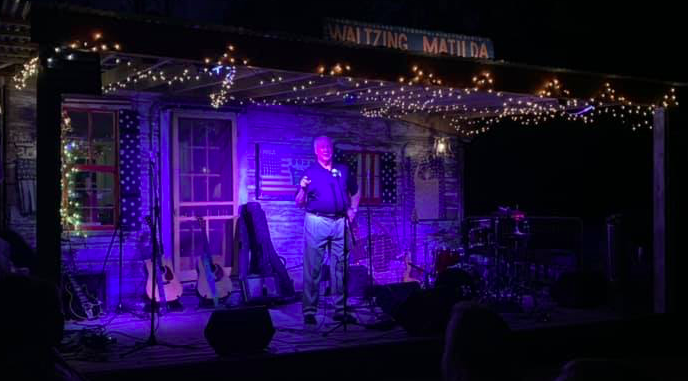
Paul Moore Campaigning For City Council at Matilda’s (2019)

It is interesting to note that in re-purposing a use permit with 12 variances for Matilda’s and then taking a subsequent strict stance against any additional music or other entertainment venues, Paul and Laura have effectively created a well-protected monopoly for Matilda’s in Milton.  It is also interesting to note that many of Paul’s allies have privately acknowledged that Paul erred in his blind advocacy for Matilda’s and in his blatant circumvention of due process, but excuse him by stating that his was a “crime of passion” . . . akin to a mama bear protecting its cubs.  This is nonsense.  Paul knew better but didn’t care.  And unfortunately (but predictably), City leadership turned a blind eye to ethical and due process violations. Lastly, it is interesting to note that Paul and Laura reached out to residents near The Painted Horse to understand their concerns, but Paul and Laura never engaged citizens that were to be impacted by Matilda’s–perhaps because nearby residents were nearly unanimous in their opposition.

I encourage citizens to attend tonight’s hearing.  It should be a good show.  Political hypocrisy at its finest.  If you can’t make it, following is a link for watching the meeting virtually.

In closing, it is worth noting that come January 2022, Milton will have three new City Council members.  I am hopeful.  These prospective Council Members would be well-advised to closely watch tonight’s hearings and learn some valuable lessons . . . a principled process is the only path to good outcomes and to restoring trust and confidence in local government.

Advocating For Good Governance,

Tim

Note: I want to emphasize that I was not opposed to Matilda’s being re-located to Milton. My objections were to a circumvention of due process and the rule of law; re-purposing a use permit with myriad variances; and total disregard for the concerns of nearby residents. I believe that a suitable home for Matilda’s in Milton could have been found by following principled process. This would have involved creating a use permit for music venues in Milton, assuming citizens wanted music venues in AG-1 zoned areas of Milton. It would have meant finding a location that did not require variances that remove basic protections to the community. It would have required clear support from the community, especially those most impacted by the music venue. And finally, it would have followed an ethical, transparent, fair, and rigorous approval process.

Uncategorized

Constitution Week, Milton’s Charter, and the Search For Good Governance

(I am still working on Part 2 of my blog post about variances.  Before publishing, I want to ensure that my facts about land use are correct and my sources are consistent and authoritative.)

This week is Constitution Week.  And it is fitting that a week (vs. a day) is dedicated to honoring The United States Constitution.  And my hope is that some Americans might take the occasion seriously and actually spend a few minutes reading and pondering The US Constitution (and its sister document, The Declaration of Independence).  Following are links to the texts of The US Constitution and to The Declaration of Independence

Constitution

Declaration of Independence

These two documents must necessarily be considered together.  As Abraham Lincoln so eloquently stated, “The Constitution is the frame of silver adorning and preserving the Declaration of Independence, which is the apple of gold.”  Lincoln, like the Founders, intuitively understood that the fundamental mission and vision of the American project is reflected in The Declaration of Independence . . . and that is securing liberty (i.e., the natural and equal rights of humankind).  The Declaration of Independence specifies WHAT we are seeking to achieve:  liberty, while The Constitution (by itself, without the amendments) addresses HOW to achieve the Declaration’s mission/vision.  The HOW is critical, because the Founders rightly understood that the biggest threat to liberty is government, which has a monopoly on police power (i.e., legal force and even legal violence).  Government’s power must be properly constrained.  These limits on federal power were to be achieved by the Constitution, which provides the architecture for our national government.  Because the Founders settled on a republican form of government (vs. direct democracy, monarchy, oligarchy, etc.), they rightly understood that the danger of republican democracy is tyranny of the majority.  Therefore, the Founders designed a government that would diffuse power, that would make majorities (combinations of factions) unstable, that would encourage deliberation and minimize rash actions, that would put certain fundamental rights beyond the reach of majorities, etc.  Various mechanisms were employed to achieve this design:  federalism, three co-equal branches of government, supermajorities for adopting Constitutional amendments, and various other checks-and-balances.

Taken together, The US Constitution and The Declaration of Independence are the most profound and influential documents in political history, (eclipsing the English Magna Carta and the French Declaration of the Rights of Man).  In the late 1700s, The Constitution and The Declaration of Independence took many then-radical ideas of great political philosophers (e.g., John Locke)—that were until their time, mostly theoretical—and put them into practice.  Through these two documents, the Founders, particularly Thomas Jefferson and James Madison, reimagined and re-engineered government—a government dedicated to the proposition that “all men are created equal;” that government power derived from “the consent of the governed;” and that rights were not a dispensation of government, but rather rights preceding government (i.e., were natural) with government’s purpose to “secure” these rights.

And what has this got to do with government in Milton?  The simple answer is EVERYTHING.  Milton City Council Members actually take an oath to support and defend The Constitution of the United States of America.  Following is the oath for the Mayor and Council members:

I do solemnly (swear) (affirm) that I will faithfully perform the duties of (mayor) (council member) of this city and that I will support and defend the Charter thereof as well as the Constitution and laws of the State of Georgia and of the United States of America.

Unfortunately, as someone who has closely watched Council for 7 years, I wonder if any Council members ever give a second thought to their oath or to The US Constitution (or any laws they swear to uphold).  If Council members do take their oaths of office seriously, why do they assert (as more than one has asserted to me personally) that “citizens don’t care about process; they only care about outcomes?”  (It was this statement that caused me to part ways with the council members that I previously and strongly supported.)  And more importantly, why do their Council’s actions consistently convey a disregard for our laws, including sometimes the Constitution itself?  (For example, Milton’s Ethics Ordinance’s wrongful use clause is blatantly anti-Constitutional.)

It is important to understand that Milton has its own version of the Constitution, which is referenced in Council’s oath of office as the “Charter,” and establishes Milton’s governmental architecture.  Almost no one knows this, but Milton’s City Council recently seriously weakened Milton’s Charter.  In early 2021, Council voted to eliminate a periodic (every 5 years) review of Milton’s Charter by an appointed group of citizens—a sort of Constitutional Convention convened every 5 years.  This review by a Charter Commission was an important—and I would argue, essential—check on the power of Council and City staff . . . and unfortunately, Milton’s government has very few such checks-and-balances (in contrast with the federal government).  And eliminating this Charter review is the opposite of “shifting power back to citizens,” which was the most important campaign theme of 2017.  (So much for campaign promises, huh?) Council argued that things were proceeding so swimmingly in Milton that they no longer needed any such oversight from citizens.  It was a singularly self-congratulatory moment for Council.  This action by Council was a fundamental Charter revision that not a single citizen opposed, that the Milton Herald neglected (to understand or) to report . . . and sadly went almost totally unnoticed by anyone in Milton .  I hope an intrepid candidate for council (in 2021 or subsequent elections) will resurrect 5-year Charter reviews.

So what might be the moral to this story?  Well, the single most important point citizens should take away is that Milton needs elected and appointed government leaders that  understand the criticality of municipal government’s architecture to the achievement of good governance and good outcomes (as our Forefathers understood it).  Hopefully, a future “James Madison” in Milton will work to reform Milton’s government processes so government works well for all citizens.  I know from experience that effective leaders focus more on process and principles (i.e., good governance) and less on policy, understanding that good policy is only possible through establishment and execution of excellent processes.

Honoring the Constitution and Milton’s Charter,

Tim

Postscript:  This issues of The Constitution and good governance are very personal for me.  For nearly 8 years, I served in the military (as a US Navy nuclear submarine officer), and I was proud to do so.  I strongly believe in our America and in good governance.  I took my military oath seriously . . . and still do:  “to support and defend the Constitution of the United States against all enemies, foreign and domestic.”  While I understand that our nation and our government are far from perfect, for most of my life, I had faith and confidence that, in the United States, my liberty is relatively secure and that justice is usually served.  It was not until I waded into local governance and politics that my faith in our political system was shaken (but thankfully not shattered).  My experiences with local government made me realize that our basic liberties (for example, the five First Amendment freedoms) in America are much more attenuated than most of us realize and that our system of justice often fails miserably.  Citizens should understand that there are enemies of good governance right here in Milton, including former and current Council members, that misuse and abuse the powers of government to exact vengeance on citizens, like myself, that have the temerity to challenge them and the status quo.  (More about this is future blog posts.)  Sometimes aided by City staff, the tools of their trade are personal attacks, selective enforcement of Milton’s laws, and frivolous ethics complaints. However, these politicians underestimate the power of the truth and the power of persuasion and thankfully often pay the price for their misdeeds.  Miltonites have not been shy about booting bad actors in our local government—many receiving their comeuppance at the ballot box; others withdrawing from government rather than face the ire of voters.  I say:  good riddance.

Uncategorized

Variances in Milton (Part 1): Radical Departure From Law and Historical Practice.

In my last post, I promised to discuss variances and how they are used (or often misused/abused) in deciding Milton’s land-use issues.  Granting of variances is a critical element in how Milton gets developed.  My position on variances has been consistent: variances should be granted according to 1) the law and 2) historical variance practice.  This means:

  • Variances should only be granted for minor discrepancies (e.g., allowing a home to be built a foot or two closer to a lot line than zoning allows)
  • Undue hardship must be demonstrated.  And in Milton, proving hardship is especially difficult as Milton’s variance law is strict and involves a four-part test for hardship; each test must be “passed.”  That is to say that our law gives staff and Council very little discretion within the boundaries of the rule of law; DO NOT believe Council members who tell you otherwise.

My position on variances–insistence on adherence to the rule of law and historical zoning practice–is NOT a radical position.  Actually, what is radical (and sometimes unlawful) is Milton’s granting of copious variances that sanction major zoning deviations and/or don’t involve undue hardship . . . sometimes to repurpose a use permit for an impermissible (and hence unlawful) use.  (This will be discussed later in this post.)

In my community advocacy, I aligned myself with a number of likeminded citizens (like current Council Members Paul Moore and Laura Bentley) who took similarly parsimonious stances on variances.  Following is a video of Laura advocating (as a citizen) against the granting of variances to a developer of a property on Providence Road, who was seeking variances (13 in all) for 80% of his unbuilt lots. Laura states correctly that “council’s granting of variances undermines our AG-1 standards” . . . and that is why I opposed every one of the 28 unjustified variances/zoning modifications (and the use permit for a music venue) that have been granted at Birmingham Crossroads.

Laura Bentley Comments Against Variances at June 20, 2016 City Council Meeting

To understand variances it is necessary to step back and to understand the lawful (and also unlawful) avenues for developing land in Milton.  There are 3 lawful ways to develop land in Milton (all of which might or might not involve variances):

  1. By-Right Development means a developer agrees to develop a property in accordance with state and local zoning conditions and standards.  The use for which he/she intends to develop the property is permitted by zoning, without having to meet any additional conditions beyond what underlying zoning requires. Such development usually requires only a land-disturbance permit (and some subsequent inspections to verify compliance), which provides notification to the city that a developer is going to disturb a property for development purposes and that he/she understands the standards (e.g., installation of soil fences) he/she must follow.  In some cases, a review by the Design Review Board or Planning Commission might be required.  These bodies will ask questions, might make suggestions, and might even identify a need for variances.  Some by-right development is defined locally; however, some by-right development (e.g., farm-wineries) is defined by the state, thereby putting limits on municipal government’s jurisdiction.
  2. Use Permits (sometimes also called Special Use Permits or Conditional Use Permits).  Localities designate certain uses as permissible (not to mean permitted) subject to meeting certain conditions for that use specified by law.  These conditions are in addition to the baseline conditions/restrictions required by underlying zoning.  Use permits come before City Council for discussion and approval/disapproval.  Council can levy additional conditions beyond those required by the use permit and underlying zoning.  Alternatively, Council can outright deny a use permit, even if all use permit/zoning conditions (or additional conditions recommended by staff, the Planning Commission, etc.) are accepted by the developer.  This is important and bears repeating . . . Council can deny a use permit that meets all the conditions specified in municipal code for a specified use.
  3. Rezoning.  In situations where a developer desires to put a property to a use that is not by right and for which no use permit exists, a third (usually more onerous) option is available:  rezoning, whereby the developer applies to have a property re-classified to a zoning designation that does allow the intended use either by right or through a use permit.  Often, such rezoning involves reclassifying a property from lower density zoning to higher density zoning or from residential zoning to commercial zoning (or occasionally, vice versa) . . . so that the developer can capture greater profits, often to the detriment of nearby property owners and the broader community.

Note:   In Milton, the rezoning process can be circumvented through the Comprehensive Land Use planning process (by changing the land use designation), with little/no transparency and public input, so that developers (later) can much more easily rezone a property.  This bypass of the law has resulted in several instances of rezoning to higher density, involving sewer extension.  This blatantly dishonest and unfair mechanism is known to council members, but thus far they have refused to fix the issue.  (I will devote an entire blog post to this issue).

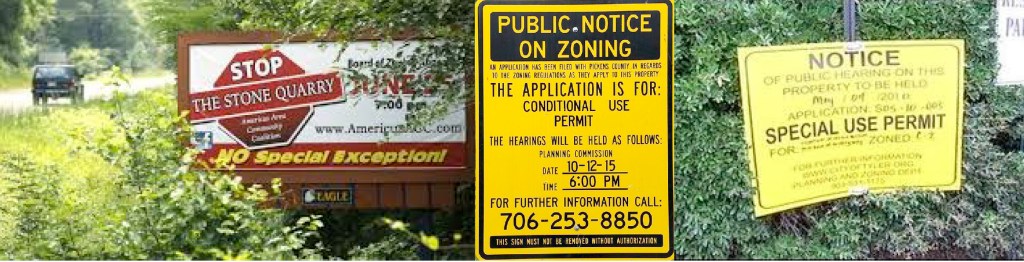
Are there any other ways to (lawfully) develop a property?  The answer is NO, other than successfully lobbying the City to change its zoning ordinances to modify zoning restrictions or to add additional special use permits.  This is a key point, because in Milton, we have seen properties approved for uses for which no special use permit exists . . . this is known as spot zoning and is patently unlawful.  (Example:  approval of the music venue at Birmingham Crossroads.)

So how do variances apply to these 3 methods for developing property?  And how are variances being used to circumvent the rule of law (as reflected in our zoning laws)?  Well, that is a topic for the next blog post.  Stay tuned . . . the business of granting variances is a particularly sordid affair in Milton that involves favors for friends and establishment of dangerous legal precedents that will eventually come back to haunt Milton (in the form of unsightly future development).

Advocating For Granting Variances According to the Law and Historical Practice,

Tim

Uncategorized

What is Milton’s Biggest Industry? . . . and The Threat to Citizens’ Basic Right to Reasonable Enjoyment of Their Property

(Photo taken of development across from Cambridge High School.  This property was rezoned to provide 3X the density that would have been allowed under AG-1 zoning.  Sewer was extended to the property.)

Does the above question seem strange?  Afterall, Milton is mostly a residential community, with some retail businesses and office parks primarily arrayed along the southern edges of the city.  Milton doesn’t really have industries, does it?  In fact, Milton does have an industry that dominates Milton’s economy, employing many hundreds of workers and dwarfing all other commercial/industrial sectors.  And you see evidence of this industry every day on Milton’s (crumbling) roads . . . the ready-mix trucks, the dirt-moving equipment, the tractor-trailers carrying building materials, etc.  Yes, Milton’s biggest industry is Development.  And Development is an industry that not only dominates our city’s landscape, it infiltrates every aspect of Milton’s community, including our government and politics.  In fact, you cannot truly understand Milton government or politics unless you understand development.  Why?  Because development is where the money is.  And there is a lot of money because there is still a lot of undeveloped land.  Milton’s remaining development potential ranges from $1B to $2B.  Accordingly, it should come as no surprise that Development dominates Milton’s government and politics.  And unfortunately, Development often also distorts Milton’s governance and politics . . . as money so often does, whether in DC or in the City of Milton.  City Council spends well over 50% of its time on land use issues.  And Development, with its many associated problems, dominates political debate in Milton.

Of course, developers are naturally keen to maximize their profits.  And this often means developers lobby the government for special favors—e.g., rezonings, use permits, zoning modifications, and variances . . . a veritable cornucopia of variances.  (Variances are the granting of exceptions to Milton’s zoning laws and, in accordance with long-established zoning practice and Milton law, are supposed to be granted only for minor discrepancies that involve proven hardship.Through campaign contributions and business/personal relationships, developers grease the gears of our city government to their benefit.  And some developers have even recruited and successfully fielded candidates.  Many of Milton’s founders were employed in the development industry (and this is reflected in our land use laws. More about this in another post.) And quite a few players in Milton’s development/construction industry have been elected to council.  In fact, Milton’s original council included three council members with deep business interests in the development industry. I often refer to Milton’s election of these council members as Milton’s Original Sin.  And to be blunt, citizens are just plain naïve if they believe that all of this money sloshing around and the presence on Council of development industry business-people (who build in Milton and invest in property in Milton) does not translate to favors for developers and degradation of our community.  (In subsequent blog posts, I will document many examples of these favors to developers and other Special Interests.)

The goal of Milton’s big developers is usually higher density, which translates to higher profits.  Unfortunately, Milton’s citizens pay the cost of this higher density in the form of traffic congestion, overcrowded schools, and lower home values. 

Often, the community has fought back against developers and sometimes won.  (I am proud to have provided leadership in some of these battles.)  However, the playing field is decidedly not level.  Developers have huge advantages:  money, expertise, and attorneys.  Council should act as a counterweight to the heavy interests of developers, but often the opposite is true, with Council often siding with developers against citizens.  You need only watch a City Council meeting to understand the sympathetic treatment afforded developers at City Hall.  Developers (and their lawyers) are allowed to speak freely at Council and interject at will.  The same behavior from a citizen results first in a warning from the Milton police followed by expulsion if the warning is not heeded.  On the other hand, developers and their attorneys are afforded wide latitude by the City, especially at Council.  In the Matilda’s hearing, the developer-applicant was even allowed to object to a motion after the motion had been made, whereupon the motion was withdrawn, amended, and passed to the satisfaction of the developer, without a peep of dissent from a single Council member.  Citizens have also witnessed City Community Development staff unabashedly rejoicing with developers that prevailed before Council . . . only in Milton.  And not only do developers get a sympathetic ear from staff and from Council, the zoning process itself is also heavily biased in favor of developers . . . bias so obvious to citizens that 1900+ Miltonites signed a petition demanding reform of the zoning process.  These same citizens voted in 2017 for candidates that promised zoning reform . . . it was promised that power would be shifted back to citizens.  However, nothing has been done and the zoning process is virtually unchanged since I got involved in government in 2015.  Obvious reforms, such as giving citizens same opportunity to speak as developers, have not been effected.  In fact, things have gotten worse since the 2017 elections.  In just the past four years, in four separate hearings before City Council, 28 variances/zoning modifications were granted at Birmingham Crossroads alone. That’s right . . . 28 variances . . . plus permission to operate a concert venue . . . a use not included on Milton’s long list of permitted uses in our zoning code.

In closing, let me be clear that I do not oppose developers or development in Milton.  I have several friends who are developers; they are good, honest, and hard-working professionals.  I fully support by-right development and even the granting of variances for minor discrepancies where hardship can be clearly proven.  However, what I do oppose is our city government egregiously bending and breaking our zoning laws for Special Interests.  I do oppose the profuse granting of variances that violate our variance ordinances and long-established variance practices.  I do oppose use permits being bastardized with copious variances to “permit” uses that are not enumerated on Milton’s long list of permitted uses.  I do oppose the corrosive and corruptive effects of developer money on good governance in Milton.

I am not advocating radical policies, but rather I am merely advocating that Milton uphold the rule of law . . . this is a matter about which we should all agree.  It is pretty simple really: Citizens have an indisputable and basic (and legal) right to reasonable certainty about appropriate uses (as codified in law) of nearby properties that might affect citizens’ enjoyment/use of their property.

Advocating for Citizens’ Property Rights and Against Favors for Special Interests,

Tim

Today’s blog post is meant to provide an introduction to development in Milton and its importance in Milton’s government and politics.  The next blog post will discuss variances, quoting directly from the American Public Planning Association, the trade organization for zoning professionals in the US.

Uncategorized

9/11 Reminds Us that Good Governance is the Best Way to Honor the Victims

Source: Alpharetta’s 9/11 20th Anniversary Poster

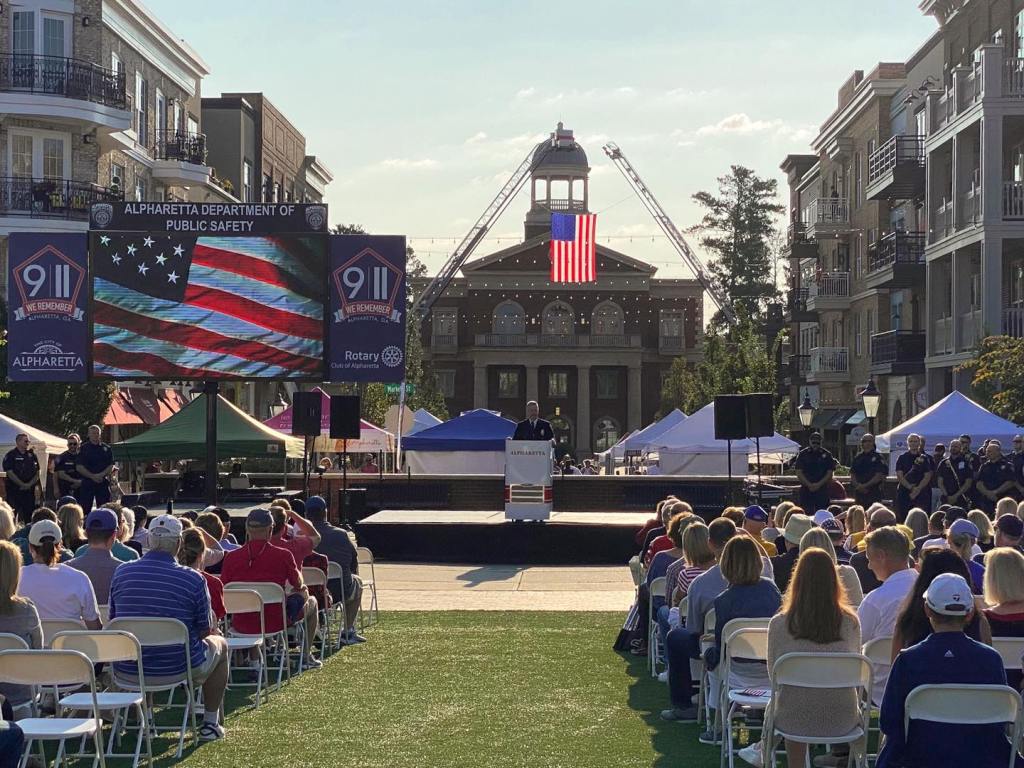
This morning I attended the 9/11 remembrance ceremonies in Alpharetta.  And I have to say that they do things right in Alpharetta; they are not just going through the motions.  The ceremony was incredible . . . not only well-produced, but the messaging was apposite and inspiring.  Attendees definitely left moved and appreciative of those national elements that distinguish our great country and have made the USA a shining beacon of liberty.  And of course, these uniquely American elements should infuse our governance from top to bottom . . . in Washington as well as in Milton (and Alpharetta).

The 20th anniversary of 9/11 provides an opportunity to reflect on those things American that we most value and must protect to survive and thrive.  In my humble opinion, America’s success as a nation has been largely driven by a dedication to principles and processes of good government (in contrast to blood-and-soil tribalism that still holds sway in much of the rest of the world).  The principles of government (with an emphasis on liberty) are set forth in the Declaration of Independence and the processes of government (i.e., its architecture) are set forth in the Constitution, with subsequent amendments (there are now 27) sometimes addressing principles, sometimes addressing processes.  Citizens are best served when our politics and governance, including at the local level, closely coincide with our cherished principles and processes (as ensconced in our laws).  In our increasingly divided nation and local community, I strongly believe that a renewed emphasis on proven good government principles and processes—concepts about which there should be little disagreementis the path to a more perfect union.  And such an emphasis is also a fitting way to honor those who tragically lost their lives on 9/11.

Remembering Those Who Lost Their Lives on 9/11,

Tim

Postscript:  Tomorrow I will post the second part of my blog post on the gating of Crooked Creek.

Source: Alpharetta Public Safety Facebook Page

Uncategorized

City Council Candidates Have a Lot of Studying To Do . . . Start with the CSO

Come January 2022, the City of Milton will have 3 new council members.  Only the District 1 race is competitive, with 3 candidates vying for the honor and privilege of representing the fine citizens of Milton.  Two candidates (for districts 2 and 3) are running unopposed. 

Candidates would be well-advised to study some of the zoning battles that have been fought in Milton over the past 5+ years.  I would recommend candidates begin their preparation with the battle over the “Conservation” Subdivision Ordinance (CSO).  This was a long and sordid affair consisting of 3 acts.  Failing to pass an ordinance, CSO proponents sought to achieve their goals through rezoning (of a property on Ebenezer Road) . . . the first of many successful rezonings, they hoped.  And they did prevail in the initial Ebenezer Road rezoning hearing before City Council.  However, the rezoning was vetoed (on procedural grounds) and the rezoning approval was reversed in a subsequent City Council hearing.  This June 20, 2016 hearing brought out so many “conservation” subdivision opponents that a second room, with a video monitor, was established to hold the overflow.  Ninety-nine citizens completed speaker cards and 1800+ citizens signed the Milton Coalition petition against the CSO.  Not to be deterred by overwhelming citizen opposition, CSO proponents pursued a rearguard action to implement the CSO by promoting community septic for residential development—i.e., private sewer systems run by HOA!  (Talk about your bad ideas . . . HOAs running sewer systems . . . what could go wrong?!?)  However, CSO proponents also failed in this endeavor, finally retreating to the shadows.  However, sensing an opportunity to resurrect “conservation” subdivisions, I suspect the CSO proponents will target Milton’s new council members, preying on their lack of historical context.  With this in mind, I have reactivated my anti-CSO blog, which was active from November 2015 to May 2016.  I have re-published (with some minor edits) a subset of the blog posts so that candidates (and citizens) can educate themselves on “conservation” subdivisions.  Several hundred hours of research and analysis went into this body of work.

Anti-CSO Blog

In closing, I must note that citizen opposition to the CSO in 2015-16 was based on theoretical arguments and anecdotal evidence from CSOs elsewhere in metro Atlanta.  However, because the CSO and subsequent Ebenezer Road rezonings were both denied and the property (now called Sweet Apple) is still being developed, we now have empirical evidence that “conservation” subdivisions would have increased density in Milton.  At various times, under AG-1 zoning rules, the Sweet Apple developer claimed the property could support (or under rezoning, he was approved for) 45, 48, 50, and 55 homes (although we definitively proved that percolation tests for individual septic systems would not support this number of homes).  Well, it turns out that the site plan (under AG-1 zoning) for Sweet Apple shows only 34 home sites, compelling evidence that the proposed Sweet Apple “conservation” subdivision would have entailed a 32% to 62% increase in density (vs. AG-1 zoning density).  Imagine such a density increase metastasizing across Milton through similar rezonings and the deleterious effects (e.g., increased traffic congestion).

(Note: The 2 lots at The Farm were not included in the original Sweet Apple property and hence are not included in the analysis of the rezoning homesites compared with AG-1 homesites.)

In addition to the CSO and (two) Ebenezer rezonings, candidates need to study other zoning battles (some were lost), such as the music venue approved (using 12 variances to bastardize a festival use permit) for the NW corner of Birmingham Crossroads; the abandonment of roads in Crooked Creek; the recent Painted Horse fiasco (Milton’s version of a Star Chamber); and, the special use permit and 15 (yes . . . 15 . . . a record in Milton) variances approved for Ashford Gardeners.

This is all to say to Milton’s City Council candidates:  Beware of the tired, retreaded agendas being schlepped by Special Interests and their agents in Milton.

(Still) Advocating Against the CSO and For Smart Land Use,

Tim

Uncategorized

Bentley Withdraws. District 1 Three-Way Race Provides Remaining Opportunity for Debate About Milton’s Future.

On Monday, Council Member Laura Bentley withdrew from the District 2 City Council Election, citing serious health issues with a family member.  I wish Laura and her family all the best as they deal with a difficult family situation.

With Laura’s departure from the District 2 race, that leaves the District 1 Council seat as the only contested election in Milton.  And it is the District 1 race where the debate over Milton’s future will occur.  (I have looked over the candidate websites and Facebook pages and will provide some preliminary observations in future posts.)  However, it would be beneficial to citizens if candidates in uncontested races continued to “campaign.”  Particularly for those members new to Council, Jan Jacobus and Juliette Johnson, it is important that citizens get to know them and understand their stances.  A series of “Get to Know Your New City Council Members” meet-and-listen events, perhaps including soon-to-be-Mayor Jamison, would set a new and positive tone for 2022 City Council, which will be seating three new members—a turnover of Council seats never seen in Milton’s 15-year history (if memory serves).

At the blog, I will continue to provide a (chronological) account of my experience in Milton politics at the page About My Involvement in Milton Politics.  You can click on the following link to go directly to that page.  Today, I have posted another installment of my account.

About My Involvement in Milton Politics

Please contact me through the Contact page with comments, questions, or suggestions (for blog topics).

Advocating For Good Governance,

Tim

Uncategorized

Pages Added to Blog: Candidate Guide; About Author; My Story

Today’s blog post is brief. I have added 3 pages to my blog. You will have to go to the blog to view these pages. They are included in the dropdown menu. Links to each page are provided below.

First, for your convenience, I have provided a consolidation of all the candidate websites and Facebook pages that are currently available.

2021 City Council Elections: Candidate Websites and Facebook Pages

Second, I have provided a brief biography about me so that readers better understand why I care about City government and my experience/expertise in good governance.

About the Author

Third, I have provided a page that provides my story about my involvement in Milton politics. This is an on-going project. I have provided an initial posting on my initial introduction to City politics. I will add to this story over time, so please return for subsequent chapters.

About My Involvement in Milton Politics: A History

Advocating For Good Governance,

Tim

Uncategorized

2021 City of Milton Elections (Part 2): Summary of Races . . . District 2 Offers Stark Choice For Voters

Today I am publishing Part 2 of my post on the 2021 City Council elections.  I will briefly discuss each of the 4 seats up for election in 2021, beginning with the uncompetitive races.

Mayor.  Council Member Peyton Jamison is running un-opposed and is succeeding Mayor Joe Lockwood, who has served as Mayor since the City’s founding in 2006.  I know Peyton quite well, as we worked closely together on Laura Bentley’s 8-member campaign team in 2017.  (Peyton and I actually organized the campaign team, which always met at my home, but that is a story for another blog post.)  In 2017, I exposed the clandestine redrawing of the boundaries for District 1 (see below link to The Milton Herald’s Black Box article).  In the wake of this scandal, the incumbent Council Member opted not to run for re-election, and Peyton ran unopposed for his current council seat.

https://www.appenmedia.com/black_box/group-questions-motives-behind-milton-redistricting/article_bebdb9ce-4f0d-5cfb-b451-ed0558fb3e0b.html

I have spoken frequently with Peyton since his election.  We don’t always agree, but I appreciate Peyton’s willingness to listen to all citizens and to consider all sides of an issue.  Peyton has a lot of energy and has matured during his 4 years in office.  However, to be successful as mayor, Peyton must be his own man—i.e., step out of Lockwood’s shadow.  He also must surround himself with smart people who offer him differing perspectives on Milton’s pressing issues.  He must stay above the fray and focus on process and principles, separating himself from the personality politics being pursued by Council Members Moore and Bentley—the sort of middle school nonsense that has plagued the city since its founding (and once necessitated the hiring of an industrial psychologist to address Council’s dysfunction).  Peyton must also demonstrate more courage (than in the past) in the face of threats to the community.  And lastly, Peyton must adopt a much stronger approach to ensuring accountability of the City’s non-elected leadership; the City is currently experiencing a serious Crisis of Competence.

District 3 covers the Highway 9 and Windward Parkway areas of Milton (and includes the expansive Crooked Creek subdivision). District 3 is Milton’s most dense district.  Jan Jacobus is the only candidate to qualify in District 3.  Mr. Jacobus has served on the Planning Commission for several years, so has some familiarity with City government, particularly land-use issues.  I do not know Mr. Jacobus, but have heard good things about him.  Even though running unopposed, I hope Mr. Jacobus nevertheless creates a web page that lays out his positions on issues of concern to citizens.  I hope his stances emphasize the critical importance of adhering to the highest principles of good governance.

District 1 encompasses Crabapple and the surrounding areas.  Three candidates are running for the District 1 seat.  Relatively speaking, all three candidates are political newbies.  The candidates are Adam D’Anella, Jami Tucker, and Andrea Verhoff.  At a later date, I will post links to their campaign websites.  My advice to these candidates is to focus on elements of good governance:  integrity/honesty, fairness, accountability, rigor, and transparency.  Good governance is prerequisite to good policy-making, but has not been a focus for the City of Milton, with predictably bad results.

District 2 encompasses the more rural, (much) less dense and mostly AG1 areas of Milton.  Insurgent candidate Juliette Johnson is taking on Old Guard candidate Laura Bentley.  Ms. Johnson is one of the owners of The Painted Horse.  Ms. Johnson has been accused of “running for the wrong reason”—i.e., revenge for the levying of (overly severe) restrictions on The Painted Horse.  However, such accusations are ridiculous . . . and self-serving, I might add.  Ms. Johnson and Ms. Jackson (the other co-owner of The Painted Horse) have experienced first-hand the dysfunction at City Hall and have been the victims of Milton’s version of a Star Chamber where they’ve had no opportunity to hear–moreover defend themselves from–“charges” leveled against them.  It is certainly a right (and excellent) reason to run (for Council) to expose and eliminate the governmental excesses and abuses that Ms. Johnson has directly experienced.  Furthermore, Integrity is an appropriate plank in Ms. Johnson’s campaign platform, given the low road being travelled by some politicians in Milton.  However, to win, Ms. Johnson must make her campaign about more than the Painted Horse, although her experience with Council overreach is certainly an issue she can (and should) lead with.  However, the past 4 years of city government are rich with failures, unsolved problems, broken campaign promises, abuses of power, etc. that Ms. Johnson can tap into.

In contrast to Ms. Johnson, Ms. Bentley represents the Old Guard in Milton.  In 2017, like Ms. Johnson (in 2021), Ms. Bentley ran as an insurgent (that I believed she was), but the reality is that Ms. Bentley (along Council Member Paul Moore) is an old hand at Milton politics—her involvement stretching back to the first city elections when she was a foot soldier for one of the two factions battling it out in Milton.  And unfortunately once in office, Ms. Bentley almost immediately put on her old faction’s jersey.  Laura reverted to the tired politics (e.g., favors for friends) of days past when Milton’s two factions spent much more time battling each other than focusing on pressing City problems.  Citizens need to carefully consider whether the time has come to reject the unproductive factionalism of yesteryear and to chart a new course for the City—a Milton united by principles of good governance.

The focus of the blog will be on the District 2 race, as that election really provides the best basis for discussing and understanding current city politics and governance.

Advocating For Truth in Politics and Governance,

Tim