Is it possible to achieve good outcomes with a corrupt process? That is the question citizens need to ask our Milton city government. Today, I sent a letter to the Milton City Manager about issues issues of conflict of interest, lack of transparency, exceeding authority, and cronyism in our government. See the letter below. In the letter, I reference the July 25th Planning Commission (PC) meeting, where the Planning Commission Chairman tells the developer at the podium that the Milton City Council regretted its decision to deny variances for the SE corner of Birmingham Crossroads. The chairman then proceeds to invite the applicant to discuss the matter further in a private meeting. That meeting did occur and shortly thereafter the developer again applied for a variance for the SE corner. At the City Council meeting on Monday night, four city council members changed their original votes and the variance was granted. Here is the video, so you can hear for yourself the conversation between the PC chairman and the developer, Tad Braswell.
Error
This video doesn’t exist
Unfortunately, the events described in this post and in my letter cause citizens to lose trust and confidence in our government. And we are seeing that in Milton. Many previously engaged citizens are disillusioned and are checking out. Citizens deserve better. Good governance is on the wane. Council members Bentley and Jamison both ran on a platform of good governance in the 2017 election. Will they now step forward to address these violations of the public trust? Will they (finally) deliver on their promises to reform our government and shift power back to citizens? If not now, when? How bad do things have to get to prompt action from our local government?
(Still) Advocating for clean, competent, courageous, and citizen-centric government
(I am copying City Council and the City Attorney on this email.)
On Monday night, I expressed concerns about the process followed for granting variances for the SE corner of Birmingham Crossroads. Previously, I have discussed with you concerns (different from the concerns that will be discussed herein) I had about the process followed for granting variances for the NW corner. I will address both the SE and NW corners in this email.
SE Corner of Birmingham Crossroads.
As you know, on July 25, 2018, the Planning Commission (PC) reviewed the preliminary plat for the SE corner for Birmingham Crossroads. In that meeting, the chairman of the Planning Commission, Mr. Paul Moore, who was calling into the meeting, stated that some council members regretted their previous (in April 2018) decision to reject the developer’s requested variances. Mr. Moore further requested to meet with the developer, Mr. Tad Braswell, to discuss this matter. I request that you, all council members, and the City Attorney watch the PC meeting. Cue to 1:20:45 in the video to hear the PC chairman’s comments; listen for 2 minutes.
The meeting requested by the PC Chair did, in fact, take place at City Hall. I do not know all people that attended, but I do know that the developer, the PC chairman, and another PC member attended. Furthermore, Mr. Moore told the other attending PC member, a friend of mine, that the Mr. Moore had concerns about the other PC member’s participation. The reason cited is that Mr. Moore did not want me, Tim Becker, to know about the meeting and what was discussed.
Steve, as you know, Mr. Braswell did come back to Council with a variance request, which was granted to him. Four council members changed their votes.
Steve, this meeting raises obvious (ethical) questions about the role of committee members and transparency. So I ask these questions:
Under whose authority and in what capacity was the PC chairman operating?
Who else attended this meeting?
Was staff there? If so, who?
How long was the meeting?
Who in our government knew about this meeting?
What was the content of this meeting?
Were notes kept from this meeting? If so, please provide them.
Why would the PC chairman not want me or other citizens to know about what was discussed?
Were conditions discussed that Mr. Braswell would need to agree to? Was Mr. Braswell coached on how to proceed with his new application?
Were there additional meetings or other communications between the PC chairman and Mr. Braswell? If so, many of the above questions pertain to these meetings and communications.
Were any city council members involved in these communications with Mr. Braswell? Did a city council member authorize or otherwise sanction this meeting? Which council members knew about this meeting?
Who informed the PC chairman that members of council regretted their decisions? Which council members were referenced? Is it appropriate for a member of the PC to discuss with a developer the stances of council members on zoning matters, particularly in public meeting (and even privately)?
NW Corner of Birmingham Crossroads.
Steve, you and I previously discussed the Planning Commission’s hearing on Curtis Mills’ application for a special use permit (and 9 concurrent variances) for the NW quadrant of Birmingham Crossroads. By his own admission, the PC chairman is a fan and frequent attendee of concerts at Matilda’s. He was aware that due to re-development, Matilda’s was soon to be homeless. The PC chairman devised a plan to find Matilda’s a new home in Milton. The PC chairman took Mr. Mills to a Matilda’s concert, introduced him to the Potters (the owners’ of Matilda’s) and suggested the idea that Matilda’s move to Mr. Mills’ land on the NW corner of Birmingham Crossroads. I first heard this story from Council Member Bentley. However, in March 2018, the PC chairman told me the same story, in the presence of 4 other people.
I have no problem with the Mr. Moore finding a home for his favorite music venue. And I supported the general notion of bringing Matilda’s to Milton, although not to the Crossroads. However, my concern is that the PC chairman did not recuse himself from hearing Mr. Mills’ application when it came before the PC. Furthermore, if you watch the PC hearing on the NW corner (and I suggest that you do), the PC chairman recommends concessions from the City (e.g., concerts on both Saturday and Friday nights) that were not even sought by the applicant. I would remind you of Milton’s city code Section 2.15 (a) – Prohibitions, part (1), which states that no appointed official shall knowingly:
“Engage in any business or transaction or have a financial or other personal interest, direct or indirect, which is incompatible with the proper discharge of official duties or which would tend to impair the independence of his or her judgment or action in the performance of official duties”
So for this matter, I have just one question:
Did the PC chairman have a direct or indirect personal interest in the granting of a special use permit for the NW corner that “would tend to impair the independence the independence of his judgment or action in the performance of official duties”?
(Note: Steve, you and I previously discussed this issue in another context. However, I assert this matter needs to be re-visited in light of Section 2.15 (a) of Milton’s City Code.)
Steve, to be clear, I am not looking to overturn either the decision on the SE or NW corners. What’s done is done. However, I assert the actions described above represent serious breaches of the public trust. Furthermore, I do believe the actions described herein are not conducive to concepts of good governance, including transparency. Citizens deserve better than this from our city government . . . much better. I request that you formally investigate both matters and provide a response back to me.
(Last 2 lines of Won’t Get Fooled Again by the Who)
November 10, 2018
Citizens:
After nearly five months of staying away, I attended this past Monday’s City Council meeting. I felt obligated to attend and speak. Following are videos of my remarks before Council.
Shifting Power Back to Citizens: Just Another Empty Campaign Promise?
On the anniversary of the 2017 election victory for good governance, I felt compelled to speak at Council. The central campaign theme of 2017 was shifting power back to citizens. Sadly, little has been done to actually shift power back to citizens. In fact, power in our city government seems to have been concentrated in just a few council members. You can listen to my remarks to Council in the following video.
Rigged Zoning Hearing
Instead of taking actions to shift power to citizens, our City Council has been bogged down with zoning hearings relating to the SE and NW corners of Birmingham Crossroads. A second hearing on the SE corner consumed vast amounts of staff resources that would have been better deployed to reforming our zoning processes. The Council hearing was a sham, as a deal had already been cut with the developer in a backroom, away from the prying eyes and ears of pesky citizens. As always, Council’s indulgence of developer requests means the agenda for Council is driven by the needs of developers, rather than citizens.
Error
This video doesn’t exist
Citizens, I understand that many of you are disillusioned by the recent actions of our city government, and you are disengaging. I feel the same way and have considerably dialed back my involvement. It is just too depressing. Same old, same old . . . Meet the new boss, same as the old boss . . .
(Still) Advocating for clean, competent, courageous, and citizen-centric government
The Zoning Modification for the SE corner was approved by Council 4-2. A number of us fought the good fight, but lost. Joe Longoria and Rick Mohrig voted against the ZM. Thanks Joe and Rick. Time permitting, I will provide more commentary on the hearing in the coming days.
Watching tonight’s proceedings confirmed what I have gradually been realizing over the last several months. We are not going to see fundamental change in our City government because of the 2017 election. Shifting power back to citizens was a nice campaign slogan, but not much more than that. I really don’t see reform of city processes that would shift power citizens.
I do think the new council members Jamison and Bentley will generally vote for the interests of citizens more than their predecessors. Both are hard workers. And I think both are providing and will provide excellent constituent services to citizens–i.e., be responsive to complaints and problems raised by citizens. However, I don’t see them pushing initiatives to improve our government. Their allegiance to Joe Lockwood is concerning, especially considering that Lockwood is the most pro-developer member of council. I get particularly worried about Lockwood’s influence when I hear his half-baked notions of governance (e.g., “citizens don’t care about process, they only care about outcomes”) parroted by other council members. It was very clear from tonight’s meeting that Lockwood is running the show unchallenged at City Hall, and that is not good for citizens or the City. Because of his rivalry with Lockwood, Bill Lusk served a useful function of acting as a check on Lockwood. Unfortunately, there are no longer any checks on Lockwood. My hope is that a council member will step forward to more forcefully challenge Lockwood. I am confident that such a council member would garner broad public support.
Advocating for clean, competent, courageous, and citizen-centric government,
Thanks for the emails that you have sent regarding the Zoning Modification for the SE corner. Nearly every citizen is asking the same question: Why is this issue again on Council’s agenda? The City’s official response is that a developer is free to come forward with a request for Zoning Modification and Council must hear it. And that is technically correct. However, there is always a back story in Milton. The real truth is that some in our City government have told the developer that Council regrets its previous decision to deny the Zoning Modification and that if the developer comes back with a similar proposal that Council will vote to approve. (In fact, one Planning Commissioner actually mentioned this in a Planning Commission meeting with the developer and then later met with the developer in a private meeting at City Hall.)
The proposal on tonight’s agenda is nearly identical to the previous proposal. The only difference is that staff is now recommending approval. To do so, staff asserts that its “professional judgment” can trump Milton’s 4-part test for granting variances. However, nowhere is Milton’s variance ordinance is such leeway provided to staff. And the City Attorney on April 23rd said as much in his comments. (See video of City Attorney’s advice to Council in my previous posts.) Nevertheless, it is a distinct possibility that the ZM will be approved tonight. I know of 2 council members that will switch their votes. Four votes are needed for approval. And it is interesting to note that even staff’s analysis for the 4-part test has changed from 6 months ago. This is ironic in that staff in its most recent analysis touts its training and expertise. Why would the analysis change from 6 months ago regarding the buffer? Why would highly trained staff with so much expertise change their analysis so dramatically? Clearly, there are folks at City Hall–likely one or more City Council members (and most likely Joe Lockwood)–that are cajoling City staff to give them a particular answer, again to provide cover for a vote reversal. This should concern all citizens. We need a Community Development department that is independent and objective–free from political influence. That is critical to ensure development in Milton is done the right and legal way.
Some council members are caving to the developer’s threats, which I believe are empty, to build 31 town homes on the site. The developer has had 3 years to build such homes, which he can build by right, but has not done so. I believe such a project does not meet the risk-return profile for his investors. In any case, I am fine with 31 town homes with a buffer and the commercial building on Birmingham Road vs. 25 single family detached homes with 10 feet between them and no buffer or commercial building on Birmingham Road.
Following is my letter to Council in opposition to the proposed Zoning Modification.
Please consider attending Council tonight to express your opposition to this Zoning Modification.
I am writing to express my opposition to the granting of a zoning modification for the southeast corner of Birmingham Crossroads. My focus is not on what should or should not get built on the SE corner, as such issues pale in comparison to the issues of 1) gutting and ignoring Milton’s 4-part variance test and 2) legislative fiat—the usurpation of Council’s powers by City staff to enact legislation without a proper public hearing.
Because the proposed plan is essentially the same plan that Council previously and unanimously denied (and in my opinion, a bit worse), the same arguments against the first plan apply to this revised plan. Given that the 2 plans are nearly identical, it would seem that any Council member that votes to approve the proposed plan has an obligation to citizens to explain why his/her vote has changed.
I would also point out that the developer has owned this property for 3 years. He claims that he loses $1000 for every day that he does not develop this property. By his reckoning, this property has already cost him over $1M in property taxes, insurance payments, mortgage payments, etc . . . and he has yet to move any dirt. By right, the developer could have built 33 town homes on this property, but has not done so. This strongly indicates that the developer and/or his investors know that town homes at this location do not fit their risk/return investment criteria. So it would seem that this developer’s threats to build townhouses are empty. That is why he keeps returning—this is the third time—to council for variances. Council needs to call his bluff once and for all.
This gets me to my main concern about this Zoning Modification. The only substantive change between tomorrow’s hearing and the April 23rd hearing is that staff has made a determination that it will ignore Milton’s variance ordinance to reverse its recommendation that Council deny this zoning modification. Staff now claims that it can ignore Milton’s 4-part variance test to achieve a better outcome (an inherently subjective determination) for the community. Staff contends that its expertise, training, and “professional judgment” trump the requirements of Milton’s variance ordinance. Unfortunately, Milton’s variance ordinance does not provide such authority to staff. Therefore, staff has violated Milton’s variance ordinance.
Staff is attempting to (radically) change Milton’s policy for granting variances. Staff’s unilateral actions to change Milton’s variance laws constitutes legislative fiat. Changing Milton’s variance ordinance can only be accomplished by Council and only through a public process that includes public hearings and opportunities for public input. And in fact, Milton’s City Attorney advised City Council at the April 23rd hearing on the SE corner that Milton’s strict variance test gives Council little flexibility. And he further advised Council that to give itself more flexibility, Council (not staff) would need to relax Milton’s variance criteria—i.e., Council would need to legislatively address the issue, including holding public hearings.And most importantly, the City Attorney explicitly states that Milton’s variance ordinance precludes granting variances to “make developments better” . . . just the opposite of what staff is now contending. I urge council members to visit my blog to watch the 4-minute video of the City Attorney’s advice to Council.
As with war, the first casualty of politics is truth. So Council, let’s be honest. Nothing has changed here. It is common knowledge that the developer has been advised by some in our City government that council regrets its April 23rd decision to deny the Zoning Modification for the SE corner. The developer has been further advised (again by some in our city government) that a majority of council will vote for his new proposed plan. (Of course, this collaboration with a developer raises all sorts of issues about ethics, transparency, etc. but those are topics for another day.) Understood in this light, staff’s epiphany about its right to apply its “professional judgment” to trump Milton’s variance ordinance is a transparent attempt to provide cover—the proverbial “fig leaf”–to those council members seeking to reverse their vote on this zoning modification. It will be interesting to hear how the City Attorney might square his support for staff’s ignoring Milton’s variance law with his advice from 6 months ago.
Council, I implore you to consider the implications of sanctioning such gross violations 1) of our variance ordinance and 2) of our process for enacting legislation. Council’s acceptance of these violations represents a serious violation of the public trust. It is the sort of action that alienates citizens and erodes public confidence. Milton’s citizens deserve better. If we are going to relax our variance criteria, let’s do it the right and legal way (the way recommended by the City Attorney on April 23rd ): through enacting an ordinance, including holding public hearings.
Council, I urge you to only consider application of Milton’s 4-part test for variances in your decision. Clearly, the requested variance does not meet the criteria of that test. And accordingly, this variance should be denied.
Thank you for considering my perspectives in this matter.
Advocating for clean, competent, courageous, and citizen-centric governance
Buried in this week’s City Council packet (on pages 209 and 210), the Milton City government surreptitiously instituted a radical change to its policy for evaluating variances, essentially gutting the strict 4-part test for variances that had been previously applied.This change was effected to provide cover for city council members that are planning to vote to approve a zoning modification for the SE corner of Birmingham Crossroads, which all 6 council members previously voted to deny. The revised policy also allowed city staff to reverse its previous recommendation to deny the zoning modification for the SE corner. The new proposal for the SE corner is nearly identical to original proposal. (In fact, I believe it is worse, as the developer eliminates a commercial building to allow room for an additional home, although he does add also add a bit more greenspace.)
Following is the City Attorney’s advice to City Council about application of Milton’s variance ordinance to the SE corner of Birmingham Crossroads. The City Attorney clearly states that Milton’s variance ordinance applies, and that granting a zoning modification would violate the law. He further advises council to change the variance criteria if council requires more flexibility. However, he does NOT advise city staff to unilaterally change our variance policy to allow for the “professional judgment” of our city staff to circumvent or supersede Milton’s 4-part test for granting variances. This policy change is a clandestine act of legislative fiat by our city government that I believe to be illegal. Such changes need to be accomplished through an ordinance passed by City Council, thereby requiring public notification and public input.
Citizens, it is important that we stand up for the rule of law in Milton. This action is the sort that leads to corruption in government and cynicism about government. Please write to our City Council members and demand that this policy be rescinded and accomplished by local legislation, requiring public hearings and allowing public comment. Please consider attending Monday night’s city council meeting to express your opposition to this policy change. Thank you.
Following is an email that I sent to our City Council about the policy change. I think that most are likely unaware of the change. However, I suspect at least one council member, operating behind the scenes, is responsible for the change.
Dear City Council, City Manager, and City Attorney:
I am writing to express my dissatisfaction with fundamental changes made to the policy for granting variances in the City of Milton. The changes effectively gut the long-standing, strict 4-part test that Milton has appliedto the granting of variances—albeit somewhat inconsistently. The 4-part standard is replaced by a subjective and squishy standard that is ripe for manipulation and corruption. These policy changes were crafted in a back room at City Hall, with no opportunity for public review and comment.The new policy provides the basis for staff to reverse its recommendation to deny the zoning modification for the SE corner. The new policy is buried in staff’s analysis of the proposed zoning modification for the SE corner of Birmingham Crossroads, so I suppose meant to escape public attention. That is no way to implement and disseminate important government policy. Furthermore, I assert effecting such changes in our laws in this fashion is illegal. And let’s be honest. The new policy is a transparent effort to provide cover for City Council members that might plan to vote for approval of the Zoning Modification for the SE corner—a zoning modification that all 6 council members denied just 6 months ago. At that time, in the April 23rd hearing, the City Attorney was clear that the 4-part test for variances needed to be applied to the zoning modification. And more importantly, the City Attorney advised that, if the City wanted more discretion, it should consider revising the 4-part standard for variances through an ordinance, which would require formal public hearings. The City chose not to follow his advice, but rather chose to surreptitiously institute a new policy through a zoning modification. This new policy is a blatant end-run around Milton’s variance ordinance. Lastly, this shift in policy represents a major shift of power from citizens—who I assert are protected by strict application of the rule of law—to politicians. This shift of power is diametrically at odds with the sentiment expressed by voters in 2017 when we elected candidates for City Council running on a platform of “shifting power back to citizens.”
Council members, I urge you 1) to read closely the City’s rationale for the shift in policy and 2) to watch the City Attorney’s comments at the April 23rd council hearing about Milton’s variance ordinance.
The City’s rationale for the policy shift is obviously carefully crafted and seems reasonable . . . on the surface. However, I ask you 1) to look past the flowery language and think about the substance of the issue and 2) to consider the importance of the rule of law. In abandoning its long-held policy of applying a strict 4-part test, the City asserts that henceforth:
“. . . planning staff is to proactively apply their subject matter expertise and extensive training; ensure best planning practices are adhered to; and to interpret and apply long-range planning documents and local ordinances . . . thorough review and thoughtful analysis, not just exclusively applying the letter of the law, but also accounting for sound planning practices and using professional judgment to determine whether a modification and/or variance requested ultimately delivers a higher quality project for the community.”
In the phrase “not just applying the letter of the law,” the City is referring to the strict 4-part test for variances and asserting that a host of other factors, like “thoughtful analysis” and “professional judgment” will be applied. While such phrases sound good on the surface to an undiscerning citizen, the City is effectively stating that variance determinations henceforth will be subjective judgments about the “best possible development for the Milton community” . . . with such subjective judgments falling ultimately to Council. And of course, in the past, city council members’ judgments of “best possible development for the Milton community” have varied dramatically. Furthermore, the use of the phrase “exclusively applying the letter of the law” is deceptive. Our the City Attorney has asserted that Milton’s variance ordinance does allow for the exercise of judgment in the application of the 4 variance tests. However, that judgment needs to occur within the boundaries of the rule of law. These boundaries have been strictly drawn in Milton . . . to protect citizens from arbitrary application of the law. And that is a good thing. In adopting its new policy, Milton is essentially erasing all legal boundaries and essentially creating a “wild west scenario” for future variance proceedings—a highly variable, consuming, and politicized process vs. a consistent, streamlined legal process. Under such a policy, more than ever, everything depends on getting your guy/gal on Council . . . a very poor governance model.
I request Council view the video from the April 23rd where the City Attorney advises Council on Milton’s variance ordinance and its inappropriateness. In that meeting, the City Attorney is crystal clear about our ordinance. The City Attorney advises City Council that if more flexibility is required, then Council should consider changing the City’s variance criteria. He further states that granting a variance “simply to make developments better” would violate our zoning ordinances. So I cannot square the City’s current policy with the advice previously given by the City Attorney. Furthermore, I do not know how the City can apply any standard other than the original standard in this case; it would seem that this case would certainly be grandfathered under the original interpretation, especially considering that the developer’s current plan differs little in substance from the original plan submitted on April 23rd. While I am not in favor of the new policy, I am also not in favor of changing our city’s variance criteria. Rather the City needs to focus its efforts on improving its zoning laws and processes, including improving its capabilities and requiring increased staff accountability.
Implicit in the city’s new policy is the notion that good process and good outcomes are antithetical. Joe Lockwood goes further and asserts that “citizens do not care about process, they only care about outcomes.” That is a direct quote. I reject this notion. Joe’s belief is wrong, dangerous, and an insult to citizens, who are more intelligent than Joe implies. In fact, through my long experience in business, I know that good process not only results in good outcomes, it a guarantor of such outcomes. And I think most citizens (at least implicitly) understand that fair application of the rule of law is foundational to good governance.Citizens understand the importance of honoring the process, wherever it might take us.
Unfortunately, Milton’s has many deficiencies in its community development processes that have led to poor outcomes for citizens. And rather than fix its processes, Milton has decided to gut the variance process with the purported goal of achieving better outcomes; this makes no sense. And rather than shifting power to citizens, which was the main theme of the 2017 elections, the new policy concentrates power in city employees and ultimately in city council. Such lawlessness will certainly lead Milton to a worse place, as the proposed new policy will invite corruption and influence of Special Interests.
It is ironic that bad process actually resulted in the current request for a zoning modification for the SE corner of Birmingham Crossroads. It is widely known, but not publicly acknowledged, that staff’s failure to properly clean up the conditions of the 2014 rezoning actually required the City to fall back to the townhouse limit established by Fulton County. And the developer is now using this technicality to bully the City into approving a zoning modification. And what is the City’s response? Its response is to further rely on staff “to determine whether a modification and/or variance requested ultimately delivers a higher quality project for the community.” This adds to the irony as we all know that staff has made quite a few serious errors in the past, in addition to the SE corner error, that have resulted in poor outcomes for the City. Remember the fiasco at the corner of Thompson and Hopewell? And it is widely acknowledged that the form-based code for Crabapple has resulted in many poor outcomes (with more to come). So a policy that de-emphasizes our 4-test variance process in favor of increasing reliance on staff’s “subject matter expertise and extensive training” seems imprudent at best and reckless, at worst. I also worry that some staff do not maintain an arms-length relationship with developers. On multiple occasions, I have witnessed staff and developers celebrating victories achieved by those developers at Council . . . one celebration clearly visible in the lobby through the glass.
The problem for Milton is that so much time is wasted on indulging developers’ requests (for zoning modifications, etc.) and fixing staff’s mistakes that little time or resources are available for reforming our processes. We need to focus on improving our processes. This includes making our processes more citizen-centric. On many occasions, I have witnessed unhappy and dispirited citizens streaming out of zoning hearings, not because of the outcome but because they were not treated fairly. Nearly a year ago, discontented citizens voted overwhelmingly to “shift power back to citizens.” However, I have not witnessed any changes to our zoning hearings that are helpful to citizens . . . changes that shift power back to citizens. Nothing has been done, and there is much that can be done. For starters, let’s allow citizens another opportunity to speak after initial public comment. It is not fair that once initial comments are made, only the developer then has an opportunity to speak. And Council needs to stop Mayor Lockwood’s allowing developers to freely approach Council and speak without being called to the podium. At the Matilda’s hearing, once a motion had been made, Mayor Lockwood allowed the applicant to interrupt the proceedings to protest the motion, and his plea resulted in an amended motion that deleted a condition. We need to end double standards that disadvantage citizens. We need to level the playing field for citizens.
City Council, as you know, I have invested much time and effort in promoting good governance in our City. I am driven only by my love for this community, Milton, that I am proud to call my home. My greatest blessing has been getting to know so many fine citizens of Milton, many of whom I consider friends . . . and that includes several of you included on this email.Our citizens are what make Milton great. And they deserve great government–much better government than they now receive. Over the past year, I have witnessed our city government putting more and more distance between itself and citizens, and it saddens me. Citizens are disengaging. The city’s clandestine change in its variance policy is just the sort of action that alienates citizens. It is the sort of action that makes citizens cynical about government and causes them to disengage. Council, our citizens deserve better. Council needs to reject this policy change. And if we need changes in our land use processes, let’s do it in a way that honors our citizens and good governance . . . by changing our city ordinances through public hearings that allow citizen input.
Advocating for clean, competent, courageous, and citizen-centric government,
This post is to inform you that I will be significantly reducing my advocacy in local politics and government. Honestly, I never expected to be involved for so long. I became engaged in November of 2015 when I joined a small group of citizens that opposed the Conservation Subdivision Ordinance (CSO). I stayed involved because my experience with the CSO alerted me to serious problems in our city government, particularly at the City Council level. I am proud of the many accomplishments achieved by you, the citizens, over the past few years. And I am proud of whatever small role I may have played in those accomplishments. However, the time has come for me to pursue other interests and for other citizens to lead the cause for good governance and smart land use. I am happy to advise and support those citizen-leaders. I will also continue to blog, but my future posts will mostly focus on 1) lessons learned and 2) the fascinating back story of the last 2.5+ years. (And I am considering writing a book on these same topics.) I hope you will continue to the find the blog interesting and informative.
My experience with city government has provided many blessings to me. The dearest of these blessings has been getting to know so many fine citizens in Milton. You are what makes Milton the special place that I have been proud to call home for over 25 years. So many times, you answered the call to write letters, to sign petitions, and to speak at Council. Thank you for your support. I appreciate it more than I can express.
One key lesson that I have learned is that just a few citizens can make a big difference in our city government. Please continue to stay involved in our local government. Please continue to show up, to stand up, and to speak out for good governance and smart land use. Your engagement is critical.
Please do not hesitate to contact me if I can assist or advise you in any way. And thanks again for your community involvement.
Advocating for clean, competent, courageous, and citizen-centric government,
Last night, the Birmingham Crossroads variance was denied. This was absolutely the right decision. It was a victory for citizens. I am quite sure that the variance would have been approved if citizens had not protested so loudly and had not shown up in numbers to express their opposition.
A false choice was presented last night between Utopian and Dystopian futures for the Southeast corner of Birmingham Crossroads . . . both futures conveniently created by the applicant.
The Utopian vision was the developer’s proposal to build a wonderland without a buffer. His vision was colorized. There were beautiful artist renderings–mostly in rich and verdant greens. There was a quaint village feel . . . you could almost taste the front porch lemonade and see forest sprites peeking from behind the bushes and trees.
The Dystopian vision (of the parcel with a buffer) was drab . . . painted in black, grays, and white. No beautiful artist renderings . . . just a sterile, two-dimensional site plan. The buffer was merely a white rectangle . . . a featureless no man’s land. No quaint village, but rather dreary proletarian housing. This was the developer’s “threat plan” . . . what he asserts he will build if denied his variance.
The contrast was stark. It might have hoodwinked some Council members, but citizens were not fooled for a second. Grizzled veterans from previous zoning battles once again streamed into City Hall to let Council know unequivocally that we were not buying what Oak Hall was selling. With some obvious reluctance (from some council members), Council sent the developer and his attorney packing.
The denial of the variance certainly cheered citizens. However, the biggest victory was for good governance. The rule of law in Milton was upheld. The importance of this victory cannot be overstated. You see, before the meeting, Mayor Lockwood has asserted “Average citizens does not care about process. They only care about outcomes.” He further asserts that process was only important to a very small group of citizens, like me, that follow city government. I will never accept this notion. Never. Last night citizens strongly asserted that they do care about process . . . about the rule of law . . . about fairness . . . about transparency . . . about honesty . . . about competence. These are all elements of a good process. And I think citizens believe–at least instinctively–that a good process will lead to good outcomes.
Generally (but sometimes reluctantly) I have supported Mayor Lockwood. However, I find Mayor Lockwood’s opinions about “average” citizens troubling and just plain wrong. Of course, on any given issue, Mayor Lockwood has a more informed opinion than an “average” citizen, but that does not mean Mayor Lockwood is right about any particular issue. And more importantly, I assert that the collective wisdom of citizens always trumps the wisdom of 7 council members.Always.
Mayor Lockwood protests that council members are not monkeys and that if it were so easy, a computer would make all of the decisions for the city. What he is implying is that we expect elected officials to exercise judgment. And I wholeheartedly agree with him. However, that judgment must be exercised within the boundaries of the rule of law. So yes, process, which includes adherence to the rule of law, is important. In fact, process and the rule of law ensure that citizen prerogatives are protected and advanced, as it keeps politicians in check. Process and rule of law devolve power to the people and away from politicians, much to the chagrin of most politicians. So yes, we expect good judgment from elected officials, but also respect for the rule of law.
Last night’s denial of the variance also produced other victories for citizens. Citizens once again faced down a developer who had been effective in his intimidation of Council. A strong message was sent to developers that threats will not work in Milton and, in fact, might actually backfire on developers.
With the denial of the variance, Council also avoided setting a dangerous legal precedent–i.e. that buffers and setbacks are malleable. Variance approval would have prompted other developers to demand equal treatment, and buffers and setbacks all over Milton would have been vulnerable.
Thanks to citizens that showed up and spoke up at this hearing and the previous hearing, including Julie Bailey, Cleveland Slater, Bill Bailey, Joan Wunderle, Daniel Fernandez, David Damiani, Sharon Mays, Kurt Nolte, Vince Taylor, Joe Whitley, Tony Outeda, and Heather Creran. Thanks also to Arnie Moore and Diane Maloney, who showed up to speak but were not permitted because of a technicality. Thanks also to the many citizens that showed up to support the speakers. Lastly, thanks to all of you that visit this blog. Over the last 48 hours, the blog has logged nearly 900 visitors and over 1,100 hits. Please consider subscribing to the blog to receive posts by email as they are published. Informed and engaged citizens are key to good governance.
Advocating to clean, competent, courageous, and citizen-centric government,
First, thank you for your outpouring of support. In the last 24 hours, over 650 Milton citizens have come to the Milton Coalition blog for information. There has also been an uptick in folks signing the Milton Coalition petitions for smart land use . . . 20 new signatures and counting. And I know many of you have written letters to Council and have forwarded my call-to-action email to friends and neighbors. Thank you.
Please consider coming to tonight’s meeting and speaking. It is important for Council to hear directly from citizens at Council meetings, and it does make a difference. Tonight’s council meeting begins at 6 pm and is at City Hall. You will need to complete and turn in a speaker card, which takes only a minute.
Following are some insights on the tonight’s Crossroads variance hearing.
Outpouring of Citizen Opposition.
My understanding is that Council has received an onslaught of letters in opposition to tonight’s variance request. So that means that Council will deny the request, right? The answer is absolutely NOT. In the past, I have heard various self-serving and ridiculous responses from Council members for disregarding citizen letters. And I believe that right now a majority of council is leaning toward approving the variance. Nevertheless, letters do matter, so keep sending them. Every little bit counts. And speaking at council matters even more and is critical to beating back this variance request.
It will be interesting to note if any Council Members even mention the overwhelming citizen opposition. They certainly should. The November 2017 election was predicated on “shifting power back to citizens.” What does it say about our Council if they vote to approve the variance in the face of such strong citizen opposition? Reference to citizen opposition is one (of many) indicators of how Council might vote . . . a positive indicator.
Legal Precedent
Several readers reminded me of the importance of legal precedence with this variance. Legal precedence is one of the most important reasons for denying this request. These sorts of decisions have a tendency to ripple throughout our community. Entirely eliminating the buffer and setback is a really big deal. Other developers will certainly demand equal treatment. And of course, granting this variance would put developers in a better position to win future legal battles against citizens. Think about that undeveloped land near you and the buffers and setback being reduced or even eliminated . . .
Be aware that tonight a Council Member may ask the City Attorney if a variance approval will set a legal precedent. This is a cynical ploy to tamp down citizen opposition. The City Attorney always states that each zoning case stands alone and does not set precedent. However, remember that the City Attorney’s job is to protect the City. The City Attorney cannot be recorded to say that a zoning decision sets precedent, as that would hurt the City in future lawsuits.
Creative Math
In making these decisions, each Council member has to go through a calculus of sorts. There are upsides and downsides. Pros and cons. However, in this case, even under the worst case scenario, I do not understand how any Council Member could vote for this variance. So what is the worst case? The developer builds 30 homes instead of 25 and the separation between houses goes from 10 feet to 0 feet. So to get this result for citizens, what is the cost? The downside? The cons? Well, since you asked . . .
A loss of citizen confidence and trust in government, resulting from rejecting overwhelming citizen opposition.
Encouragement of corruption and loss of confidence in government resulting from a disregard for the rule of law. Variances require a finding a hardship.
A dangerous legal precedent is established–i.e., buffers and setbacks can be more easily reduced or eliminated.
Encouragement of other developers to threaten Council to bend the rules for their benefit. In approving this variance, council would continue a long history of indulging developers that has resulted in vast amounts of staff and Council time being spent on ridiculous developer proposals. This vicious cycle needs to be ended once and for all. A line must be drawn in the sand.
Loss of over 1 acre of greenspace at the same time the City is buying greenspace. That makes absolutely no sense.
A chance to create an even better development with a buffer. Council is overlooking the possibility that the developer might actually come back with a better proposal that includes the buffer.
And remember that the worst case scenario is a threat and likely a bluff, as we have witnessed many times in the past. Folks, the bottom line is that the calculus for approval just does not pencil out.
Striking A Good Deal For Citizens?
Beware. If it seems the variance is going to be approved, you will see conditions added to approval of the variance. This is standard practice in these proceedings. It is meant to make citizens and Council members feel better about the outcome. However, the addition of conditions is mostly political theater and meant to provide cover for an unpopular vote. You must understand that developers view these proceedings as a negotiation from Day 1. Accordingly, they generally submit proposals that they know are prima facie unacceptable. This creates negotiating “head room” while allowing Council to save face. Additionally, over the past 2+ years, I have noticed that Council is a terrible negotiator. (I say this as someone who has taught classes and written articles on negotiation.) Council consistently makes rookie mistakes, like negotiating with themselves and laying all their cards on the table. It can be painful to watch. But make no mistake about it . . . approval of a variance with conditions would be the classic Pyrrhic victory. Council needs to stand strong and deny this variance.
Please consider speaking at tonight’s council meeting. Let’s once again face down developers that are seeking to bend and break our rules through coercing Council. Let’s stand up for the rule of law. Let’s make it clear to Council that citizens are in charge. As always, thank you for your strong support for good governance in Milton.
Gradually, I have concluded that the Birmingham Crossroads variance request for the SE corner is more important than any issue that has come before Council since I become involved in November 2015 . . . more important than even the CSO and the subsequent Ebenezer rezonings. I say this because the Crossroads variance request concerns the essential role of City government. It involves fundamental issues of rule of law and due process. Council members must decide whether (or not) they take seriously their oath of office, which requires them to uphold the U.S. Constitution and the laws of Milton. And this includes long-established laws and practices for granting variances. Yes, it is that simple . . . and yes, it is that important.
Some council members have asserted that citizens do not care about process—that is, how government works; rather they assert that citizens care only about outcomes. Such sentiments are not only wrong; they are dangerous. Essentially, such politicians are asserting that the ends justify the means. If our city processes do not lead to the “right” outcomes (according to a subjective determination by these politicians), then it is fine (for City Council) to disregard or subvert government processes. Of course, this is a recipe for chaos and manipulation. And, in fact, we have witnessed such chaos and manipulation in Milton over the past few years. Furthermore, this failure to respect the rule of law concentrates power in politicians, not the people. Council meetings become cage matches or a Night at the Improv. Every issue gets duked out at Council, with governance becoming essentially an exercise in subterfuge and improvisation. And this disrespect for process has created an environment that allowed certain politicians—some still sitting on Council—to advance (mostly in the shadows) the interests of Special Interests (primarily developers).
The variance process is relatively straightforward. It is intended for minor deviations from zoning laws. The American Planning Association provides the following examples: “a house will be a foot too close to a lot line or a few feet too tall, or the lot does not quite meet the minimum size for the zoning district, or a commercial business has one or two parking spaces fewer than the zoning ordinance requires.” Entirely eliminating a 75-foot buffer (over an acre of greenspace) is not minor. (Note: It is disconcerting that Council would even consider reducing greenspace in Milton, given that 82% of voters approved the Greenspace Bond in 2016. It is also worth noting that this is the second reduction in greenspace at the Crossroads, as Council previously approved a reduction of the village green in the Publix shopping center to allow construction of an interior roadway and additional parking.)
The standards for variances have not changed in 100 years and are unambiguous. An applicant must prove that enforcement of zoning regulations would cause “undue hardship” to the applicant. In the Crossroads case, the applicable zoning regulation is a requirement for a 75-foot wide buffer (and additional 10 foot setback) between the mixed use parcel and the AG-1 parcel that comprise the proposed development. In its recommendation for denial of the variance, city staff made a compelling case that the required buffer does not represent a hardship in developing the property. Furthermore, the applicant’s attorney even admitted that the buffer did not represent a hardship in developing the property. You read that correctly . . .even the applicant admits to no hardship. Confusing, huh? So Council determined on its own that there was a hardship? No, the truth is that Council did not even consider, even for a moment, the central and dispositive question of hardship. The word “hardship” was never uttered. Staff’s analysis of hardship was never considered . . . or even acknowledged. The comments of several citizens similarly fell on deaf ears. There was a total lack of any sort of process . . . not even a nod to good governance. No rule of law, but rather Milton’s version of jungle law.
So what did Council discuss instead (of hardship) and why did Council eventually defer the matter of the variance? Well, the applicant’s zoning attorney threatened that if the variance was denied, the developer would cram town homes onto the site . . . adding “and it won’t look pretty.” So Council reprimanded him for making threats, right? WRONG. No one on council uttered a peep in defense of the citizens. Rather, Council engaged a long and convoluted discussion of hypotheticals about what might get built if the variance is denied. The applicant baited Council with his threats and Council eagerly took the bait. Council proceeded to air Milton’s legal dirty laundry before an applicant that has threatened to sue the City if the variance is not approved. Council sure gave him plenty of good material for his lawsuit. Council asked staff for its opinion of what might get built and heard several and conflicting answers to this question. Mayor Lockwood, who is responsible for the running of Council meetings, allowed yet another Council meeting spiral out of control . . . reminiscent of the first Ebenezer hearing. Council eventually realized it had entered a legal quagmire and voted to defer its decision on the variance. However, by this time, the damage had already been done. It was a sorry display. Most importantly, the issue of what might get built, while interesting, is not relevant in adjudication of a variance application . . . period.
Are you getting the picture? A complete and utter lack of process resulted in a long and painful hearing that damaged the City’s future legal position in this matter, with Council opting to kick the can down the road.
Had Council followed good governance processes, Council deliberations would have lasted less than 5 minutes. Here is how council’s last hearing should have gone down. Council Member asks “Is there a hardship?” No says staff. And even the applicant admits this fact . . . no hardship, no variance . . . . motion for denial . . . denial approved. Case closed. (BTW, some citizens have been discussing suing the City; I cannot imagine a court upholding a variance approval without a finding of hardship.)
So putting aside the issue of process, should citizens be concerned about what might get built at the Crossroads? I do not think so. Ultimately, what the developer will build if the variance is denied is unknown and unknowable. Currently, Oak Hall is seeking eliminate the buffer and build 25 single family detached (with only 10 feet of separation) homes. If the variance is denied, the builder has asserted that he will build 30 townhomes and has submitted a drawing that some Council members are calling the “threat plan.” However, threatening to build higher density and/or ugly houses is a common tactic, but usually a bluff. Remember the Ebenezer rezoning when the developer submitted a plan for 48 homes on 65 acres; he also threatened to drain the pond and cram in 55 homes. However, he is currently building 21 homes on (the most attractive) 38 acres; it is doubtful that the remaining 27 acres will support more than an additional 9 homes, for a total of 30 homes (vs. the threatened 48 homes). We’ve seen the “idle threat” tactic also used with the Reserve at Providence and the Hamby Road sewer extension.
What actually gets built is ultimately a function of marketability, financing, and other factors—many known only to the developer. So comparing the current application to some hypothetical “threat plan” is a false choice, reminiscent of the dishonest assertion that the development across from CHS was a choice between a church and 27 townhome units (when, in fact, the land was zoned AG-1 and should have been built out as an AG-1 development for a maximum of 8 homes). And is there really much of a difference between townhomes and detached homes separated by 10 feet? Both will look out-of-place at the Crossroads.And wouldn’t it be better to shield whatever gets built with a tree buffer? The point is that whatever gets built will likely not be appreciably worse than what is currently proposed . . . and it might actually look better provided that we don’t cave to the developer’s threats. And a buffer will ensure that anything unsightly will be mostly hidden from view. Council needs to call the developer’s bluff and send him packing. (BTW, Oak Hall is the same developer that obtained rezoning and variances for the first high density “conservation” subdivision in Woodstock and then promptly flipped the property to Pulte, which built exactly the sort of development that you would expect from Pulte.)
I urge citizens to write to their City Council members. Demand that they uphold the rule of law and deny this variance. Please also consider attending Monday’s Council meeting to demand that Council do their darn job, stand up for citizens, and stop indulging the threats of developers. Your voice matters and needs to be heard loud and clear. It is time that Council draw a firm line in the sand and stop these nonsense applications for zoning changes that consume vast amounts of staff and Council time . . . time better spent on adopting good governance practices and processes that will achieve better outcomes for citizens.
Lastly, I am not naive to the fact that bad process resulted in the bad outcomes that Council is dealing with. Legacy members of Council bear some responsibility for the difficult issues at the Crossroads. However, the solution is NOT to continue to apply bad process to correct these past bad outcomes. Such an approach only perpetuates the cycle of poor decision-making and leads to even worse outcomes. The solution is to follow the process wherever it takes us. And if we believe the outcome is suboptimal, then we need to fix the process. That is how the rule of law works. If you don’t like the law and its outcomes, then you change the law. You don’t subvert or manipulate the process to achieve outcomes. That model ultimately plays into the hands of developers, who have much more time, resources, and expertise to manipulate a bad process. Council members that don’t understand or believe this are naive . . . and I suspect are being played by other Council members with strong ties to the development industry.
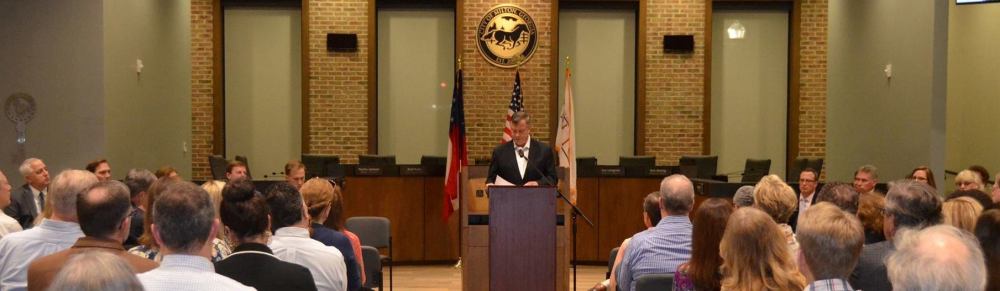
Last week, Mayor Joe Lockwood delivered a “State of the City” speech. The speech was preceded by a nice cocktail hour, paid for by the Chamber of Commerce and catered by local vendors (including Cheeses and Mary). The Mayor spoke to a packed City Council Chamber. He was followed in his remarks by short updates from each of the city’s department heads. The City Manager, Steve Krokoff, gave introductory and closing remarks. It was quite a nice event.
The State of the City event was powerfully symbolic of positive changes that have occurred in the City over the past 2+ years. This change has been steady and substantive. As with all “State of . . . ” speeches, the mayor recited the positive achievements of the City and painted an uplifting vision for the future. Mayor Lockwood acknowledged the contributions of the City Council (including former council members), city staff, and county/state officials. However, Mayor Lockwood reserved the most credit for the city’s success to citizens, where it rightfully belongs. This was condign acknowledgment of the role citizens have played in the progress of the City. The Mayor’s remarks highlighted the exceptionalism of Milton, owing to the specialness of its citizens. However, Mayor Lockwood went even further with his remarks. Mayor Lockwood not only acknowledged Milton’s citizens, he challenged Milton’s citizens to engage in our city government. And “challenge” was the perfect word, as it demonstrates our new city council’s recognition that good governance is directly correlated with citizen engagement. Our founding fathers were acutely aware of this correlation. They understood that consent of the governed meant much more than free and fair elections; they knew that good governance required active participation of citizens.
I especially liked that Mayor Lockwood was specific in his challenge, recommending 9 actions to citizens:
Attend a city council meeting.
Reach out to council members.
Participate in a community planning event (e.g., a Community Zoning Information Meeting).
Respond to a community survey.
Follow local government on social media and post a comment.
Sign up to participate in the citizens’ government academy.
Visit a fire station.
Chat with a Milton police officer.
Attend one of the City’s special events.
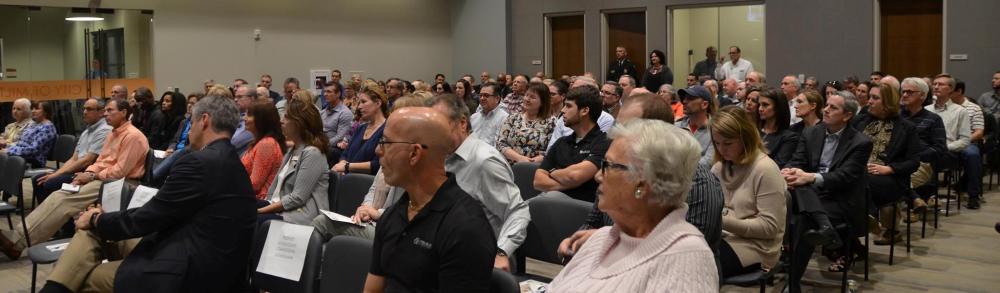
Mayor Lockwood also asked for a show of hands from citizens that were at the new City Hall for the first time. It was refreshing to see a few dozen raised hands, evidence of new faces and voices in our city government.
Mayor Lockwood’s speech was indicative of recent positive changes in our city government. The speech was a clear signal that citizens will not only be heard and respected by our local government, but citizens will be proactively engaged in local governance. This emphasis on citizens is evident in our new council, whose proceedings are marked by professionalism and integrity. I believe that a new day is dawning in Milton’s governance . . . governance recognizing that our great citizens can make Milton America’s greatest small city . . . but only if we proactively engage those citizens.










 Milton Coalition