City Council Candidate Bentley, Election 2017, Good Governance, Smart Land Use

Election Was a Battle of the I’s: Information vs. Incumbency

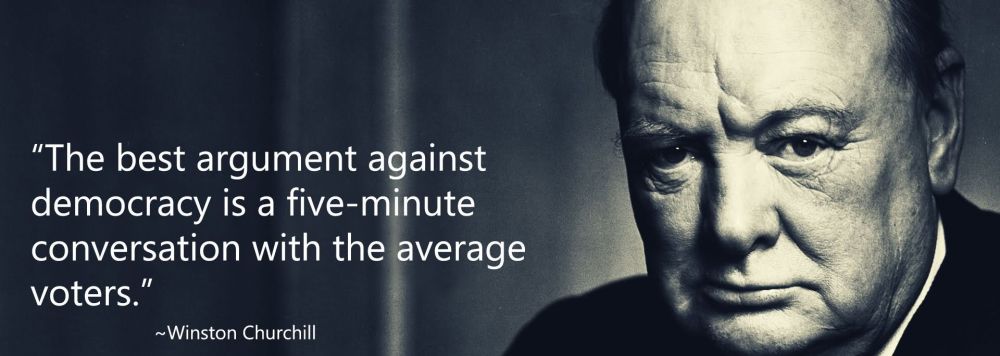
the-best-argument-against-democracy-is-a-five-minute-conversation-with-the-avertage-voters-politics-quote

The above quote from Mr. Churchill is one of favorites.  And generally I agree with the sentiment expressed, particularly as it relates to state and national politics.  However, Milton is different.  As with so many things, Milton’s citizens showed their exceptionality in Tuesday’s election.  Voters understood the issues facing Milton, like overcrowded schools and insufficient transparency, and delivered a mandate for change.  They delivered a mandate for smart land use and good governance. 

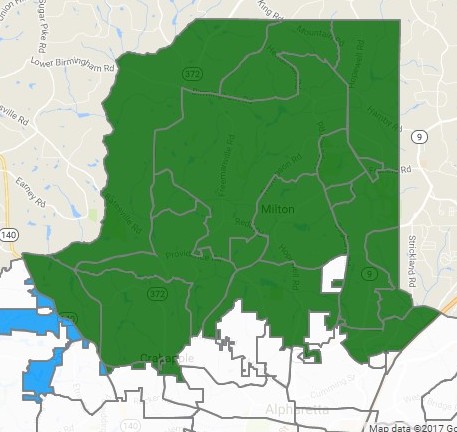
And make no mistake about it, Ms. Bentley’s capturing of 71.23% of the vote against an entrenched, 11-year incumbent is a huge mandate.  Furthermore, Ms. Bentley’s message resonated throughout the diverse geographies of Milton, from the town homes in Deerfield to the mostly still rural areas in the far north reaches of Milton.  In fact, Ms. Bentley racked up huge victories in Crabapple (76%) and Milton Lakes (78%).  These southern areas of Milton are where rezonings to higher density pose the biggest threat to quality of life and property values.

Election Map
Areas Won By Bentley (shaded in green)

Ms. Bentley also racked up big victories in District 3, including in Crooked Creek (65%).  I mention this because District 3 Council Member Longoria chose to not endorse a candidate.  And the other District 3 Council Member Mohrig tacitly supported Mr. Lusk, including waving signs for Mr. Lusk on election day.  The result was that Lusk signs often outnumbered Bentley signs in many parts of District 3, including on the lawns of some influential Miltonites.

And frankly, the abundance of Lusk signs and the many strong advantages of incumbency did cause some within the Bentley camp to fret about a possible close election.  I was not among the fretters.  I predicted Bentley would win 72% of the vote; she won 71.23%.  And please know that it is especially difficult to predict the outcome local elections.  We had no polling data.  And our proxies for polling data (e.g., likes at a Facebook page) were crude at best.

So how did I know the election would be a Bentley Blowout?  Answer:  conversations with (mostly random) citizens–a foreign notion to some sitting council members.  Stretching back two years to the battle over the CSO, I have spoken with many hundreds of citizens about the issues facing Milton.  I found that most citizens were/are increasingly dissatisfied with over-development in Milton.  And furthermore, this sentiment does not vary depending on where citizens live, as we all sit in the same traffic.  We all send our kids to the same overcrowded schools.  We all are concerned about our property values.

Even two years ago, this community sentiment against reckless development was obvious with opposition to the CSO.  At the time, the dueling CSO petitions showed that 70+% of citizens opposed the ordinance, which citizens realized would accelerate development, introduce high density housing where it did not belong, and allow HOA-run private sewer systems.

For the next two years, this overwhelming citizen opposition to over-development was repeatedly demonstrated in various zoning hearings–e.g., Ebenezer Road, Donegal Lane, and Reserve at Providence.  However, some on Council–sometimes a majority–repeatedly refused to acknowledge the obvious and strong community opposition to reckless development in Milton  . . . much to their detriment, as 2 new council members dedicated to smart development will join Council in January.

This past Tuesday, informed Milton citizens showed up in droves to the polls and rejected the status quo.  Information trumped incumbency.  With the election, the specialness of our community shone through.  Miltonites are a smart, caring, and hard-working lot.  It is these good qualities and so many more that have made us the number one community in Georgia.  And it is these qualities that will ensure that our community maintains its special sense of place and becomes number one in good governance.

On election day, power was indeed shifted back to the informed citizens of Milton.  Ms. Bentley’s platform for change was overwhelmingly approved.  Now the hard work of implementing that change begins.  Click here to find Bentley’s campaign platform–a blueprint for smart land use and good governance:  Bentley’s Blueprint for Smart Land Use and Good Governance  And please stay engaged.

Advocating For Citizens,

Tim Becker

********************************************************************************

Postscript:  I will be blogging about Pizza-gate, so stay tuned.

Election 2017, Smart Land Use

A Vote For Bentley: A Small Investment to Protect Your Big Investment

A vote for Laura Bentley is a small investment to protect your big investment—the value of your home.

There are countless reasons to vote for Laura Bentley.  However, did you know that voting for Laura Bentley is a wise financial move for voters?  Consider the following:

  • The Pew Research Center reported that 81% of adults it polled stated that buying a home was the best long-term financial investment.
  • The Wall Street Journal reported that for the top 20% of wealthiest Americans, equity in their principal residence was 30% of their overall net worth and their single biggest investment. For the middle 60% of Americans, equity in their principal residence was 63% of their net worth.

The takeaway is that Americans care a lot about the value of their property, which is intimately tied up with their financial security and well-being.  For most Americans, equity in their principal residence is their largest financial asset, and they want to protect that asset.  However, most Americans and Miltonites might not realize that their local government has a big impact on the value of their home equity.  How Milton gets developed—things such as density and housing quality—influences the look and feel of Milton and our quality of life.  We only get one chance to get it right.  There are no do-overs when it comes to development.  If we get development wrong, property values stagnate or decline.  We see examples of poor development all around us.  Roswell and Alpharetta have significant areas of blight.  We can expect the same in Milton if we get development wrong.  Accordingly, our city’s land use decisions, particularly decisions at City Council, have significant and far-reaching effects. 

So voters must ask themselves which candidate—Laura Bentley or Bill Lusk—will better protect and enhance property values in Milton?  Mr. Lusk has made it clear that he believes that land use decisions are best left to developers—i.e., the City should largely defer to the wishes of developers.  Or in his words:  “Leave it to the professionals.”  Following are 2 videos—each about 2 minutes long—where Mr. Lusk very clearly demonstrates his view that developers should be largely left to their own devices.  In these videos, he is arguing against giving the Planning Commission additional authority to oversee development in Milton.  Listen closely as he berates the planning commission, asserting that its members are non-professionals rendering subjective opinions.  He uses an analogy to make his point, comparing developers to cardiologists vs. the planning commission, which is like going to your “Cousin Mike” for advice about whether to get a triple bypass.  He further asserts that he does not want to put any “hurdles” in the way of developers.  His low regard for our Planning Commission is stunning and reprehensible.  Watch these videos and then ask yourself whose interests Mr. Lusk is protecting:  your interests or the interests of developers?

City Council Candidate Laura Bentley has a very different perspective on development.  Recently, Ms. Bentley met with 18 realtors, most of whom live in Milton.  This group of professionals stands in stark contrast to developers.  Realtors are our community’s experts on property values.  Realtors are an important, but overlooked, stakeholder group in Milton.  Unlike developers, realtors have a long-term interest in protecting and enhancing property values in Milton.  Furthermore, realtors understand the macro factors that impact property values.  Ms. Bentley was keen to get realtors’ perspectives on development in Milton and its impact on property values.  And it was quite clear that realtors are concerned about reckless development negatively affecting Milton’s quality of life (e.g., overcrowded schools and congested roadways) and ultimately threatening property values in Milton.  Realtors and Ms. Bentley both understand that we cannot let developers drive land use decision in Milton, as Mr. Lusk asserts.  In fact, at least 2 dozen realtors have signed Milton Coalition petitions advocating for smart land use in Milton—petitions that Mr. Lusk has repeatedly berated and dismissed.

Of course, Mr. Lusk has a long and consistent record of bowing to the demands of developers.  Since he was re-elected in 2013, he has voted for 3 re-zonings to higher density.  He has voted to extend sewer 4 times to allow higher density.  He was the key sponsor of the so-called “conservation” subdivision ordinance, which was supported by Atlanta’s two largest developer lobbying groups and was intended to allow developers to profitably develop marginal land in Milton.  Lastly, Mr. Lusk voted against the citizen-generated Comprehensive Land Use Plan.  Ms. Bentley has strongly opposed Mr. Lusk on every one of these issues.

Clearly, Ms. Bentley is the candidate that will protect and increase property values in Milton.  She will not defer to developers.  She will listen to the community, especially our terrific local real estate professionals.  Citizens might consider their support and vote for Bentley as a small investment to protect their big investment—the value of their home and property.

Advocating For Citizens,

Tim Becker

City Council Candidate Bentley, Election 2017, Good Governance, Smart Land Use

Bentley: Representing Citizens For The Last 2+ Years . . . Let’s Make It Official

Author:  Tim Becker

Citizens, for over 2 years, Laura Bentley has been representing us before Council.  Over the past 2+ years, Bentley has attended nearly every City Council meeting (and dozens of other government meetings).  Bentley has addressed Council many dozens of times.  Advocating for citizens has been a full-time job for Ms. Bentley.  She has weighed in a every major issue before the City.  And she has proposed a number of initiatives that have been put on Council’s agenda and been approved.  Bentley has been a leader in opposing reckless development in Milton.  This includes leading efforts to successfully defeat dangerous rezonings to higher density in Milton. 

No candidate for Council in the history of Milton has come close to this level of involvement in our city government.  Because of her involvement, citizens are more apt to come to Ms. Bentley with questions and concerns than her opponent, who currently sits on Council!  If you don’t believe me, ask the residents of Wood Road and Ebenezer Road.  She advised both groups about zoning proposals that were going to desecrate their communities.  Ask the residents of Brookshade and Vickery Crest.  Ms. Bentley advised them on multiple re-zonings to higher density that threatened their property values.

Through her advocacy, Ms. Bentley has accumulated experience that trumps her opponent’s claim of being the more experienced candidate.  Mr. Lusk’s time in office with no record of accomplishments is NOT experience.  On Day 1, Ms. Bentley will be ready to serve on Council.  For the past 2 years, Ms. Bentley has been there for citizens.  Now it is time for us to be there for her and make her representation official by electing Laura Bentley to Council.

Following are a number of videos that clearly demonstrate Bentley’s advocacy on the major issues facing the City.  They demonstrate that Bentley clearly stands with citizens and against reckless development in Milton.  In these videos, she demonstrates the passion and intelligence that are her hallmarks.

  1. Bentley Leading the Charge Against the Infamous CSO

Laura Bentley led the opposition to the infamous CSO.  This included enlisting dozens of citizens to come speak before Council.  The CSO was a developer-promoted scheme to increase density, accelerate development, and introduce HOA-run sewer systems into rural Milton.

2. Bentley led the opposition to the Ebenezer Road rezoning.  Initially, the builder sought to cram 55 homes on 65 acres, with some houses on quarter acre lots.  Today, 21 homes are being built on most attractive 38 acres.  The remaining and less attractive 27 acres will likely support only a handful of homes, if and when it gets developed.  Delayed development is conservation.  Following is Bentley at the first Ebenezer hearing.

Unfortunately, the Ebenezer rezoning passed during the first hearing.  However, based on significant procedural issues (e.g., Council Member Thurman interfering 9 times in the hearing when she was recused), the Mayor vetoed the Council decision.  The rezoning was denied during the second hearing.  Following are Ms. Bentley’s impassioned Council comments against the rezoning at the second hearing.

Following is the vote on the Ebenezer rezoning, with Lusk and Kunz voting against denial of the rezoning.  They sided with builder’s proposal for 48 homes.  Notice their green shirts . . . this was to show solidarity with those promoting the Ebenezer rezoning.  Mr. Lusk and Mr. Kunz both actively promoted the developer’s project and rezoning ahead of the rezoning hearing, violating their duty of judicial impartiality.

3.  Bentley speaks against generous granting of variances.  On the night of the 2nd Ebenezer vote, Bentley also spoke against a variance request from a developer, who was seeking variances for 80% of his unbuilt lots!  Developers in Milton know that if they perform poor due diligence in purchasing a property, they can always come to Council to fix their mistakes.  In this situation, led by Ms. Bentley, citizens once again faced down a developer, who ended up withdrawing his variance application.  Mr. Lusk was silent during the discussion.

4.  Laura Bentley led the charge on protecting 3 acre lots on gravel roads.  She met with a group of Wood Road residents on multiple occasions to advise them and ensure they were successful in their aim of protecting their community.  If you drive down Wood Road today, you will see a raft of Bentley signs in appreciation of Ms. Bentley’s leadership.  Mr. Lusk was largely silent during the 3-acre lot size discussion.  His protege, Matt Kunz, and Lusk’s political soulmate, mayoral candidate Laura Rencher, both supported allowing one-acre lots on gravel roads!

5.  Laura has promoted initiatives to maintain Milton’s rural viewshed to preserve the look and feel of our community, to uphold our property values, and to honor our rural heritage.

6.  Laura Bentley led citizens in expressing support for Milton’s Comprehensive Land Use Plan (CLUP).  The CLUP is a ctizen-generated document that is developed by a 17-member committee that captures the community’s desires and aspirations for land-use in Milton.  It designates how every parcel of undeveloped property in the city should be developed.  The CLUP was developed over a 12-month period, was facilitated by consultants, and involved several citizen workshops.  The CLUP was approved 7-0 by the Planning Commission.  Despite the 100s of hours expended to develop the CLUP and generous citizen input, Mr. Lusk (and Mr. Kunz) voted against the CLUP.  Lusk and Kunz argued that the CLUP should include the infamous CSO, despite widespread citizen opposition to this ordinance.  It was the ultimate act of disrespect toward citizens.  It was a vote against citizens.

Ms. Bentley spoke in favor of the CLUP every time it was on the City Council’s agenda.  Following is a video of Ms. Bentley speaking at a City Council working session.

Ms. Bentley also spoke in favor of transmitting the CLUP to the State of Georgia.  Following is a video of her comments before Council:

Conversely, Mr. Lusk opposed the CLUP transmittal, arguing in favor of adding language to allow so-called “conservation” subdivisions.  Listen to Mr. Lusk’s comments.  He just doesn’t get it or doesn’t want to get it.  Citizens have rejected this notion of cluster housing in rural Milton . . . end of story.  Mr. Lusk, what part of NO don’t you understand?

And here is the vote on the CLUP transmittal with Lusk voting against it.  Clearly, Mr. Lusk believes he knows better than citizens what is best for the City.

Finally, in October 2016, the CLUP came before Council for a final vote.   And once again, Mr. Lusk argued for his precious CSO.  Following are Ms. Bentley’s Council Comments urging approval of the citizen-driven and Planning Commission-approved Comprehensive Land Use Plan.

7.  Laura Bentley expressed clearly and concisely her and  citizens’ displeasure with the non-transparent changing of electoral district lines engineered by Council Member Karen Thurman so that she could keep her seat when she moved out of her district.

Citzens, Laura Bentley has been there for us–the citizens–for the last 2+ years.  It is time for us to be there for her with our support and our votes.  Vote For a Better Milton.  Vote For Bentley.

Advocating For A Better Milton,

Tim Becker

Council Member Bill Lusk, Election 2017, Smart Land Use

Must-See Video: Mr. Lusk’s Views on Development In His Own Words . . .

. . . A Far Cry From His Campaign Mailer.

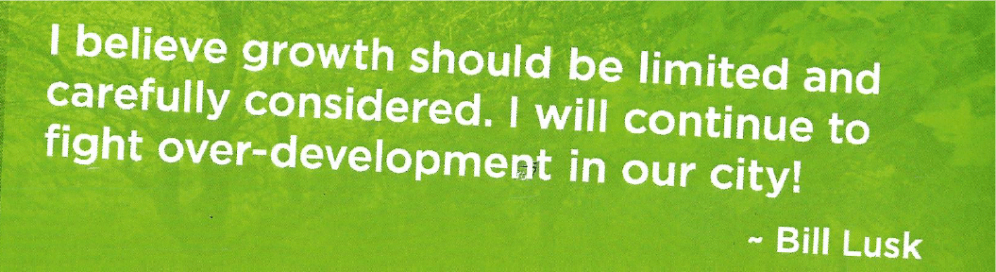
Lusk Mailer Excerpt - Land Use Claims
Snapshot excerpt of most recent Bill Lusk mailer.

Author:  Tim Becker

If you are visiting the blog today, it is probably because you received an email sent to Milton Coalition supporters.  You are an informed voter who is seeking more information.  Please do me a favor.  Watch the following 4 minutes of video.  After watching, if you believe Mr. Lusk represents your desires for development, please vote for Mr. Lusk.  However, if Mr. Lusk’s views cause you concern, then please vote for Laura Bentley.  I have provided a lot of written commentary below; however, feel free to skip the commentary and just watch the videos . . . I think you will get it.

***************************************************************************

Recently, Mr. Lusk sent out a campaign mailer.  It confirmed what most of us think about most politicians.  Their actions and voting record belie their words.  For the last 3+ years, Mr. Lusk has shamelessly advocated for the interests of developers.  However, now that we are in the election season, Mr. Lusk is repositioning himself as a limited growth candidate that is going to “continue to fight over-development in our city.”  (See above mailer excerpt.)  Frankly, Mr Lusk’s mailer is nonsense.  His voting record shows that Mr. Lusk has voted for EVERY re-ezoning to high density over the last 3 years. Mr. Lusk favors unfettered growth; he has been a primary enabler of over-development in Milton.  Fortunately, Mr. Lusk has left a video record of his true positions on development in Milton.

(Note:  The videos are not sound bites, so are a few minutes in length.  I believe informed voters want the whole story, not manipulated sound bites.)

In this first video, Mr. Lusk shows his deep contempt Milton’s Planning Commission – that is, they are a group of non-professionals (he calls them “Cousin Mike”) that render subjective opinions.  Developers are compared to cardiologists to whom we should defer on land use issues!  The truth is that our Planning Commission is group of seasoned professionals that only focuses on land-use issues.  For example, Paul Moore has been involved in land use planning for over 20 years.  The Planning Commission has consistently and unanimously denied reckless rezonings only to be rebuffed City Council.  The Planning Commission has also led the effort to enhance our current zoning regulations to ensure developers are held to a high standard.

At the end of the video, Mr Lusk argues for leaving the development of Milton to the developers . . . “Leave it to the professionals.”  Does this sound like the something you would say if your were truly advocating that “growth should be limited” and if your aim was to truly “fight over-development”?  Of course not.

In the next video, watch as Mr. Lusk argues against putting any “hurdles” in the way of developers.  I ask you to look around Milton at all the reckless development occurring.  I think a few “hurdles” might be prudent.

Watch as Mr. Lusk states that “we have pretty good control over development.”  Really?  Has he driven around Milton lately?  Has he been stuck in the traffic circle line at the Cogburn-Hopewell roundabout that stretches for miles?  His kids were never in Milton’s schools, so he has not experienced the overcrowding.

Mr. Lusk cites the tree ordinance as an example of “good control” over development.  Really?  Has Mr. Lusk seen all of the clear-cutting in Milton?  Did you know that clear-cutting is actually illegal?  Probably not, because our tree ordinance is routinely ignored by developers because its penalties are minuscule.

And I think it would be good to make it more difficult to get land disturbance permits . . . currently, getting a land disturbance permit is as simple as ordering a burger at a drive-through.

Citizens, I got involved in city government 2 years ago because I was fed up with reckless development.  I have attended nearly every city council meeting since then.  And I can tell you that Mr. Lusk is not for “limited growth” and he has not fought over-development . . . quite the opposite.  Mr. Lusk is definitely the developers’ candidate.  Laura Bentley is the citizens’ candidate.  Vote for Smart Land Use in Milton!  Vote For Bentley!

Advocating For Smart Land Use,

Tim Becker
CHS Town Homes
Town house development across from CHS . . . Mr. Lusk made motion to approve.
Council Member Bill Lusk, Election 2017, Mayoral Candidate Rencher, Smart Land Use

Lusk-Rencher Running Away From Their Advocacy of CSO . . . Don’t Be Fooled

October 12, 2017

A vote for the Lusk-Rencher ticket is a vote for the CSO.  Both Lusk and Rencher are currently running away from their advocacy of so-called “conservation” subdivisions, which were roundly rejected by Milton’s citizens, with over 2500 signing one or more petitions against such cluster housing.  However, if elected, it is a sure bet that Lusk-Rencher will run back to their beloved CSO and once again try to force such cluster housing upon their constituents.

At their campaign websites, neither Council Member Bill Lusk nor mayoral candidate Laura Rencher mentions so-called “conservation” subdivisions or the infamous Conservation Subdivision Ordinance, or CSO.  Of course, Mr. Lusk was the chief proponent on Council of the CSO and “conservation” subdivisions.  And through her tax-exempt educational charity Preserve Rural Milton (PRM), Ms. Rencher was the chief political lobbyist for the CSO and conservation subdivisions (Note:  PRM’s tax-exempt status has been revoked because of failure to file required annual forms for 3 consecutive years.)  Unfortunately, with their reckless and unworkable conservation subdivision proposals, the Lusk-Rencher duo dominated the city government’s land-use policy-making for nearly 2+ years.  In that time, the City made very little progress on practical and effective land-use policies.  And during this time, developers pursued unfettered development with reckless abandon.

With the CSO, Lusk-Rencher hijacked the city’s policy-making process, bypassing staff and the City Manager, to develop a Frankenstein ordinance that only a developer could love.  And in fact, Atlanta’s two largest developer lobbyist groups did support the CSO in public comment at the City Council hearing where the CSO was denied.  Lusk-Rencher’s CSO required NO conservation of buildable land . . . not one square inch.  Randall Arendt, the father of the conservation subdivision, advises that a MINIMUM of 35% of buildable land be conserved in a conservation subdivision.  Furthermore, Arendt explicitly advised Milton against counting unbuildable land (e.g., stream buffers) as conserved land, but was ignored.  Arendt further advised that Milton’s one-acre minimums (Arendt prefers jurisdictions with larger minimum lot sizes) and lack of sewer made conservation subdivisions impractical for Milton, and again his advice was ignored

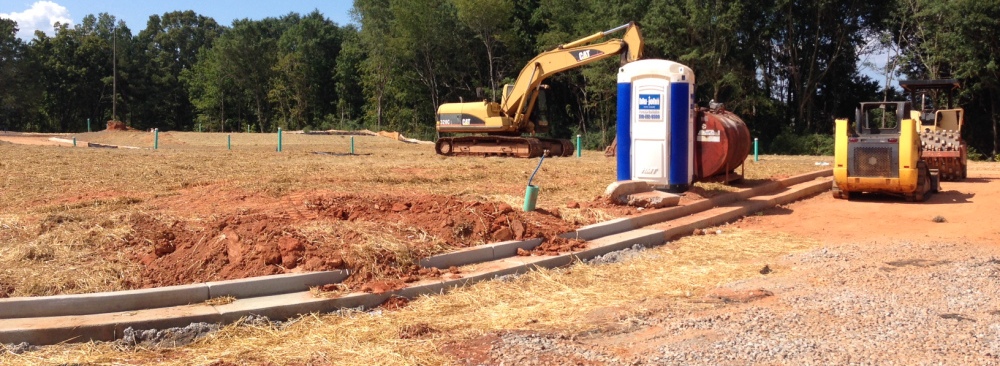
CHS Town Homes

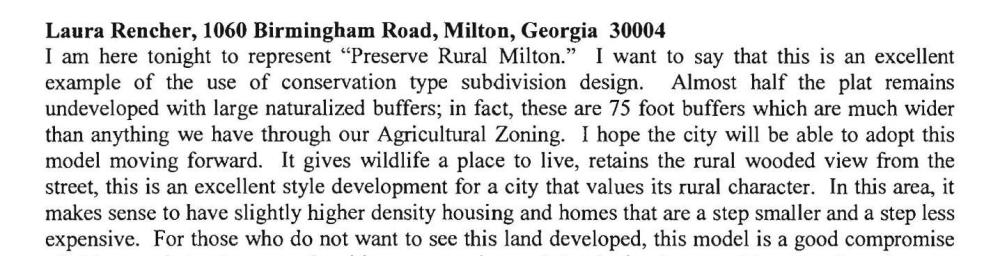
The Lusk and Rencher alliance goes further back than the CSO, stretching back to the rezoning of the land across from Cambridge High School in 2013.  Both Lusk and Rencher supported the Cambridge townhouse development (although Rencher advocated for granting 2+ times density rather than 3+ times that was granted).  Here is what Rencher stated in public comment (from the Council Meeting minutes):

Rencher CHS Public Comment

Where are the “large naturalized buffers”?  Where is the “rural wooded view from the street”?  Rencher claims this development to be “an excellent style development for a city that values it rural character” . . . really?

Mr. Lusk echoed Ms. Rencher’s comments.

Lusk Council Comment 3

Yes, Mr. Lusk, the property’s zoning should have remained AG-1.  Under AG-1 zoning, the developer would have built no more than 7 homes.  Seven homes on 1 acre lots would have looked much better than the clear-cut pipe farm and retention pond that currently mar the property.  The current buffers are skimpy.  Where is the conserved land (i.e., 50% of the parcel) that was promised?

Of course, the most controversial battle over “conservation” cluster housing occurred with the Ebenezer rezoning in the first half of 2016.  Ms. Rencher and Mr. Lusk both promoted Brightwater Homes’ development and its rezoning application.  Through PRM, Ms. Rencher scheduled tours of Brightwater’s property, with Mr. Lusk co-leading tours with Brightwater’s CEO.  In advocating for Brightwater’s Ebenezer rezoning ahead of the rezoning hearing, Mr. Lusk violated his duty of judicial impartiality.  Mr. Lusk even sported a green polo shirt to demonstrate his solidarity with Ms. Rencher and Brightwater Homes.  It is hard to wrap your mind around a City Council Member so shamelessly promoting a developer’s project.

The Ebenezer rezoning was only denied after overwhelming citizen opposition, with so many opponents attending the final City Council hearing that a holding room had to be created for the overflow crowd—a first in Milton’s history.  Of course, the actual development of the Ebenezer property is proving that opponents were correct with their arguments.  Rather than 48 homes being built on the 65 acres, it seems fewer than 30 will eventually be built under AG-1 zoning.

Despite strong public opposition, Mr. Lusk and Ms. Rencher continued to promote “conservation” subdivisions.  In November 2016, Mr. Lusk voted against the Comprehensive Land Use Plan (CLUP) because its conservation subdivision language had been removed.

So citizens, don’t be fooled by Lusk-Rencher’s silence on “conservation” subdivisions.  Lusk-Rencher still strongly favor such high density development, but realize their election prospects are slim if they publicly embrace such cluster housing.  However, if Lusk and Rencher are elected, you can be sure that they will promote “conservation” subdivisions with a vengeance.

Tim Becker

Smart Land Use

Thanks to Realtors For Supporting Smart Land Use!

Home Improvements

September 8, 2017

Today, I want to thank Milton’s realtors for their support for smart land use over the past many months.  More than anyone else, realtors are the community’s experts on property values.  Every day, they deal with buy-sell transactions of property.  They see the numbers on home values.  They know what enhances a home’s value and what does not.  Realtors understand the critical importance of sense of place in supporting and increasing high property values in Milton.  They understand the threats to property values from poorly managed development.  And many of these realtors have “skin in the game” in that they live in Milton—i.e., their home values and quality of life are affected by the development decisions made in Milton.  Thankfully, many of these real estate agents have not been shy about expressing their concerns about land use in Milton.  I have identified nearly 3 dozen that have signed the Milton Coalition’s anti-CSO and/or Smart Land Use petitions.  Quite a few Milton realtors had advocated passionately for smart land use.

CHS Town Homes

In many ways, real estate agents share diametrically opposed views to developers.  Most developers are transactional—i.e., narrowly focused on maximizing the profit of a specific development.  They tend not to take a broader market-based view.  They follow the money.  Once an area is built out and its market potential is exploited, these developers are off to the next lucrative market.  Most Milton developers do not live in Milton.  For those developers that do live in Milton, their development interests generally outweigh any personal interests they may have—that is, the value of their property pales in comparison to profits made from development.  Lastly, developers are not shy about spreading around money to ensure their interests are protected.  In Milton, it is amazing how much influence a large campaign contribution can buy.

This is not to say that there are not good developers in Milton.  There certainly are honest, decent developers that want to be good stewards of the land and the community.  They understand and are faithful to Milton’s sense of place.  These developers tend to be smaller developers that actually live in Milton.

Over the last 22 months, it has become clear to me that realtors’ interests are closely aligned with the interests of citizens.  They act as a counterweight to reckless development.  We are fortunate to have so many fine realtors that understand and want to protect the specialness of Milton:  the four-board fences, the gravel roads, the horse farms, and the tree-lined streets.  Milton’s specialness makes homes in Milton a good investment.  Accordingly, I’d like to give a big shout-out to Milton’s realtors.  Thanks for your support of smart land use and good governance.

c4a352_c787efc5db8a42289f590497c9037ae8

Tim Becker

Smart Land Use

AG1 Zoning Provides Superior Results on the Ebenezer Property

Ebenezer Sub

September 3, 2017

This week’s Milton Herald ran a story about the aftermath of the Ebenezer rezoning that occurred 14 months ago.  Following is a link to the article:

Milton Herald: Ebenezer Saga Ends With No Fanfare

This article is a must-read for citizens who have an interest in land use.  Staff reporter Joe Parker captured the essence of the Ebenezer re-zoning, despite its complexities and Parker not being present at the rezoning hearings.

The Ebenezer rezoning provides a theory-to-practice case study of “conservation” subdivisions.  The theory postulated that the 65 acres on Ebenezer would support 55 homes under AG-1 zoning.  In fact, theoretical yield plans were created by Brightwater Homes that showed how an AG-1 zoned subdivision might be laid out.  These plans for the property ostensibly “proved” 55 homes, then 50 homes, and finally 48 homes were possible under existing AG-1 zoning.  Unfortunately, such theoretical yield plans do not consider the practical realities of development.  The fatal flaw of the Ebenezer yield plans was that they effectively ignored whether the property’s soils would support septic systems.  Brightwater’s second theoretical yield plan placed some septic fields partly/fully in soils that would not support septic—that is, the soils would not perc . . . a frequent issue in Milton that keeps housing density low.  This discrepancy was initially found by a layman on Ebenezer Road who overlaid the theoretical yield plan on the soils map for the property.  A local development professional was then engaged, who performed detailed analysis and confirmed that the yield plan was terribly flawed.  Of course, there were other issues that also cast doubt on whether the land would really support 48-55 homes—for example, steeply sloped land that seemed uneconomic to develop.  And there were further concerns about whether land covered with septic drip lines could really be considered “green space.”

It took a lot of work, but those of us who opposed the re-zoning persuaded enough Council Members that the Brightwater plans were flawed.  And now our arguments are being validated by the actual build-out of the subdivision:  21 homes on the most attractive 38 acres.  It is unlikely that the remaining 27 acres will support more than 8 additional homes.  In any case, the development of the remaining undeveloped land will be delayed.  And delayed development is conservation.  So the instead of 48 – 55 homes on 65 acres proposed by Brightwater, it seems existing zoning will likely support < 30 homes.  The denial of the Ebenezer rezoning was clearly a win for the community.  More importantly, the Ebenezer rezoning educated citizens about development schemes meant to bend and break the rules to achieve higher density housing than existing zoning allows.

Fortunately, the Comprehensive Land Use Plan (CLUP) developed in the wake of the Ebenezer rezoning erased all references to so-called “conservation” subdivisions.  The CLUP is a plan that, through citizen workshops, captures the aspirations of the community for land use.  The CLUP was approved by the 17-member committee that drafted it and then was unanimously approved by the Planning Commission.  However, the battle is still not over.  Two Council Members—Lusk and Kunz—have vowed to continue the promote rural cluster housing.  Accordingly, both Lusk and Kunz voted against CLUP.

Note:  I have driven out to the Ebenezer property several times.  Brightwater Homes has certainly made an effort to conserve as many trees as possible and are to be commended for that.

Tim Becker

Good Governance, Smart Land Use

Johns Creek Post – Holding the Powerful Accountable in Our Sister City

JC_Post_Logo2-e1439759369243

August 24, 2017.

(You’ll want to read to the end.  The video at the end is must-see tv.)

Today, I wanted to direct you to a story from the Johns Creek Post, which is a website in Johns Creek devoted to City government issues.  Similar to this blog, the Johns Creek Post has a mission of holding government officials–especially elected representatives–accountable.  I have been subscribing to the JCP for the last three months and have been comforted knowing there are other concerned citizens actively engaging their government in our sister cities.  If you are not getting enough of your local government fix from this blog, I highly recommend subscribing to the JCP.

“Motor Court” Homes Proposed For Bell Road: Denied

The JCP‘s story concerns a high density development that a developer proposed in Johns Creek.  There was strong opposition from local residents.  Sensing that he would lose the vote before Council, the developer requested to withdraw his proposal and was granted his request.  It is important to understand that a City Council can reject such a withdrawal request, discuss the developer’s proposal, and accept/approve the developer’s proposal.  However, if the developer’s proposal is rejected, he has to wait a year before submitting another proposal for that particular property.  However, when a request for withdrawal is granted, the developer can immediately come back with a modified proposal.  As the JCP noted, this submit-and-withdraw tactic is one of many used by developers to wear down citizen opposition.

download

We see similar tactics used in Milton.  A variation of this tactic is constantly morphing rezoning applications.  I have seen rezoning applications (e.g., the Ebenezer Road rezoning) that were constantly revised during the vetting process, including during the final days before the rezoning was heard by Council.  And to add insult to injury, citizens are not informed of these changes unless they are constantly calling Community Development and asking about changes.  And often, the changes are not “tracked,” meaning that a citizen cannot easily compare the latest version of an application to previous versions.  Sometimes the zoning process feels like a game of whack-a-mole.  The reality is that citizens do not have the time and expertise to continuously monitor and react to constantly changing developer proposals.  Zoning processes need to be reformed to level the playing field for citizens.  Furthermore, Council needs to be alert to manipulative tactics by developers and take actions to ensure citizens’ interests are protected.

I have attended quite a few contentious zoning hearings.  The one common denominator has been citizens’ frustration.  Not because of the outcome, but because citizens felt unfairly treated.  What is needed in Milton is a top-to-bottom review with an objective of making zoning processes more citizen-centric.

*****************************************************************************

Johns Creek Post – Part 2

JC Town Hall

Following is more exciting post from the JCP.  It still shocks me to see elected officials attack citizens in this manner.  (Perhaps I am mistaken, but it seems some profanity might have muted in this video.)

Viral Video: Town Hall Meltdown

Of course, we have witnessed similar behavior in the past year from three Council Members in Milton, despite a policy approved by Council in February 2016 that stressed the importance of government officials, including elected representatives, being deferential to citizens.  Although do we really need a policy that states that elected officials should be respectful and courteous in their interactions with constituents?  Shouldn’t this be obvious to our elected officials?  Thin-skinned, ego-driven politicians probably need to find another line of work.

Tim Becker

Smart Land Use

Sewer Creep = Higher Density = Higher Developer Profits

Sewer Creep

August 22, 2017

Ever wonder why Milton is so different from the surrounding areas—think Johns Creek, Alpharetta, Roswell and even Forsyth County—where builders are cramming homes onto every square inch of land?  The reason is simple . . . the vast majority of Milton does not have access to sewer.  Sewer exists only on the edges of Milton—i.e., in the Highway 9/Windward and the Crabapple areas.  In the interior of Milton, where sewer does not exist, each home has a septic system to clean its wastewater.  In Milton, such septic systems require 1) at least an acre of land and 2) soils that can adequately filter wastewater—i.e., land that “percs”, shorthand for “percolates.”  This second point is important, as some land in Milton does not “perc”—i.e., it is unsuitable for septic.  This requires lots even larger than an acre—sometimes a lot larger–that encompass soils suitable for filtering a home’s wastewater.  The lack of sewer is what makes Milton . . . Milton—that is, low density and more rural in its look and feel.

Unfortunately, assisted by some members of Council, sewer has been allowed to slowly “creep” further into Milton.  And any time sewer is allowed to creep, higher density follows in its shadow.  Higher density and sewer have an inextricable, ying-and-yang relationship.  And the ill effects of this higher density are congested roads, overcrowded schools, and diminished property values.  There are many concrete examples of this nexus of sewer creep and higher density.

CHS Town Homes
Townhouse Development Across from Cambridge High School

Like what you see across from Cambridge High School?  That eyesore townhouse development is an example of sewer creep/high density . . . the builder was gifted 3 times more density than the existing zoning allowed.  Yesterday, I blogged about the Ebenezer rezoning, where a developer and some Council members advocated for a private (i.e., HOA maintained and operated) sewer system that would have resulted in much higher density on the subject 65 acres.  The soils on much of the Ebenezer parcel were unsuitable for septic . . . and that is why a private sewer system was needed.  Thankfully, after a long battle, the Ebenezer rezoning was denied by Council.  And now, with Ebenezer, we have a concrete case study that clearly demonstrates the existential threat to Milton of so-called “conservation” subdivisions, which are really just schemes for extending sewer and achieving higher density housing.

So why are ordinary citizens constantly fighting against sewer creep in Milton?  The reason is that developers hate septic and conversely love sewer.  Sewer Creep = Higher Density = Higher Developer Profits.  It is that simple.  And unfortunately, developers have a lot of power in our City.  They have time, money, expertise, highly paid attorneys, and connections.  Through liberal campaign contributions, lobbying, manipulation of zoning loopholes, and other unsavory tactics, developers are often able to buy/finagle/coerce their way to sewer extension and higher density.  This sewer creep has now been allowed by our City Council 4 times in the past 4 years—this, despite past pledges from every Council Member not to extend sewer.  This constant and never-ending battle against sewer creep requires ongoing vigilance and engagement from citizens to protect our beautiful community.

IMG_1785

Tim Becker

Smart Land Use

Ebenezer Epilogue: Opponents’ Arguments Validated . . . Fewer Homes and Delayed Development

banner3

August 21, 2017

Fourteen months have passed since the Ebenezer rezoning was rejected by City Council on June 20, 2016.  The vote was a watershed moment in Milton’s history.  You might recall that so many re-zoning opponents showed up that a holding tank was created for the overflow—the first time in our City’s history.  Ninety-nine opponents of the rezoning completed speaker cards—another record.  In less than 4 weeks, an on-line petition espousing 9 principles of smart land use and good governance amazingly garnered nearly 1800 signatures and over 600 impassioned comments.  The residents of Ebenezer Road unequivocally demonstrated nearly universal local opposition to the re-zoning.  Citizens clearly expressed their opposition to reckless development and its ill-effects, and prevailed in the battle over the Ebenezer re-zoning.

cropped-epilogue-logo-4

Many of you know the story of the Ebenezer rezoning’s defeat; you were part of it.  Thank you.  However, there is a comforting epilogue to the Ebenezer rezoning that is mostly unknown to citizens.  Specifically, the story since the rezoning validates the arguments made against the Ebenezer rezoning and, more generally, the arguments made against so-called “conservation” subdivisions.

You might recall that rezoning proponents asserted that, with or without the rezoning, the same number of homes (55 in the original proposal and 48 in the final proposal) would be built on the 65-acre Ebenezer property.  Well, that has turned out to be dramatically wrong.  It is doubtful whether even 30 homes will eventually be built on the 65 acres.  Brightwater Homes is currently developing a portion of the 65 acres  It purchased the most attractive 38 acres and is building 21 homes on 1+acre lots.  The remaining 27 acres of land are considerably less attractive for development, so likely will support just a few additional homes.  So instead of the 55 homes in the original Brightwater Homes proposal, the Ebenezer Road property will likely support no more than 30 homes on the 65 acres.  Much of the remaining un-built 27 acres could stay undeveloped (i.e., conserved) for many years to come.  Delayed development is conservation!  Following is Brightwater Homes’ original proposed “conservation” subdivision.  Much of the “conserved” land is unbuildable or uneconomic to build; it also includes “non-green” elements, such as the community septic system.  In retrospect it is clear that, with the denial of both the CSO and the Ebenezer rezoning, our community dodged a bullet.

Original Ebenezer Plan

So have “conservation” subdivision proponents admitted they were wrong?  Believe or not, they have not.  In fact, Mr. Kunz and others have doubled down on the notion of “conservation” subdivisions.  Just last Monday night, Mr. Kunz again promoted conservation subdivisions in a Council working session, continuing to assert that the community is “divided” about “conservation” subdivisions.  Of course, our post from 2 days ago showed where Mr. Kunz’s true allegiances lie . . . with developers, not citizens . . . and developers desperately want “conservation” subdivisions.

Now you know the rest of the story . . .

Tim Becker