Council Member Matt Kunz, Ethics, Good Governance, Smart Land Use

Councilor Kunz Unashamedly Joins Forces With Developers Against His Constituents

August 19, 2017

The old cliche is that a picture paints a 1000 words.  The photos below were sent to us by a citizen.  They clearly show where Council Member Kunz’s loyalties lie.  It is crystal clear that Mr. Kunz has unabashedly joined forces with developers.  Mr. Kunz has long been a shameless advocate for developers in Milton, helping them bend, break, and change the rules for their benefit.  Citizens, if the photos below cause you concern, then please consider becoming engaged in local government.  Write to City Council.  Come to a City Council meeting and express your dissatisfaction with the influence of Special Interests.  We need to take back our city government from the developers and other Special Interests that exert far too much influence over our City Council.  Please get involved.

Following is an advertisement for a January 2017 event where Council Member Matt Kunz was the guest of honor/VIP.  He delivered a speech and swore in members of the Board of the Greater Atlanta Home Builders Association (GAHBA), which engages in significant lobbying on behalf of developers.

Matt Kunz AHBA Speaking Engagement

Following is a photo (taken in January 2017) of Council Member Matt Kunz swearing in the Charlie Bostwick, the new president of the Greater Atlanta Home Builder’s Association.  Disregarding his duty of judicial impartiality, Kunz aggressively and publicly promoted Mr. Bostwick’s proposed subdivision in the Spring/Summer of 2016.  Was this speaking and swearing-in gig payback for his strong advocacy on behalf of developers?

Kunz Swearing In Bostwick

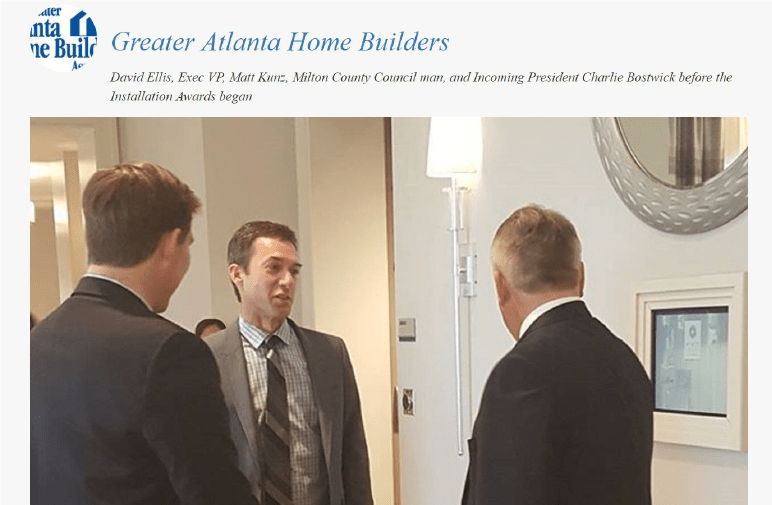
Following is a photo of Council Member Kunz hobnobbing with executives of the Greater Atlanta Home Builders Association.  At the time this photo was taken, Mr. Ellis was a long-time registered lobbyist for the GAHBA.

Kunz at GAHBA Meeting

Tim Becker


Smart Land Use

Council Needs to Strictly Uphold Milton’s Comprehensive Land Use Plan (CLUP)

comprehensive-planning

July 6, 2017

If you spend any time observing land use proceedings (e.g., rezoning hearings) of our City government, you are likely to hear reference to The CLUP.  CLUP stands for Comprehensive Land Use Plan—sometimes shortened to Comprehensive Plan.  The CLUP is the City of Milton’s long-range strategic plan for land use.  While it is not a legally binding document, it is a critical document as it captures the community’s preferences for land use.  Furthermore, the CLUP is reflected in the City’s zoning and other land use rules and regulations, which are legally binding.  The American Planning Association describes the CLUP as follows:

The comprehensive plan should be the centerpiece of the community planning program.  It is the means through which an organizing and sustainable vision can be provided for the community . . . The comprehensive plan is the vision framework within which other types of plans and implementing tools should operate . . . the comprehensive plan must accurately reflect a consensus and serve as a coherent vision for the community.

Why-I-created-a-Vision-Statement-for-my-Child-with-Special-Needs

Milton’s CLUP is a fairly detailed document and weighs in at a hefty 82 pages.  There are many elements to the CLUP.  It begins with a profile of Milton that presents a lot of data presented in graphs.  Much of this data is demographic in nature.  The CLUP also sets forth a vision and a mission for land use.  A considerable portion of the CLUP consists of setting forth objectives for various land use issues, such as development patterns or housing.  Given its importance, transportation and mobility is the subject of an entire section of the CLUP.  All of these previous sections are a lead-in to the most important sections of the CLUP, which deal with community/land use maps and narratives that provide detailed explanations of community preferences for land use.  The future land use map is particularly critical, as it provides a specific land-use designation for most parcels of land.  (We will have more to say about this below.)  Finally, the CLUP provides a work plan for achieving the vision, mission, and objectives of the CLUP.

The CLUP is updated every 5 years through an intensive 12-month process that provides many and substantive opportunities for citizen input.  This includes multiple workshops with citizens and liberal public comment at meetings of the Comprehensive Plan Advisory Committee (CPAC).  The CPAC is a 17-member stakeholder group that reflects diverse views of the community and is charged with incorporating the community’s preferences into the CLUP.  The CLUP was most recently updated in 2016.

consensus-accuracy

It is critical to understand that the CLUP is different from other government-generated documents in that it is directly a product of citizen input.  The CLUP reflects community consensus on land use.  This community consensus is why it is so important that the City, particularly City Council, not deviate from the CLUP, for to do so is to deny the will of citizens.  The CLUP, more than any other City document, truly manifests the “consent of the governed.”  Accordingly, it was surprising that 2 Council Members, Lusk and Kunz, voted against approval of the 2016 CLUP, essentially dismissing the citizen consensus on land use achieved over a period of 12 months and reflected in the CPAC’s 17-0 approval of the CLUP.  Mr. Lusk’s and Mr. Kunz’s opposition revolved around their advocacy of cluster housing in unsewered areas of Milton—a proposal favored by developers that citizens have repeatedly and overwhelmingly opposed.

Similarly, it was surprising when Council Member Thurman, the Council liaison to the CPAC, questioned the authority of the CLUP in her vote to approve a rezoning that violated the CLUP’s future land use map.  The City of Milton has chosen (deliberately we assume) to use parcel-specific maps for future land use for most areas of Milton, as opposed to character-based maps.  This means that there is little flexibility in how a specific parcel is to be developed.  Most parcels have a specific land-use designation that dictates how those parcels should be developed.  During the 2016 CLUP update process, quite a few citizens invested time to ensure Milton’s land-use designations reflected their preferences.  Accordingly, it was disconcerting to citizens to see community consensus on land use (achieved just 7 months earlier) so cavalierly disregarded by Council in its approval of a rezoning (to higher density) of 3 parcels on Hopewell Road in May 2017.

The central point of this discussion is that the CLUP is a critically important document that reflects community consensus on land use and accordingly needs to be strictly upheld by Council.  Council approval of rezonings that clearly violate the CLUP needs to stop!  Perhaps, it is time that citizens send Council a message in this fall’s elections that we are serious about the community’s prerogatives being respected at Council, starting with the CLUP.

Following is a link to Milton’s CLUP.

Milton Comprehensive Land Use Plan

Good Governance, Smart Land Use

Milton’s Two Most Important Documents: Charter and Comprehensive Land Use Plan

Cornerstone

July 3, 2017

To understand the politics of Milton and the problems currently affecting our City government, citizens must have a basic understanding of 1) the City Charter and 2) Comprehensive Land Use Plan (CLUP).  These documents are the cornerstones of our local governance.  The Charter and CLUP guide many of the day-to-day actions and activities of our government.  Good governance in Milton depends on these documents being respected and upheld.

Milton’s Charter is like Milton’s version of the U.S. Constitution.  It established our city and provides the basic structure of our city government.

The Comprehensive Land Use Plan (CLUP) is Milton’s long-term strategic plan for land-use.  It is a detailed document that lays out a vision for land use but also includes specific guidance on how Milton’s land is to be developed.  It is important because so much of our government activity revolves around development.

Because of the Charter and CLUP’s importance, the City has established rigorous,  transparent, and participatory processes for amending these documents.  Changes to these documents require 1) serious discussion and debate and 2) opportunities for citizen input.

In the coming days, we will discuss the Charter and CLUP in greater depth:  what they are, why they are important, the process for amendment, and the like.  We will also discuss how the Charter and CLUP have been disregarded and violated by the City Council and the resulting negative impact on citizens.

***********************************************************************

Alpharetta Council Member Jim Gilvin’s Latest Blog Post.

Following is Jim Gilvin’s latest blog post.  Jim is fighting the good fight for smart development in Alpharetta.  Jim is obviously a passionate advocate for citizens in Alpharetta.  His blog posts are intelligent and well-reasoned.  His posts provide good discussions of the same issues that we are facing in Milton–albeit on a smaller scale.  However, those of us that have been residents of Milton for 20+ years remember when Alpharetta was at the same stage of development that Milton now finds itself.  Hopefully, Milton will make better decisions.  Smart development will only happen if citizens are engaged and demand that our City Council uphold the vision of the city established when Milton was founded in 2006.  It will only happen if we elect our own Jim Gilvins here in Milton.  Hopefully, six years from now, we will not be lamenting the results of today’s development decisions.

Alpharetta Six Years Later

Tim Becker

Smart Land Use

Level the Playing Field For Citizens

fair-balance

May 31, 2017

Last night, a number of citizens attended an informational meeting for a new subdivision being proposed on Hamby Road.  Such informational meetings are one element of enhancements to our zoning process promoted by the Milton Coalition and recently approved by City Council.  Notification is provided by letter to nearby residents.  The meeting is also advertised by the City, so that citizens further away might attend.  Prior to the implementation of these informational meetings, all that a developer needed before building was a land disturbance permit (LDP).  Often, the first notification that citizens received of a new subdivision was the sound of chainsaw and the appearance of bulldozers.  Today, before a builder gets a LDP, she/he must appear before the public to explain his concept for the subdivision, answer questions, and listen to community input.  This is just one example of sensible enhancements to our zoning process that are being promoted by the Milton Coalition.

The City will be further enhancing this process by replacing the informational meeting with a Planning Commission hearing.  In the future, the Q&A mostly occur between the developer and the Planning Commission.  However, as with all public hearings, citizens will still be able to make a public statement that will be part of the public record.  The Milton Coalition hopes that the Planning Commission will allow some public input (e.g., submission of questions) during the hearing, so as not to lose the informal (and valuable) give-and-take with the developer now enjoyed by citizens.

The City needs to continue to seek ways to enhance our zoning process.  Such reform is one of the nine elements of the Milton Coalition’s Petition For Smart Development and Good Governance.  Specifically, our petition calls for “reforms needed to make the zoning process citizen-centric.”

Currently, citizens are at a decided disadvantage in zoning matters.  Developers have time, money, knowledge, highly paid attorneys/advisors, and connections that citizens are generally lacking. 

Rezoning hearings before City Council are a particularly frustrating experience for citizens.  Many citizens walk away from these meetings feeling frustrated, angry, and helpless.  At a rezoning hearing, each side is initially allowed 10 minutes to make their case.  To their credit, the Mayor and Council are always good about extending the 10 minutes to let all citizens speak.  (Equal time is then allocated for the developer, which is fair.)  However, once the public comment portion of the hearing is over, citizens have no other opportunities for input.  Thereafter, the discussion is developer-dominated.  Council questions the developer, thereby allowing the developer to continue to make his case.  This is frustrating to citizens, as developers often provide false or misleading information that frequently goes unchallenged.  Such was the case during the most recent council-approved rezoning.

It is important to understand that a (re)zoning hearing is a quasi-judicial proceeding.  However, in a real court, both sides are allowed the same opportunities to press their case.  There is back-and-forth exchange; examination and cross-examination.  However, the current practice in Milton only allows citizens to make the equivalent of an “opening statement,” but thereafter the developer’s position is presented largely unchallenged.  This is inherently unfair to citizens.

field

The Milton Coalition advocates that the City review its current hearing process for opportunities to level the playing field for citizens in opposition to a zoning application.  For example, at the end of the Council’s Q&A, the mayor can ask if any citizens want to address issues raised during the Q&A.  We know this may not be a common practice, but we would like to think that here in Milton we aspire to be the best.  And that means giving citizens equal time and opportunities to press their case.

More generally, the Milton Coalition advocates for a deep review of our entire zoning process to ensure that the playing field is truly level for citizens that oppose a zoning request.  While we applaud the recent changes the City has implemented, we believe that there are many more opportunities to make our zoning process more rigorous, fair, transparent, and citizen-friendly.  The City should identify and seize those opportunities.

(In future posts, we will have more to say about last night’s informational meeting with citizens.  Seminal issues around sewer and density were raised.)

Smart Land Use

Replace Horse on Milton’s Logo with a Bulldozer?

Milton Logo with Bulldozer

May 30, 2017

The latest rezoning of 3 parcels on Hopewell Road has outraged citizens.  In just the last seven days, our blog has received over 300 hits and 60 citizens have signed the Milton Coalition Petition For Smart Development and Good Governance.  The number of Milton citizens that have signed this petition has now surpassed 1,850; 639 have left comments.  One comment about replacing the horse on Milton’s logo with a bulldozer especially resonated with us.  Following are some of the recent comments made to us by citizens.

  • We will make sure these council members hear us loud & clear in their next election.
  • Milton is being bulldozed quickly by the developers & their friends on the city council. Cluster homes only benefit developers. Soon Milton will look no different than John’s Creek or Alpaharetta; completely over developed with no large tracts of land left. Take the horse off the city signs and replace it with a bulldozer.
  • Please please please do not make living in Milton any more of a nightmare. We have lived here more than 25 years and seen the destruction of a beautiful place firsthand.
  • Milton needs to preserve the rural environment that made it so desirable vs. compromising the community to further the tax base
  • Preserve Milton! This rezoning is unacceptable.
  • We’re already experiencing reduced property values as the result of high density housing in the Crabapple area. Enough!
  • Please control and limit more development. There is already far more housing developments than needed. Use what we have and keep Milton beautiful.
  • Feeling pinched enough to consider relocating away even though I moved here only 4 years ago from NJ. There are days that in the time it takes to commute here locally (7-8 mi), I could have traveled 4 times further in NJ.
  • If I wanted to live in Johns creek or Cumming, I would have moved there. We moved to Milton because of the rural feel, non-congested roads, and great schools. Adding high density properties will lower values because this will become just like all of the other areas that are much cheaper to live.
  • This is totally against why we voted for the city of Milton. Very disappointing.
  • Keep and respect Milton’s original zoning vision to ensure that it’s rural history, charm and the safe transportation of its residents are perpetuated.
  • I moved here due to the charm of Milton with the estate lots – not cluster homes!
  • I oppose cluster housing and specifically live here because it is not allowed!

images (2)

Council, please listen to your citizens ( . . . and staff . . . and the Planning Commission) and deny these reckless rezonings that violate the original vision of Milton and Milton’s own Comprehensive Land Use Plan!

Smart Land Use

Hopewell Rezoning’s Silver Lining: Clarity on Development Issues

downloadCitizens, we know you are frustrated to learn that Council has approved a rezoning to allow higher density on 3 parcels on Hopewell Road.  This approval comes despite overwhelming citizen opposition to such rezonings and other developer schemes to skirt Milton’s current zoning to achieve higher density and inflated profits.  However, there is silver lining in Council’s rezoning approval . . . the debate over land use in Milton has been clearly defined:


  • Either the Comprehensive Land Use Plan (CLUP) will be followed or not. The CLUP is Milton’s strategic plan for land use.  It was just approved by Council 7 months ago.  The CLUP is developed through a rigorous year-long process by a 17-member committee.  It involves a lot of citizen input.  The CLUP is City Council’s contract with citizens regarding land use.  However, with the latest rezoning, the CLUP was summarily disregarded.
  • Either Milton’s Intergovernmental Agreement (IGA) with Fulton County regarding sewer will be followed or not. The IGA governs where sewer is allowed.  It was a compromise developed through a lot of debate and hard work.  The IGA was also summarily disregarded by the latest rezoning.
  • Either the Planning Commission’s recommendations will be seriously considered or not. The latest rezoning is just the latest example of Council overruling the Planning Commission, who (along with staff) unanimously recommended denial of the rezoning.  The Planning Commission cited the CLUP and IGA in its decision.  The Planning Commission always respects the Rule of Law; Council often does not.
  • Either we will reject sewer extension (including authorizing residential community septic) or not. The latest rezoning will require Council to approve another ordinance to extend sewer to the subject property.  During Council’s rezoning discussion, one council member suggested that Council revisit the sewer map to “clean it up.”  Citizens, beware!  This is likely a ploy to extend sewer under the guise of “correcting” the sewer map.
  • Either Council will focus on solving the problems of Milton (like traffic congestion) or it will be consumed with ridiculous zoning requests into eternity. Council needs to draw a bright line in the sand regarding developers’ rezonings and variances that increase density:  Zero Tolerance.  The latest rezoning has now opened the door to a new wave of developer requests.  This means Council and City staff will spend inordinate amounts of time and resources on these requests vs. solving the City’s worsening problems, such as traffic congestion and strain on our infrastructure.
  • Either Council will respect the views of citizens or not. After all, how many petitions will it take to convince Council to listen to us?  How many times do we need to pack Council chambers to get our point across?  How many letters do we have to write before our message is received?

battle_lines

The Hopewell rezoning has provided clarity to citizens.  That is good.  Citizens will have a choice at the ballot box in 5 months.  Three council members fall clearly on the side of developers; they vote for nearly every developer request, no matter how ridiculous, that comes before them.  They are a lost cause.  One council member falls clearly on the side of citizens; he will never vote for any developer request that increases density.  Unfortunately, there are 3 council members straddling the divide who will need to clarify their positions in the coming months; hopefully, they will side with citizens.

Smart Land Use

High Density = Traffic Congestion, Overcrowded Schools, and Lower Property Values

May 26, 2017

Rezoning = Higher Density = Higher Developer Profits – Lower Citizen Quality of Life

The above “equations” concisely describe residential rezoning in Milton.  Nearly every rezoning request submitted to Council involves a developer asking for higher density than the current zoning, usually AG-1, allows.  Higher density means more housing units per acre of land.  And of course, higher density means higher developer profits, because revenues are increased and certain fixed costs get distributed across more housing units.  And higher density almost certainly means a lower quality of life for citizens . . . no matter where you live in Milton.  We all drive on the same roads and we send our kids to the same schools and we all want to protect our investment in our homes.

So let’s consider the current situation in Milton

Traffic Congestion.

gallery-1444330260-gridlock-1015

Traffic jams have become ubiquitous in Milton.  Some of us have difficulty even making a right turn out of our subdivisions or driveways.  And a left turn?  Forget it . . . that is a suicide mission.  Stop sign lines are getting longer and longer.  Some traffic circles, built to facilitate traffic flow, have already become overwhelmed to the point where the city is considering technologies (i.e., stop lights) to meter flow into the traffic circles.  And cut-through traffic represents a growing danger to public safety, as drivers seek to shave time off their commute.  At Birmingham Crossroads, 70 vehicles per hour cut through the Publix parking lot during the evening rush hour.

So why would Council ever approve a rezoning that puts more cars on the road?

Overcrowded Schools.

th

The excellent public schools are a key reason that many of us move to Milton.  Despite the recent construction of new schools and expansion of existing schools, Milton’s schools are again facing overcrowding.  School board members have stated that the school system cannot keep up with the population increases.  Portables are installed or being planned for a number of schools.  School overcrowding is directly correlated with school quality.  And school quality is directly correlated with property values.  It is interesting to note that all 5 council members voting for the recent rezoning do not have school-age children.

So why would council ever approve a rezoning that puts even more students in our schools?

Lower Property Values.

ThinkstockPhotos-101049081-1

Americans’ housing wealth at $25.6T nationally exceeds Americans’ $21.2T wealth in their stock and bond portfolios.  For the average American, their home is far and away their largest investment.  And the value of that investment is highly correlated to the community’s quality of life (e.g., traffic congestion) and school quality.  You do not have to go far to see the folly in reckless development.  Despite constructing quasi-superhighways everywhere, John’s Creek’s traffic is paralyzed by gridlock, even in the middle of the day and on weekends.  Despite relatively new housing stock, Alpharetta and Roswell are plagued with blighted, high-crime areas.  Their answer to this blight is double down on high density.  And Forsyth County is Exhibit A in the idiocy of extending sewer . . . high density subdivisions are popping up like mushrooms after a good rain.  Milton’s real estate agents understand these issues best and many of them are the Milton Coalition staunchest supporters.

So why would council ever approve a rezoning that threatens property values of Milton?

So if traffic congestion (and other quality of life issues), overcrowded schools, and property values are a concern, Milton citizens need start considering replacing Council members that are approving density giveaways.

Tomorrow, we will explore how the priorities of certain Council members differ from the priorities (described above) of most citizens.

Smart Land Use

Development is Key to Understanding Milton’s Government and Politics

img_4539-1

(Photo taken of development across from Cambridge High School.  This property was rezoned to provide 3X the density that would have been allowed under AG-1 zoning.  Bill Lusk made initial motion to approve, which was seconded by Matt Kunz.)

May 25, 2017

Several days ago, the Milton Coalition did a soft re-launch of our blog.  For 6 months, we had let our blog go dormant.  However, the rezoning of 3 properties on Hopewell Road prompted a number of citizens to urge us to step up our efforts against reckless development in Milton . . . including resurrecting the blog.  Today’s blog post is meant to provide an introduction to development in Milton and its importance in Milton’s government and politics.

You cannot understand Milton government or politics unless you understand development.  Why?  Because development is where the money is.  And it is a lot of money.  Milton’s remaining development potential ranges from $1B to $3B.  Development is far and away Milton’s biggest industry.  Accordingly, it should come as no surprise that development dominates Milton’s government and politics.  City Council spends well over 50% of its time on land use issues.  And development, and its attendant problems, dominate political debate in Milton.

Campaign-Contributions-Guy-with-Money-Bag

Of course, developers are naturally keen to maximize their profits.  And this often means lobbying the government for special favors—e.g., rezonings and variances.  Through campaign contributions and business/personal relationships, developers seek to grease the gears of our city government to their benefit.  Their goal is usually higher density, which translates to higher profits.  Unfortunately, Milton’s citizens pay the cost of this higher density in the form of traffic congestion, overcrowded schools, and lower home values. 

Northern_Rivers_Builder_People_Power_Community

Fortunately, the community has been fighting back against developers.  And we have been mostly winning.  Several rezoning/variance applications have been denied or withdrawn.  A cluster home ordinance was voted down.  And ambiguities and gaps in our ordinances are being addressed.  However, to secure these victories will require replacement of some Council members who are promoting higher density development in Milton.

300x201x4-55c00d3138566b1176a56ad399cd5b4269da34d54a6c7

After 2 election cycles with no contested elections, it appears certain that Milton will have competitive races in 2017.  And it appears certain that the main campaign issue will be Milton’s unconstrained development.  The campaign will pit citizens against moneyed special interests.  It will be a battle for the heart and soul of Milton.  Voters will be presented a stark choice.  Citizens can surrender to developers (and their proponents on Council) and become Anywhere, USA.  Or we can assert our prerogatives and preserve what makes Milton special.  It is that simple.

Tomorrow’s post is “Rezoning = Higher Density = Higher Developer Profits – Lower Citizen Quality of Life”

Milton Superstars, Smart Land Use

Planning Commission:  A Bright Spot in Our City Government

GettyImages-185002046-5772f4153df78cb62ce1ad69

May 24, 2017

Milton’s Planning Commission meets tonight at 6 pm at City Hall in Council’s chambers.  Please consider attending a future Planning Commission meeting and expressing your appreciation and support for the Planning Commission.

The Milton Coalition has closely watched our city government for the last 18 months.  Our representatives attend every City Council meeting.  We also attend other city government meetings, including Planning Commission meetings.  The Planning Commission is a bright spot in our City government.  It is composed of a dedicated group of professionals who render objective recommendations.  We are impressed with the Planning Commission’s unwavering commitment to upholding the original vision of Milton—a vision overwhelmingly supported by Milton’s citizens.  The Planning Commission has shown surprising and refreshing independence.  Despite being frequently overruled by Council, the Planning Commission has adopted and defended principled positions on planning issues.  In reaching its recommendations, the Planning Commission has consistently resisted the pressure of Special Interests and avoided the politics that often dominates our City Council.  Planning Commission members are not afraid to ask tough questions of developers that stand before them.  Milton is a better community because of the Planning Commission.

The Milton Coalition extends its support and thanks to the Planning Commission.  We advocate for an expanded role for the Planning Commission in Milton, including denial and approval authority for some zoning issues–for example, preliminary platting, which staff supports.  Many other communities, including some nearby municipalities, have conferred additional powers on their planning commissions 1) to provide better checks and balances regarding land use and 2) to free up Council time to address issues outside of land use.  Given the Planning Commission’s experience and professionalism, the Milton Coalition believes entrusting the Planning Commission with additional authority would be wise in Milton.

Citizens, please consider attending a Planning Commission meeting to express your appreciation and support for its citizen volunteers.  They especially need our support in light of some council members’ recent public disparagement of the Planning Commission and its recommendations.

Tomorrow’s Post: Development is Key to Understanding Milton’s Government and Politics

Smart Land Use

Stop The Insanity

OLYMPUS DIGITAL CAMERA

May 23, 2017

Question:  Why was the most recent rezoning (of 3 parcels on Hopewell Road) so important?

Answer:  Council missed a golden opportunity to stop the rezoning madness in Milton.

Re-zonings and other applications by developers for special treatment are consuming vast amounts of staff and Council time and diverting scarce resources away from more important matters, such as traffic congestion.  Council spends well over 50% of its time on various requests from developers.  That is time not spent on solving issues of concern to citizens, such as traffic congestion. 

gallery-1444330260-gridlock-1015

Some council members will tell you that Council is obligated to hear these zoning requests.  This is a dishonest answer.  While it is true that developers have a right to these zoning hearings, the primary impetus for developers’ requests is an indulgent council.  Developers know that that they will get a sympathetic ear at Council.  Developers know that council members Lusk, Thurman, and Kunz will vote unquestioningly for any developer request.  (Council member Lusk has even stated that he trusts developers more than our own Planning Commission, who he characterizes as unqualified non-professionals who render subjective judgments.)  So that means that developers need to find only 1 more vote on Council to get approval of their requests.  The result is that Council is deluged with developers’ requests for rezonings, zoning modifications, and variances.  And while a compliant council grants special favors to developers, Milton’s problems—many (ironically) the result of reckless development—go unaddressed.

img_4585

So with the Hopewell rezoning, Council had the chance to draw a bright line in the sand regarding re-zonings that seek higher densities than are allowed by right under existing zoning.  Unfortunately, Council blew it and caved to the developer, granting twice the density than AG-1 zoning likely would have allowed.  Worse, Council opened the door to a raft of new rezoning applications that are sure to land on Council’s docket in the near future.