Uncategorized

Variances in Milton (Part 1): Radical Departure From Law and Historical Practice.

In my last post, I promised to discuss variances and how they are used (or often misused/abused) in deciding Milton’s land-use issues.  Granting of variances is a critical element in how Milton gets developed.  My position on variances has been consistent: variances should be granted according to 1) the law and 2) historical variance practice.  This means:

  • Variances should only be granted for minor discrepancies (e.g., allowing a home to be built a foot or two closer to a lot line than zoning allows)
  • Undue hardship must be demonstrated.  And in Milton, proving hardship is especially difficult as Milton’s variance law is strict and involves a four-part test for hardship; each test must be “passed.”  That is to say that our law gives staff and Council very little discretion within the boundaries of the rule of law; DO NOT believe Council members who tell you otherwise.

My position on variances–insistence on adherence to the rule of law and historical zoning practice–is NOT a radical position.  Actually, what is radical (and sometimes unlawful) is Milton’s granting of copious variances that sanction major zoning deviations and/or don’t involve undue hardship . . . sometimes to repurpose a use permit for an impermissible (and hence unlawful) use.  (This will be discussed later in this post.)

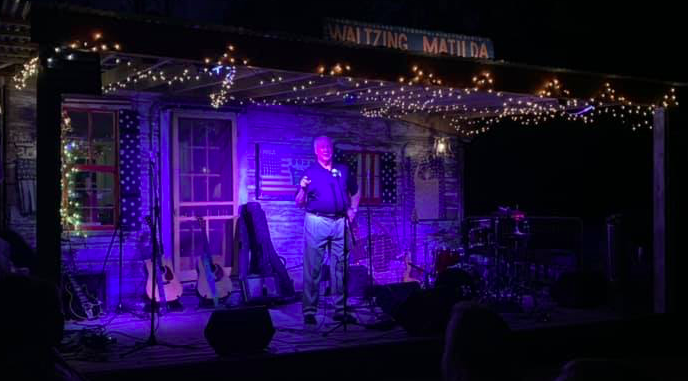
In my community advocacy, I aligned myself with a number of likeminded citizens (like current Council Members Paul Moore and Laura Bentley) who took similarly parsimonious stances on variances.  Following is a video of Laura advocating (as a citizen) against the granting of variances to a developer of a property on Providence Road, who was seeking variances (13 in all) for 80% of his unbuilt lots. Laura states correctly that “council’s granting of variances undermines our AG-1 standards” . . . and that is why I opposed every one of the 28 unjustified variances/zoning modifications (and the use permit for a music venue) that have been granted at Birmingham Crossroads.

Laura Bentley Comments Against Variances at June 20, 2016 City Council Meeting

To understand variances it is necessary to step back and to understand the lawful (and also unlawful) avenues for developing land in Milton.  There are 3 lawful ways to develop land in Milton (all of which might or might not involve variances):

  1. By-Right Development means a developer agrees to develop a property in accordance with state and local zoning conditions and standards.  The use for which he/she intends to develop the property is permitted by zoning, without having to meet any additional conditions beyond what underlying zoning requires. Such development usually requires only a land-disturbance permit (and some subsequent inspections to verify compliance), which provides notification to the city that a developer is going to disturb a property for development purposes and that he/she understands the standards (e.g., installation of soil fences) he/she must follow.  In some cases, a review by the Design Review Board or Planning Commission might be required.  These bodies will ask questions, might make suggestions, and might even identify a need for variances.  Some by-right development is defined locally; however, some by-right development (e.g., farm-wineries) is defined by the state, thereby putting limits on municipal government’s jurisdiction.
  2. Use Permits (sometimes also called Special Use Permits or Conditional Use Permits).  Localities designate certain uses as permissible (not to mean permitted) subject to meeting certain conditions for that use specified by law.  These conditions are in addition to the baseline conditions/restrictions required by underlying zoning.  Use permits come before City Council for discussion and approval/disapproval.  Council can levy additional conditions beyond those required by the use permit and underlying zoning.  Alternatively, Council can outright deny a use permit, even if all use permit/zoning conditions (or additional conditions recommended by staff, the Planning Commission, etc.) are accepted by the developer.  This is important and bears repeating . . . Council can deny a use permit that meets all the conditions specified in municipal code for a specified use.
  3. Rezoning.  In situations where a developer desires to put a property to a use that is not by right and for which no use permit exists, a third (usually more onerous) option is available:  rezoning, whereby the developer applies to have a property re-classified to a zoning designation that does allow the intended use either by right or through a use permit.  Often, such rezoning involves reclassifying a property from lower density zoning to higher density zoning or from residential zoning to commercial zoning (or occasionally, vice versa) . . . so that the developer can capture greater profits, often to the detriment of nearby property owners and the broader community.

Note:   In Milton, the rezoning process can be circumvented through the Comprehensive Land Use planning process (by changing the land use designation), with little/no transparency and public input, so that developers (later) can much more easily rezone a property.  This bypass of the law has resulted in several instances of rezoning to higher density, involving sewer extension.  This blatantly dishonest and unfair mechanism is known to council members, but thus far they have refused to fix the issue.  (I will devote an entire blog post to this issue).

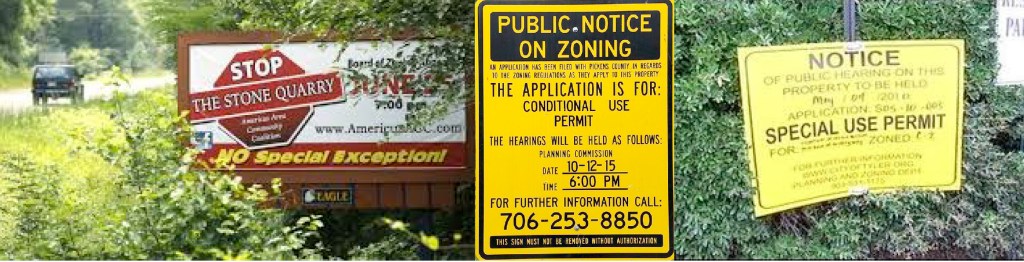
Are there any other ways to (lawfully) develop a property?  The answer is NO, other than successfully lobbying the City to change its zoning ordinances to modify zoning restrictions or to add additional special use permits.  This is a key point, because in Milton, we have seen properties approved for uses for which no special use permit exists . . . this is known as spot zoning and is patently unlawful.  (Example:  approval of the music venue at Birmingham Crossroads.)

So how do variances apply to these 3 methods for developing property?  And how are variances being used to circumvent the rule of law (as reflected in our zoning laws)?  Well, that is a topic for the next blog post.  Stay tuned . . . the business of granting variances is a particularly sordid affair in Milton that involves favors for friends and establishment of dangerous legal precedents that will eventually come back to haunt Milton (in the form of unsightly future development).

Advocating For Granting Variances According to the Law and Historical Practice,

Tim

Uncategorized

What is Milton’s Biggest Industry? . . . and The Threat to Citizens’ Basic Right to Reasonable Enjoyment of Their Property

(Photo taken of development across from Cambridge High School.  This property was rezoned to provide 3X the density that would have been allowed under AG-1 zoning.  Sewer was extended to the property.)

Does the above question seem strange?  Afterall, Milton is mostly a residential community, with some retail businesses and office parks primarily arrayed along the southern edges of the city.  Milton doesn’t really have industries, does it?  In fact, Milton does have an industry that dominates Milton’s economy, employing many hundreds of workers and dwarfing all other commercial/industrial sectors.  And you see evidence of this industry every day on Milton’s (crumbling) roads . . . the ready-mix trucks, the dirt-moving equipment, the tractor-trailers carrying building materials, etc.  Yes, Milton’s biggest industry is Development.  And Development is an industry that not only dominates our city’s landscape, it infiltrates every aspect of Milton’s community, including our government and politics.  In fact, you cannot truly understand Milton government or politics unless you understand development.  Why?  Because development is where the money is.  And there is a lot of money because there is still a lot of undeveloped land.  Milton’s remaining development potential ranges from $1B to $2B.  Accordingly, it should come as no surprise that Development dominates Milton’s government and politics.  And unfortunately, Development often also distorts Milton’s governance and politics . . . as money so often does, whether in DC or in the City of Milton.  City Council spends well over 50% of its time on land use issues.  And Development, with its many associated problems, dominates political debate in Milton.

Of course, developers are naturally keen to maximize their profits.  And this often means developers lobby the government for special favors—e.g., rezonings, use permits, zoning modifications, and variances . . . a veritable cornucopia of variances.  (Variances are the granting of exceptions to Milton’s zoning laws and, in accordance with long-established zoning practice and Milton law, are supposed to be granted only for minor discrepancies that involve proven hardship.Through campaign contributions and business/personal relationships, developers grease the gears of our city government to their benefit.  And some developers have even recruited and successfully fielded candidates.  Many of Milton’s founders were employed in the development industry (and this is reflected in our land use laws. More about this in another post.) And quite a few players in Milton’s development/construction industry have been elected to council.  In fact, Milton’s original council included three council members with deep business interests in the development industry. I often refer to Milton’s election of these council members as Milton’s Original Sin.  And to be blunt, citizens are just plain naïve if they believe that all of this money sloshing around and the presence on Council of development industry business-people (who build in Milton and invest in property in Milton) does not translate to favors for developers and degradation of our community.  (In subsequent blog posts, I will document many examples of these favors to developers and other Special Interests.)

The goal of Milton’s big developers is usually higher density, which translates to higher profits.  Unfortunately, Milton’s citizens pay the cost of this higher density in the form of traffic congestion, overcrowded schools, and lower home values. 

Often, the community has fought back against developers and sometimes won.  (I am proud to have provided leadership in some of these battles.)  However, the playing field is decidedly not level.  Developers have huge advantages:  money, expertise, and attorneys.  Council should act as a counterweight to the heavy interests of developers, but often the opposite is true, with Council often siding with developers against citizens.  You need only watch a City Council meeting to understand the sympathetic treatment afforded developers at City Hall.  Developers (and their lawyers) are allowed to speak freely at Council and interject at will.  The same behavior from a citizen results first in a warning from the Milton police followed by expulsion if the warning is not heeded.  On the other hand, developers and their attorneys are afforded wide latitude by the City, especially at Council.  In the Matilda’s hearing, the developer-applicant was even allowed to object to a motion after the motion had been made, whereupon the motion was withdrawn, amended, and passed to the satisfaction of the developer, without a peep of dissent from a single Council member.  Citizens have also witnessed City Community Development staff unabashedly rejoicing with developers that prevailed before Council . . . only in Milton.  And not only do developers get a sympathetic ear from staff and from Council, the zoning process itself is also heavily biased in favor of developers . . . bias so obvious to citizens that 1900+ Miltonites signed a petition demanding reform of the zoning process.  These same citizens voted in 2017 for candidates that promised zoning reform . . . it was promised that power would be shifted back to citizens.  However, nothing has been done and the zoning process is virtually unchanged since I got involved in government in 2015.  Obvious reforms, such as giving citizens same opportunity to speak as developers, have not been effected.  In fact, things have gotten worse since the 2017 elections.  In just the past four years, in four separate hearings before City Council, 28 variances/zoning modifications were granted at Birmingham Crossroads alone. That’s right . . . 28 variances . . . plus permission to operate a concert venue . . . a use not included on Milton’s long list of permitted uses in our zoning code.

In closing, let me be clear that I do not oppose developers or development in Milton.  I have several friends who are developers; they are good, honest, and hard-working professionals.  I fully support by-right development and even the granting of variances for minor discrepancies where hardship can be clearly proven.  However, what I do oppose is our city government egregiously bending and breaking our zoning laws for Special Interests.  I do oppose the profuse granting of variances that violate our variance ordinances and long-established variance practices.  I do oppose use permits being bastardized with copious variances to “permit” uses that are not enumerated on Milton’s long list of permitted uses.  I do oppose the corrosive and corruptive effects of developer money on good governance in Milton.

I am not advocating radical policies, but rather I am merely advocating that Milton uphold the rule of law . . . this is a matter about which we should all agree.  It is pretty simple really: Citizens have an indisputable and basic (and legal) right to reasonable certainty about appropriate uses (as codified in law) of nearby properties that might affect citizens’ enjoyment/use of their property.

Advocating for Citizens’ Property Rights and Against Favors for Special Interests,

Tim

Today’s blog post is meant to provide an introduction to development in Milton and its importance in Milton’s government and politics.  The next blog post will discuss variances, quoting directly from the American Public Planning Association, the trade organization for zoning professionals in the US.

Uncategorized

9/11 Reminds Us that Good Governance is the Best Way to Honor the Victims

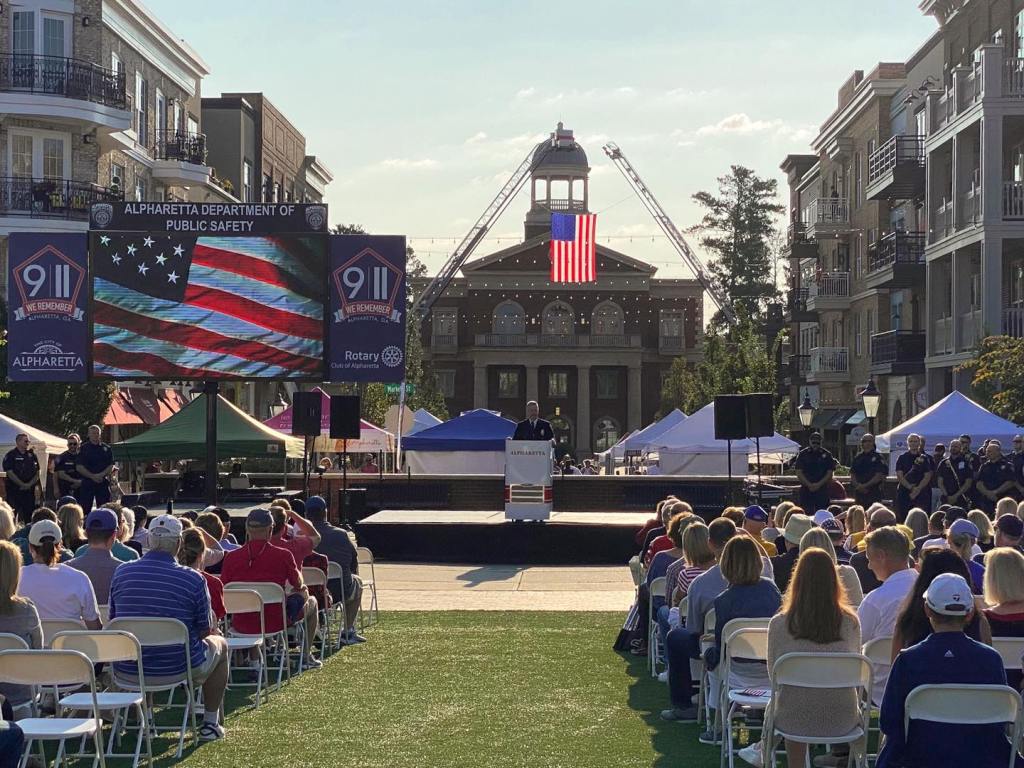
Source: Alpharetta’s 9/11 20th Anniversary Poster

This morning I attended the 9/11 remembrance ceremonies in Alpharetta.  And I have to say that they do things right in Alpharetta; they are not just going through the motions.  The ceremony was incredible . . . not only well-produced, but the messaging was apposite and inspiring.  Attendees definitely left moved and appreciative of those national elements that distinguish our great country and have made the USA a shining beacon of liberty.  And of course, these uniquely American elements should infuse our governance from top to bottom . . . in Washington as well as in Milton (and Alpharetta).

The 20th anniversary of 9/11 provides an opportunity to reflect on those things American that we most value and must protect to survive and thrive.  In my humble opinion, America’s success as a nation has been largely driven by a dedication to principles and processes of good government (in contrast to blood-and-soil tribalism that still holds sway in much of the rest of the world).  The principles of government (with an emphasis on liberty) are set forth in the Declaration of Independence and the processes of government (i.e., its architecture) are set forth in the Constitution, with subsequent amendments (there are now 27) sometimes addressing principles, sometimes addressing processes.  Citizens are best served when our politics and governance, including at the local level, closely coincide with our cherished principles and processes (as ensconced in our laws).  In our increasingly divided nation and local community, I strongly believe that a renewed emphasis on proven good government principles and processes—concepts about which there should be little disagreementis the path to a more perfect union.  And such an emphasis is also a fitting way to honor those who tragically lost their lives on 9/11.

Remembering Those Who Lost Their Lives on 9/11,

Tim

Postscript:  Tomorrow I will post the second part of my blog post on the gating of Crooked Creek.

Source: Alpharetta Public Safety Facebook Page

Uncategorized

City Council Candidates Have a Lot of Studying To Do . . . Start with the CSO

Come January 2022, the City of Milton will have 3 new council members.  Only the District 1 race is competitive, with 3 candidates vying for the honor and privilege of representing the fine citizens of Milton.  Two candidates (for districts 2 and 3) are running unopposed. 

Candidates would be well-advised to study some of the zoning battles that have been fought in Milton over the past 5+ years.  I would recommend candidates begin their preparation with the battle over the “Conservation” Subdivision Ordinance (CSO).  This was a long and sordid affair consisting of 3 acts.  Failing to pass an ordinance, CSO proponents sought to achieve their goals through rezoning (of a property on Ebenezer Road) . . . the first of many successful rezonings, they hoped.  And they did prevail in the initial Ebenezer Road rezoning hearing before City Council.  However, the rezoning was vetoed (on procedural grounds) and the rezoning approval was reversed in a subsequent City Council hearing.  This June 20, 2016 hearing brought out so many “conservation” subdivision opponents that a second room, with a video monitor, was established to hold the overflow.  Ninety-nine citizens completed speaker cards and 1800+ citizens signed the Milton Coalition petition against the CSO.  Not to be deterred by overwhelming citizen opposition, CSO proponents pursued a rearguard action to implement the CSO by promoting community septic for residential development—i.e., private sewer systems run by HOA!  (Talk about your bad ideas . . . HOAs running sewer systems . . . what could go wrong?!?)  However, CSO proponents also failed in this endeavor, finally retreating to the shadows.  However, sensing an opportunity to resurrect “conservation” subdivisions, I suspect the CSO proponents will target Milton’s new council members, preying on their lack of historical context.  With this in mind, I have reactivated my anti-CSO blog, which was active from November 2015 to May 2016.  I have re-published (with some minor edits) a subset of the blog posts so that candidates (and citizens) can educate themselves on “conservation” subdivisions.  Several hundred hours of research and analysis went into this body of work.

Anti-CSO Blog

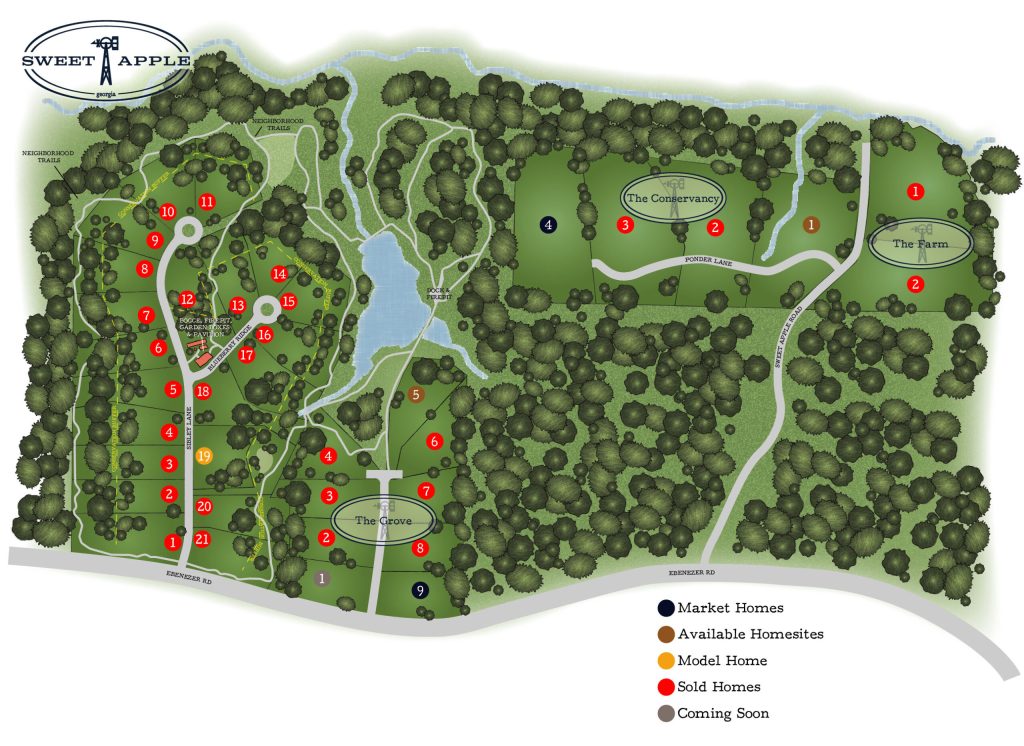
In closing, I must note that citizen opposition to the CSO in 2015-16 was based on theoretical arguments and anecdotal evidence from CSOs elsewhere in metro Atlanta.  However, because the CSO and subsequent Ebenezer Road rezonings were both denied and the property (now called Sweet Apple) is still being developed, we now have empirical evidence that “conservation” subdivisions would have increased density in Milton.  At various times, under AG-1 zoning rules, the Sweet Apple developer claimed the property could support (or under rezoning, he was approved for) 45, 48, 50, and 55 homes (although we definitively proved that percolation tests for individual septic systems would not support this number of homes).  Well, it turns out that the site plan (under AG-1 zoning) for Sweet Apple shows only 34 home sites, compelling evidence that the proposed Sweet Apple “conservation” subdivision would have entailed a 32% to 62% increase in density (vs. AG-1 zoning density).  Imagine such a density increase metastasizing across Milton through similar rezonings and the deleterious effects (e.g., increased traffic congestion).

(Note: The 2 lots at The Farm were not included in the original Sweet Apple property and hence are not included in the analysis of the rezoning homesites compared with AG-1 homesites.)

In addition to the CSO and (two) Ebenezer rezonings, candidates need to study other zoning battles (some were lost), such as the music venue approved (using 12 variances to bastardize a festival use permit) for the NW corner of Birmingham Crossroads; the abandonment of roads in Crooked Creek; the recent Painted Horse fiasco (Milton’s version of a Star Chamber); and, the special use permit and 15 (yes . . . 15 . . . a record in Milton) variances approved for Ashford Gardeners.

This is all to say to Milton’s City Council candidates:  Beware of the tired, retreaded agendas being schlepped by Special Interests and their agents in Milton.

(Still) Advocating Against the CSO and For Smart Land Use,

Tim

Uncategorized

Bentley Withdraws. District 1 Three-Way Race Provides Remaining Opportunity for Debate About Milton’s Future.

On Monday, Council Member Laura Bentley withdrew from the District 2 City Council Election, citing serious health issues with a family member.  I wish Laura and her family all the best as they deal with a difficult family situation.

With Laura’s departure from the District 2 race, that leaves the District 1 Council seat as the only contested election in Milton.  And it is the District 1 race where the debate over Milton’s future will occur.  (I have looked over the candidate websites and Facebook pages and will provide some preliminary observations in future posts.)  However, it would be beneficial to citizens if candidates in uncontested races continued to “campaign.”  Particularly for those members new to Council, Jan Jacobus and Juliette Johnson, it is important that citizens get to know them and understand their stances.  A series of “Get to Know Your New City Council Members” meet-and-listen events, perhaps including soon-to-be-Mayor Jamison, would set a new and positive tone for 2022 City Council, which will be seating three new members—a turnover of Council seats never seen in Milton’s 15-year history (if memory serves).

At the blog, I will continue to provide a (chronological) account of my experience in Milton politics at the page About My Involvement in Milton Politics.  You can click on the following link to go directly to that page.  Today, I have posted another installment of my account.

About My Involvement in Milton Politics

Please contact me through the Contact page with comments, questions, or suggestions (for blog topics).

Advocating For Good Governance,

Tim

Uncategorized

Pages Added to Blog: Candidate Guide; About Author; My Story

Today’s blog post is brief. I have added 3 pages to my blog. You will have to go to the blog to view these pages. They are included in the dropdown menu. Links to each page are provided below.

First, for your convenience, I have provided a consolidation of all the candidate websites and Facebook pages that are currently available.

2021 City Council Elections: Candidate Websites and Facebook Pages

Second, I have provided a brief biography about me so that readers better understand why I care about City government and my experience/expertise in good governance.

About the Author

Third, I have provided a page that provides my story about my involvement in Milton politics. This is an on-going project. I have provided an initial posting on my initial introduction to City politics. I will add to this story over time, so please return for subsequent chapters.

About My Involvement in Milton Politics: A History

Advocating For Good Governance,

Tim

Uncategorized

2021 City of Milton Elections (Part 2): Summary of Races . . . District 2 Offers Stark Choice For Voters

Today I am publishing Part 2 of my post on the 2021 City Council elections.  I will briefly discuss each of the 4 seats up for election in 2021, beginning with the uncompetitive races.

Mayor.  Council Member Peyton Jamison is running un-opposed and is succeeding Mayor Joe Lockwood, who has served as Mayor since the City’s founding in 2006.  I know Peyton quite well, as we worked closely together on Laura Bentley’s 8-member campaign team in 2017.  (Peyton and I actually organized the campaign team, which always met at my home, but that is a story for another blog post.)  In 2017, I exposed the clandestine redrawing of the boundaries for District 1 (see below link to The Milton Herald’s Black Box article).  In the wake of this scandal, the incumbent Council Member opted not to run for re-election, and Peyton ran unopposed for his current council seat.

https://www.appenmedia.com/black_box/group-questions-motives-behind-milton-redistricting/article_bebdb9ce-4f0d-5cfb-b451-ed0558fb3e0b.html

I have spoken frequently with Peyton since his election.  We don’t always agree, but I appreciate Peyton’s willingness to listen to all citizens and to consider all sides of an issue.  Peyton has a lot of energy and has matured during his 4 years in office.  However, to be successful as mayor, Peyton must be his own man—i.e., step out of Lockwood’s shadow.  He also must surround himself with smart people who offer him differing perspectives on Milton’s pressing issues.  He must stay above the fray and focus on process and principles, separating himself from the personality politics being pursued by Council Members Moore and Bentley—the sort of middle school nonsense that has plagued the city since its founding (and once necessitated the hiring of an industrial psychologist to address Council’s dysfunction).  Peyton must also demonstrate more courage (than in the past) in the face of threats to the community.  And lastly, Peyton must adopt a much stronger approach to ensuring accountability of the City’s non-elected leadership; the City is currently experiencing a serious Crisis of Competence.

District 3 covers the Highway 9 and Windward Parkway areas of Milton (and includes the expansive Crooked Creek subdivision). District 3 is Milton’s most dense district.  Jan Jacobus is the only candidate to qualify in District 3.  Mr. Jacobus has served on the Planning Commission for several years, so has some familiarity with City government, particularly land-use issues.  I do not know Mr. Jacobus, but have heard good things about him.  Even though running unopposed, I hope Mr. Jacobus nevertheless creates a web page that lays out his positions on issues of concern to citizens.  I hope his stances emphasize the critical importance of adhering to the highest principles of good governance.

District 1 encompasses Crabapple and the surrounding areas.  Three candidates are running for the District 1 seat.  Relatively speaking, all three candidates are political newbies.  The candidates are Adam D’Anella, Jami Tucker, and Andrea Verhoff.  At a later date, I will post links to their campaign websites.  My advice to these candidates is to focus on elements of good governance:  integrity/honesty, fairness, accountability, rigor, and transparency.  Good governance is prerequisite to good policy-making, but has not been a focus for the City of Milton, with predictably bad results.

District 2 encompasses the more rural, (much) less dense and mostly AG1 areas of Milton.  Insurgent candidate Juliette Johnson is taking on Old Guard candidate Laura Bentley.  Ms. Johnson is one of the owners of The Painted Horse.  Ms. Johnson has been accused of “running for the wrong reason”—i.e., revenge for the levying of (overly severe) restrictions on The Painted Horse.  However, such accusations are ridiculous . . . and self-serving, I might add.  Ms. Johnson and Ms. Jackson (the other co-owner of The Painted Horse) have experienced first-hand the dysfunction at City Hall and have been the victims of Milton’s version of a Star Chamber where they’ve had no opportunity to hear–moreover defend themselves from–“charges” leveled against them.  It is certainly a right (and excellent) reason to run (for Council) to expose and eliminate the governmental excesses and abuses that Ms. Johnson has directly experienced.  Furthermore, Integrity is an appropriate plank in Ms. Johnson’s campaign platform, given the low road being travelled by some politicians in Milton.  However, to win, Ms. Johnson must make her campaign about more than the Painted Horse, although her experience with Council overreach is certainly an issue she can (and should) lead with.  However, the past 4 years of city government are rich with failures, unsolved problems, broken campaign promises, abuses of power, etc. that Ms. Johnson can tap into.

In contrast to Ms. Johnson, Ms. Bentley represents the Old Guard in Milton.  In 2017, like Ms. Johnson (in 2021), Ms. Bentley ran as an insurgent (that I believed she was), but the reality is that Ms. Bentley (along Council Member Paul Moore) is an old hand at Milton politics—her involvement stretching back to the first city elections when she was a foot soldier for one of the two factions battling it out in Milton.  And unfortunately once in office, Ms. Bentley almost immediately put on her old faction’s jersey.  Laura reverted to the tired politics (e.g., favors for friends) of days past when Milton’s two factions spent much more time battling each other than focusing on pressing City problems.  Citizens need to carefully consider whether the time has come to reject the unproductive factionalism of yesteryear and to chart a new course for the City—a Milton united by principles of good governance.

The focus of the blog will be on the District 2 race, as that election really provides the best basis for discussing and understanding current city politics and governance.

Advocating For Truth in Politics and Governance,

Tim

Uncategorized

2021 Elections: Two Competitive Races and Opportunity to Send Message to Council

The focus of today’s post is the 2021 City Council elections.  I will start with some of the basics as there are quite few new subscribers to the blog.  There will be 2 parts to this post, with the second part published tomorrow.

On August 19th, qualifying for upcoming City Council elections ended.  The qualification period lasted 3 days.  Qualification is when candidates officially declare their candidacy, filing the necessary paperwork at City Hall and paying fees to the City Clerk.  The City ascertains that filing candidates are residents of Milton and running in the correct district.  Qualifying ensures that candidates’ names appear on the November ballot. 

Milton’s elected government consists of a mayor plus a city council, comprised of 6 members–two from each of Milton’s three districts.  The Mayor sits on Council and has a vote; he/she also retains some special powers and serves as a kind of “head of state” for ceremonial functions (ribbon-cuttings, etc.).  In Milton, in 2021, voters will elect the Mayor and 3 Council members–one from each of Milton’s three districts.  (Elections are staggered every 2 years, so the remaining three Council members will be elected in 2023.)  The Mayor and Council Members serve four-year terms.  Voting is at-large, meaning that all Milton citizens vote for all council members, regardless of the candidate’s or the voter’s district.  So in 2021, all voters will vote for the Mayor and for three Council members.

Two of the four 2021 races will be competitive.  That is both good news and bad news.  The good news is that two races are competitive.  Milton needs competitive races to keep politicians honest and to foster debates about important city issues.  And one of the races features an upstart against an incumbent.  This race is especially encouraging as it gives citizens an opportunity to send a message to our city government about citizens’ satisfaction with the status quo and with the City government’s accomplishments (or lack thereof) over the past 4 years.  (I will have much more to say about this topic as I strongly believe things are not well in Milton and governance has sadly regressed over the past 4 years.) 

The bad news is that only 2 races are competitive.  It is troubling that more citizens do not enter the political arena; Milton desperately needs smart, honest, and caring elected representatives.  However, citizens’ reluctance to run is understandable given the often dysfunctional (and sometimes toxic) political environment in Milton (the Matilda’s and Painted Horse fiascos are Exhibits A and B of the dysfunction at City Hall.)  Many eminently qualified citizens do not run out of fear, disgust, or both.  In 2013 and 2015, things were so bad that there were actually no competitive elections in Milton.  However, through the hard work of a small group of citizens that I was proud to be a part of (and sometimes lead), citizens rebelled and ejected several City Council members in 2017 and 2019. 

Milton actually has a good track record when it comes to “throwing the bums out.”  Many incumbents have been voted out of office (or sometimes saw the writing on the wall and declined to run).  It is helpful that Milton’s elections occur in odd-numbered years, when there are (usually) no state or federal candidates on the ballot.  This means that only the most committed and informed voters show up at the polls . . . folks like you who are willing to invest to understand the election landscape and are much less likely to be persuaded by appeals based on incumbency and “experience.”

In tomorrow’s post, I will provide my observations on the four City Council seats up for election.

Advocating For Miltonites,

Tim

Uncategorized

Citizen Education and Engagement Are Key to Good Governance

A few days ago, I sent an email to my email distribution list.  Thousands of Milton’s citizens received my email announcing that I had re-launched the Milton Coalition blog in advance of the 2021 City Council elections.  I was encouraged by the response.  My email program and my blog both provide aggregated statistics on citizen responses.  My dashboard shows that 44.1% of citizens opened my email and that 21.6% of these readers clicked through to the Milton Coalition Blog.  This compares with an average open rate of 19.34% and clickthrough rate of 12.66% for political emails.  Also, my dashboard indicates that, on average, each person opening the email forwarded the email to one other person, thereby doubling the email’s distribution.  Thank you.  My blog dashboard shows that the blog has been viewed over 450 times (over 10% coming from citizens’ posts on social media) in the past 48 hoursAround two dozen citizens became new subscribers.  Welcome.  I am humbled by your trust and confidence as indicated by these statistics.  And I am (once again) encouraged by the engagement of so many Miltonites in local good governance.  It is my firm belief that excellent local governance correlates closely with citizen engagement and that education is a necessary prerequisite to such engagement.

Screenshot From Milton Coalition Email Dashboard

When I first engaged in city government in late 2015, it was obvious to me that there was a need for well-reasoned, well-researched perspectives on City government.  The Milton Herald provided some coverage, but it lacked depth and analysis.  And the paper’s editor also seemed to be biased toward one of the two factions battling it out in Milton.  There were also communications from the City, but most were the equivalent of cotton candy—a lot of air and very little nutritional value.  And finally there were several partisan Facebook pages, where the back-and-forth dialogue resembled the verbal equivalent of a food fight.  A lot of nastiness, but little insight.  Does anyone really change their minds based on these Facebook battles? In view of this dearth of accurate and actionable information, I launched the Milton Coalition Blog and slowly built up readership.  It has been a labor of love for me.  Since the blog’s inception, I have published over 275 blog posts.  At times (the run-up to the 2017 election or key City Council meetings), the blog has attracted many hundreds of readers daily.

My hope is that the blog will once again provide citizens with a source of useful information and insights in the run-up to the City Council Elections.  Please feel free to reach out to me with comments and questions.  Please let me know if you find any factual errors, but realize that my opinions are my opinions (supported by facts).  Please feel free to challenge me . . . I welcome an honest, respectful debate.

Advocating for Citizen Engagement,

Tim

Uncategorized

Council Member Bentley: Yet Another Promise Broken

(Last updated August 25, 2023)

(Trigger Warning:  I realize that some readers may find my blog harsh, although I prefer the descriptor “hard-hitting.”  However, I urge you to invest the time to read and understand my perspective.  I invested the better part of 2+ years of my life for the cause of good governance in Milton.  I partnered with Laura Bentley to achieve good governance in Milton; I know Laura (politically) better than probably anyone in Milton.  I have paid a very high price for my involvement in local politics, including spending over $10,000 on an attorney.  And I certainly deeply regret my support for certain politicians.  However, if you are in the I’ve-made-up-my-mind-so-don’t-confuse-me-with-the-facts camp, feel free to unsubscribe from my blog.  Conversely, if you care about Milton and can handle the truth, I believe you will find my future blog posts enlightening.

Upon being elected to City Council, Laura Bentley stated to me and others:  “I intend to serve only one term.  Beginning day one, I am going to find a successor.”

Yesterday, the City of Milton posted the names of candidates who qualified for the Mayorship and for City Council seats.  (Two City Council seats will be competitive.  That is good; the community benefits from competitive local races.)  Surprise of surprises (tongue in cheek), Council Member Bentley paid her fees and qualified for re-election.  Laura’s reversal on re-election was predictable, following in the wake of so many other broken promises. 

Very early in her term, Ms. Bentley demonstrated a singular lack of integrity in the conduct of her office.  And I suppose at some point when engaging in deception, you cross a sort of Rubicon, where political dishonesty just becomes routine.  (See below passage from Dante’s Purgatorio.)  Frankly, I do not think Laura gave a second thought to breaking her promise to serve only one term.  As Laura’s longest and strongest supporter, I was shocked by Laura’s behavior during her first few months in office.  Many of her strongest supporters were similarly shocked.  The foundation of my and supporters’ political bond (and friendship) with Laura was our dedication to shared political principlesstrict adherence to zoning laws and practices (and more generally to the rule of law); improved transparency; shifting power to citizens (through structural changes to city government); enhanced accountability; improved government competence; reform of the zoning process; the end of cronyism; honesty; fairness; a level playing field for citizens (vs. developers); strong deference to residents most impacted by Council decisions;  and the highest ethical standards for conduct of our government.  Within a few short months after taking her oath of office, Laura had abandoned most/all of these principles; the Matilda’s debacle is Milton’s poster child for poor governance (as I will explain in future posts).  Sadly, our City has gone backwards over the last 4 years.  Many of Laura’s strongest supporters have disengaged in disgust . . . another victory for cynicism about politics and politicians.  I myself eventually went into quasi political exile, no longer actively engaged but still watching the terrible dysfunction at City Hall.  However, with election season upon us, I feel compelled to re-engage.  Voters need to understand the problems at Council and with City staff and the resulting ill effects on Milton’s quality of life.

I believe integrity (and more generally political ethics) will be a key issue in the upcoming District 2 election.  For me personally, professional integrity is a litmus test for politicians.  No integrity, no support.  Applying this standard, I will not be supporting Ms. Bentley for a second term.  

For those of you with a more literary bent, I end this blog post with a favorite passage from Dante’s Purgatorio:

He sank so low that all means

for his salvation were gone,

except showing him the lost people.

For this I visited the region of the dead . . .

Advocating For Integrity in Politics,

Tim