Fourteen months have passed since the Ebenezer rezoning was rejected by City Council on June 20, 2016. The vote was a watershed moment in Milton’s history. You might recall that so many re-zoning opponents showed up that a holding tank was created for the overflow—the first time in our City’s history. Ninety-nine opponents of the rezoning completed speaker cards—another record. In less than 4 weeks, an on-line petition espousing 9 principles of smart land use and good governance amazingly garnered nearly 1800 signatures and over 600 impassioned comments. The residents of Ebenezer Road unequivocally demonstrated nearly universal local opposition to the re-zoning. Citizens clearly expressed their opposition to reckless development and its ill-effects, and prevailed in the battle over the Ebenezer re-zoning.
Many of you know the story of the Ebenezer rezoning’s defeat; you were part of it. Thank you. However, there is a comforting epilogue to the Ebenezer rezoning that is mostly unknown to citizens. Specifically, the story since the rezoning validates the arguments made against the Ebenezer rezoning and, more generally, the arguments made against so-called “conservation” subdivisions.
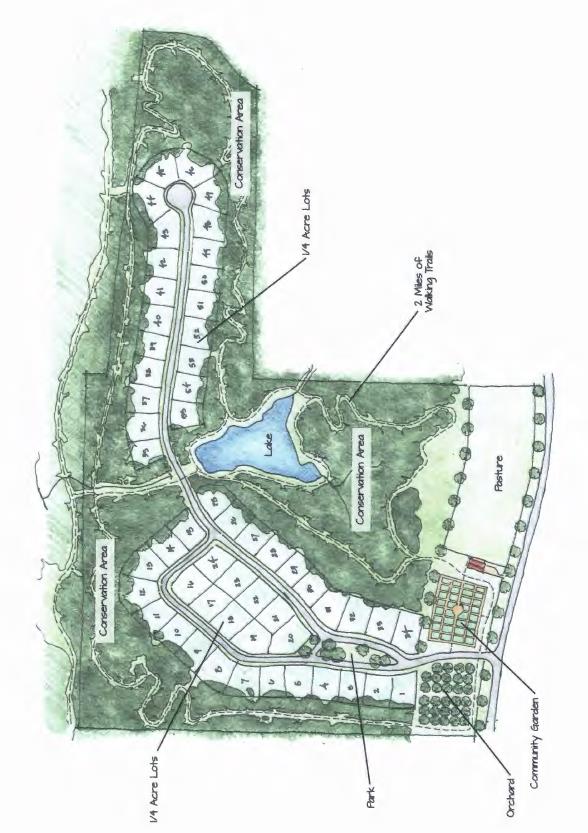
You might recall that rezoning proponents asserted that, with or without the rezoning, the same number of homes (55 in the original proposal and 48 in the final proposal) would be built on the 65-acre Ebenezer property. Well, that has turned out to be dramatically wrong. It is doubtful whether even 30 homes will eventually be built on the 65 acres. Brightwater Homes is currently developing a portion of the 65 acres It purchased the most attractive 38 acres and is building 21 homes on 1+acre lots. The remaining 27 acres of land are considerably less attractive for development, so likely will support just a few additional homes. So instead of the 55 homes in the original Brightwater Homes proposal, the Ebenezer Road property will likely support no more than 30 homes on the 65 acres. Much of the remaining un-built 27 acres could stay undeveloped (i.e., conserved) for many years to come. Delayed development is conservation! Following is Brightwater Homes’ original proposed “conservation” subdivision. Much of the “conserved” land is unbuildable or uneconomic to build; it also includes “non-green” elements, such as the community septic system. In retrospect it is clear that, with the denial of both the CSO and the Ebenezer rezoning, our community dodged a bullet.
So have “conservation” subdivision proponents admitted they were wrong? Believe or not, they have not. In fact, Mr. Kunz and others have doubled down on the notion of “conservation” subdivisions.Just last Monday night, Mr. Kunz again promoted conservation subdivisions in a Council working session, continuing to assert that the community is “divided” about “conservation” subdivisions. Of course, our post from 2 days ago showed where Mr. Kunz’s true allegiances lie . . . with developers, not citizens . . . and developers desperately want “conservation” subdivisions.
Certain politicians in Milton are lightning rods for controversy. Yesterday, we exposed one of those politicians, Council Member Matt Kunz, who has positioned himself as an unapologetic champion for developers in Milton. Such advocacy is bound to elicit the ire of ordinary citizens.
On the other hand, certain elected officials largely escape controversy. Burt Hewitt is one of those politicians. Mr. Hewitt’s life is pretty simple. Why? Because Mr. Hewitt purposely stays out of the spotlight. He is deferential to citizens, even a small minority that largely (and often noisily) disagrees with him. And he is not constantly skulking around in the shadows, promoting the agenda of Milton’s Special Interests. Most importantly, you know where Mr. Hewitt stands . . . and that is squarely on the side of citizens. Based on my observations, he applies a simple set of principles to his voting:
Hewitt will never vote for any ordinance, rezoning, etc. that will (or even might) increase density. Accordingly, he is against those things that enable higher density, such as community septic, sewer extension, and complex re-zonings.
Hewitt likes to keep things simple and clear. He understands that complexity and ambiguity provide opportunities for manipulation, particularly by Special Interests.
Hewitt does not like delay. He does not like “kicking the can down the road.” He understands that dithering (like complexity) also provides opportunities for manipulation.
Applying these three principles, you can predict with 90% accuracy how Mr. Hewitt will vote on a particular matter before Council. That is a good thing . . . we need to know what principles guide our Council Members and be assured they will consistently hew to these principles. But more importantly, we need to know that Council Members are advocating for the prerogatives of citizens, not Special Interests. Burt Hewitt is proof that life can be pretty darn simple for an elected official . . . that sides with citizens.
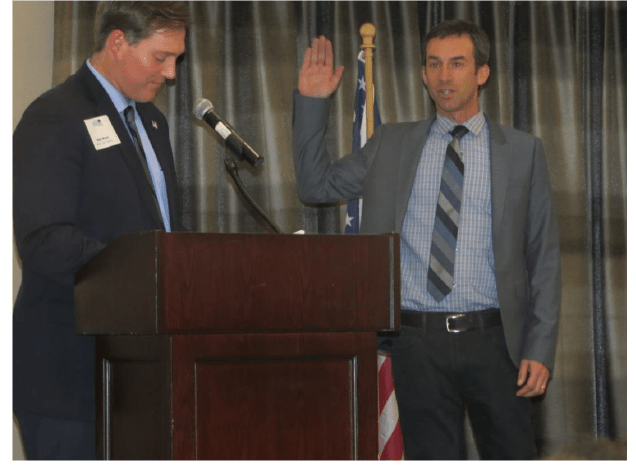
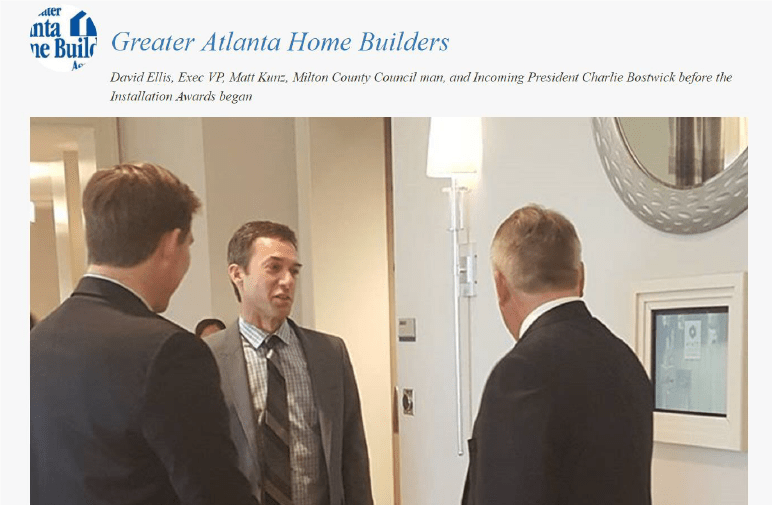
The old cliche is that a picture paints a 1000 words. The photos below were sent to us by a citizen. They clearly show where Council Member Kunz’s loyalties lie. It is crystal clear that Mr. Kunz has unabashedly joined forces with developers. Mr. Kunz has long been a shameless advocate for developers in Milton, helping them bend, break, and change the rules for their benefit. Citizens, if the photos below cause you concern, then please consider becoming engaged in local government. Write to City Council. Come to a City Council meeting and express your dissatisfaction with the influence of Special Interests. We need to take back our city government from the developers and other Special Interests that exert far too much influence over our City Council. Please get involved.
Following is an advertisement for a January 2017 event where Council Member Matt Kunz was the guest of honor/VIP. He delivered a speech and swore in members of the Board of the Greater Atlanta Home Builders Association (GAHBA), which engages in significant lobbying on behalf of developers.
Following is a photo (taken in January 2017) of Council Member Matt Kunz swearing in the Charlie Bostwick, the new president of the Greater Atlanta Home Builder’s Association. Disregarding his duty of judicial impartiality, Kunz aggressively and publicly promoted Mr. Bostwick’s proposed subdivision in the Spring/Summer of 2016. Was this speaking and swearing-in gig payback for his strong advocacy on behalf of developers?
Following is a photo of Council Member Kunz hobnobbing with executives of the Greater Atlanta Home Builders Association. At the time this photo was taken, Mr. Ellis was a long-time registered lobbyist for the GAHBA.
I wanted to alert you to an important meeting that is occurring tonight. The City of Milton is updating its Comprehensive Park Master Plan. Of course, parks–both active and passive–are a key element of a vibrant and cohesive community. Our City has made progress in updating and expanding our parks. However, much more is needed. And that is the purpose of the Master Plan: to set a future course for our parks.
This blog has strongly advocated for active (and passive) parks. And despite the recent opening of Bell Memorial Park, we still have a shortage of sports fields. I fully support the City acquiring additional land for sports fields and for active parks. (This might even include a Parks Bond.) However, I strongly believe that such parks need to be centrally located–that is closer to where most people live in Milton. Traffic is a huge and worsening problem in our City. Accordingly, parks need to be conveniently located to minimize travel distances and times and thereby ensure maximum utilization. Parks also need to match the character of the areas of the City where they are located.
It is also critical that any park plan be developed in the context of the City’s greenspace initiatives. In November 2016, 82% of voters approved a $25M Greenspace Bond to raise monies to fund greenspace initiatives. Voters spoke loudly and clearly that they want additional greenspace. The bond-funded greenspace initiatives are clearly meant to supplement the City’s current inventory of greenspace (e.g., Birmingham Park). In other words, the City’s current greenspace inventory should be viewed as a firm and inviolate baseline for future greenspace initiatives. Land in this inventory should not be re-purposed for other non-greenspace uses. Such re-purposing would be tantamount to 1) using greenspace bond monies to subsidize other City initiatives and 2) circumventing the will of voters.
Tonight’s meeting is from 6:00 – 8:00 pm at the previous City Hall, now called the Municipal Court, located at 13000 Deerfield Parkway. Please attend and speak.
Election Day is November 7, 2017. In Milton, our elected government consists of a mayor and a City Council, comprised of 6 members–two from each of Milton’s three districts. The Mayor sits on Council and has a vote. In Milton, in 2017, we will elect the Mayor and 3 Council members–one from each of Milton’s three districts. (The other three Council members will be elected in 2019.) The Mayor and Council Members serve four-year terms. Voting is at-large, meaning that all Milton citizens vote for all council members, regardless of their district. So in 2017, all voters will vote for the Mayor and three Council members.
It looks like Milton will have competitive elections in 2017. This is a positive development. Competitive elections are good for the health of our democracy in Milton. Competition requires candidates to define and defend their positions on the issues. Competitive elections clarify issues for voters and foster healthy debate on those issues. It is great news that citizens will have choices in 2017.
So far, four candidates have announced their candidacy for office in Milton. Following are links to candidate websites or newspaper announcements.
Mayor Joe Lockwood has announced he is running for a third and final term. Following is a link to his announcement in the Milton Herald.
No candidates have announced they are running for the District 3 seat currently held by Joe Longoria.
We expect that there will be other announcements of candidacies in the coming month. Qualifying is the last week of August. Qualifying is when candidates formally enter the race by submitting their papers and paying a qualifying fee. This means their names will appear on the ballot. It isn’t official until then; some announced candidates may ultimately withdraw from the race and choose not to qualify. It is shaping up to be an interesting election. Stay tuned . . .
Council Member Bill Lusk has pooh-poohed Milton’s redistricting scandal as much ado about nothing. The Milton Herald wrote about Mr. Lusk that he felt “the request was a minor change and he didn’t think it required a public discussion.” Furthermore, Mr. Lusk was the only member of Council that complied with Ms. Thurman’s request for a letter to Representative Jones supporting legislation to change the district. Mr. Lusk made minor modifications to a form letter provided to him by Ms. Thurman.
We strongly disagree that the district change was minor. As we have discussed (in more detail) in previous posts, Ms. Thurman should have vacated her seat when she moved outside her district. Changing District 1’s boundaries meant that all of Milton’s voters—every one of them (as voting is at large)—were disenfranchised. Furthermore, the one third of Milton voters that live in District 1 were denied the opportunity to run for the vacated seat. So the redistricting was actually a major change that impacted all voters. Furthermore, with this district change, Mr. Lusk’s actions revealed his propensity for non-transparency, even when changing Milton’s Charter.
Unfortunately, there is an even darker side to this story. It is a story that Mr. Lusk would prefer that citizens not know. You see, Mr. Lusk was the one person, other than Ms. Thurman, that most directly benefited from the redistricting. By moving the district lines, Mr. Lusk eliminated a potential competitor for his seat. Had the district lines not been changed, Ms. Thurman would have found herself in Mr. Lusk’s district and might have challenged him. Additionally, Mr. Lusk and Ms. Thurman have been political allies since the founding of the City, so the district change kept their alliance intact. So you see, Mr. Lusk was Ms. Thurman’s primary accomplice in clandestinely changing the district lines in Milton, so that he could eliminate a potential competitor while also keeping his voting bloc intact. Mr. Lusk aided and abetted the thwarting of democracy in Milton. Now you know the rest of the story . . .
Big Brother: Should you be careful about communicating with volunteers on Milton’s Committees?
July 25, 2017
Did you know that, in Milton, an e-mail to a government official’s private e-mail account about a matter outside that government official’s responsibilities and sent to the official in his capacity as a private citizen constitutes a government record that is then subject to open records laws? If not, then read on . . .
Consider the following scenario. You have a friend with whom you communicate by e-mail (or text). That friend serves on one of the City’s volunteer committees. You may not even know about your friend’s government service. One day, you send that friend a political e-mail about some City government issue that has nothing to do with the committee on which your friend serves. And that e-mail includes other news and information you would rather the world not know about. Did you know that email (or text) is a government record discoverable through an Open Records Request (ORR)? Well, according to Milton’s City Attorney, such communications are property of the Milton City government and can be made public subject to the redacting of certain personal information (like your personal cellphone number).
How do we know this? Because the City has already published such communications as part of a massive ORR submitted by Council Member Karen Thurman. More importantly, the City Attorney has stated that the law supports his views on privacy; we strongly disagree. This Thurman ORR encompasses e-mail and text communications of around 40 city government officials over a two-year period. This ORR targets members of five committees, who all use private e-mails for their City business. And these members may be your friends, your business colleagues, or mere acquaintances. And you might not even know they serve on a Milton City government committee. However, if you send them a communication about anything that can be construed as “city business,” your communication is a public record, including the parts that do not relate to City business whatsoever. In Milton, it has now become necessary for citizens to vet their friends, neighbors, colleagues, and acquaintances to determine whether they serve on a volunteer government committee. And perhaps, volunteers on citizen committees need to include disclaimers on their private e-mails:
“Warning! I serve on a Milton citizen volunteer committee. Any communications sent to or from me that can be construed as City of Milton business are considered public records discoverable through an Open Records Request.”
Of course, this de facto policy reeks of Big Brother. Furthermore, we believe it is patently unconstitutional–a violation of citizens’ privacy. In Griswold vs. Connecticut, the United States Supreme Court established a citizen’s right to privacy. In the wake of Griswold, a whole body of case law further defines this constitutional right to privacy. We wonder how far the City Attorney might extend its definition of “government official.” For example, if you participate in Milton’s Adopt-A-Road program, are your e-mails now subject to scrutiny by the government if they contain information that might be construed as “government business?” What nowadays is not government business?
Of course, we believe one purpose of these broad and vague ORRs is to coerce and to intimidate citizens to not exercise their First Amendment political rights: speech, assembly, and petition. Some Council Members are increasingly politically vulnerable because more and more citizens in Milton are objecting to their wrongdoing and misbehavior. Some politicians are looking for ways to silence influential citizens, who (armed with the truth about their wrongdoing and misbehavior) are organizing citizens through petitions and other means. Unfortunately, the City Attorney seems to be aiding and abetting the efforts of Council Members to abridge citizens’ political rights. The City Attorney has adopted an unjustifiably broad (and we believe, unconstitutional) definition of a public record that facilitates (and perhaps even incents) politically-motivated fishing expeditions that waste taxpayer money.
So how should the City Attorney process an ORR that seeks to gather all communications relating to “city business” from citizens serving on volunteer committees? First, the City should provide guidance to ORR recipients about how to respond to the ORR. In this situation, none was provided; ORR recipients were just forwarded the ORR without guidance. Specifically, the City Attorney should define “city business” for ORR recipients. And we believe this definition of “city business” should be narrow—that is, limited to matters before the committee on which a citizen is serving. Furthermore, communications that fit this definition should be cleansed of information not relevant to the matter before the committee.
We believe a longer-term and better solution to this issue of transparency vs. privacy would be 1) to issue City e-mail accounts to all committee members and 2) to require that City email be used for all City Business conducted by that committee. This is a simple and clean solution. All city-issued e-mail accounts would then be subject to public examination and there would be no need to request private or company e-mails. This would not only solve the privacy problem, but it would eliminate any burden on volunteers to make judgments about e-mail and to provide e-mails. The City would simply retrieve committee members’ emails from the City server.
(Note: The City does not notify a citizen who is the subject of an ORR that he/she is the subject of an ORR. The City does inform City Council Members. This needs to change. If you are the subject of an ORR, then you have a right to know that. This is an issue of good governance and just plain common courtesy.)
Update on processing of Ms. Thurman’s ginormous ORR.
Normally, a response to an ORR is required within 3 days. However, because of the breadth of Ms. Thurman’s ORR, the City had to extend the response period. Processing is likely going to cost the City a lot of money, because of the time and resources involved. Due to its sensitivity, Ms. Thurman’s ORR is being processed by the City Attorney, who contracts to the City. A staff attorney is processing Ms. Thurman’s ORR, so taxpayers will be paying lawyer, not clerk, rates. Ms. Thurman will be charged for some of the costs of the ORR. However, because of how fees are computed for processing ORRs, taxpayers will likely be subsidizing a good portion this ORR’s costs. So you will be paying for a politician’s attempts to dig up political dirt. And we are sure that these efforts, like a similar ginormous ORR submitted by Ms. Thurman in 2008, will come to nought. This ORR will be a huge waste of money for taxpayers.
We will be submitting our own ORR to determine what resources were expended on this ORR and the cost to Ms. Thurman and to taxpayers. We will keep you updated.
Lastly, citizens, please know that we will continue to report on the affairs of our City government at this website. Our focus is on policy and good governance. You have a right to know what is going on with your local government. We appreciate the trust and confidence you have placed in us. Even if we have to hire lawyers to protect our free speech rights, we will continue to advocate for clean, competent, courageous, and citizen-centric government.
First, I appreciate the tremendous outpouring of support from Milton’s citizens. Since the relaunch of the blog in late May, over 1300 of you have visited the blog and it has received nearly 3500 hits. Around 130 new people have signed our petition. Our videos have been watched nearly 700 times.
Several attempts are being made to silence Milton’s citizens, including the submission of a massive Open Records Request, but I am certain it will all come to nought. As always, my focus will be on debating policy and governance, rather than the politics of personal destruction.
Today’s blog is about the impact of the redistricting on Milton. Of course, the process violated nearly every principle of good governance: transparency, rigor, fairness, and citizen participation. But what about the act itself? Who cares that 182 citizens were moved? According to Bill Lusk, the change was minor. And Ms. Thurman claims that because voting in Milton is at-large (i.e., all Milton citizens vote for all Council Members, regardless of district), the change did not affect how a single citizen votes. However, this is backwards logic.
From my perspective, the change affected how every citizen votes. Because all Milton citizens vote for all Council Members, all Council Members represent all citizens. And as often as not, a citizen takes his concerns to a Council Member based on a referral, a friendship, agreement on an issue, or some other factor that has nothing to do with a Council Member living in a citizen’s district. And even Ms. Thurman acknowledges that the residents of The Estates at Atlanta National were, in fact, seeking her out although she was outside their district. In fact, she contends that many considered her their representative. So you see, it is not necessary to change district boundaries to represent any citizen in Milton. And City Council members represent non-district citizens all the time; that is their obligation.
So the argument that the district lines needed to be moved so that Ms. Thurman could represent the residents of The Estates at Atlanta National (EAN) is contrived. And it was manufactured to disguise the real reason: Ms. Thurman needed to change the district lines to keep her seat on Council when she moved to EAN. The result is that democracy was thwarted in Milton. Why?
First, the change should have been approved by our elected representatives on Council before it was introduced as legislation.
Second, Ms. Thurman should have relinquished her seat before she moved. This would have resulted in an election to fill her seat. However, changing the district boundaries allowed Ms. Thurman to keep her seat. In so doing, Ms. Thurman denied all Milton voters an opportunity to elect a new District 1 representative. All voters were disenfranchised. So while Ms. Thurman contends that not a single voter was affected, I contend that every voter was affected.
Third and lastly, changing the district lines denied all of the voters in District 1 the right to run for the District 1 seat.
So with the district change, democracy was thwarted in Milton. And at the time, not a single Milton voter knew about it, but now they do . . .
There is a positive outcome in all this. It is highly unlikely that a Council Member will ever again get Milton’s Charter changed without Council approval and public input. Those days are over. Good governance is on the march. Last Monday night even Ms. Thurman acknowledged (finally) that she wished she had gone about the district change differently.
Excerpt from March 22, 2015 email from Council Member Thurman to Representative Jan Jones:
We are still hoping to be able to build another house. The soil is not good on the lot so we are waiting to see if we can get another plan drawn up that will include bringing in soil that will perc.
These are probably the two most important sentences in the whole Redistricting Scandal. Why? Because these two sentences completely obliterate Ms. Thurman’s main argument that she did not intend to move when the bill (HB 570) to change the district lines was being drafted and introduced. This email was sent just 3 months after Ms. Thurman bought her lot in EAN and just 4 days after HB 570 passed in the Georgia House of Representatives. Does this sound like someone that is not intending to build herself a home on the purchased lot in EAN and move to that home? Of course not.
Consider the following:
Dec 18, 2014: Ms. Thurman buys a lot in the Estates at Atlanta National (EAN) for $115,500
Jan 11, 2015 (or earlier): By her own admission, Ms. Thurman lobbies Representative Jan Jones to change the district lines.
March 9, 2015: A bill (HB 570) is introduced in the Georgia legislature to change District 1’s lines to include EAN
March 18, 2015: HB 570 passes in the Georgia House of Representatives.
March 22, 2015: Ms. Thurman sends the above email that refers building a home for herself on the purchased lot in EAN and specifically mentions that another plan will have to be drawn up to deal with septic issues. So clearly Ms. Thurman had a previous plan drawn up for her home while HB 570 was being drafted and introduced. (And obviously Ms. Thurman had spoken previously with Ms. Jones about the building of this home.)
Early August, 2016: Thurman moves to new home on the purchased lot in EAN
It is no coincidence (as she implies) that Ms. Thurman lobbied Jan Jones to change District 1’s boundaries to include the lot where she built her new home. Plainly, Ms. Thurman intended to move to EAN, which was outside of her district. The first step in building a new home is to draw up a plan and clearly Ms. Thurman had drawn up a plan simultaneous with the introduction and passage of HB 570. This is indisputable.
Ms. Thurman continues to assert that it was coincidental that she lobbied to change her district lines within a month of purchasing a lot at EAN. On Monday night, Ms. Thurman argued no more than 5 times that she had no intent to move while HB 570 was being drafted and introduced. She recited the same arguments repeatedly. Most arguments were patently ridiculous. For example, she asserts that she did not even know if the lot was buildable when it was purchased. Who buys a lot for $115,500 assuming that it might not be buildable? Ms. Thurman’s strategy on Monday night was to bury the audience in nonsensical arguments, hoping to sow doubt and confusion in listeners. The strategy did not work. Even Council members were plainly not buying her arguments. Clearly, from the date of the purchase of her lot in EAN, Ms. Thurman set a goal of moving to EAN, established a plan for building a home, and successfully executed that plan. She never deviated from her plan.
Following is the video of Ms. Thurman’s comments about the redistricting. She is throwing everything against the wall, hoping something will stick. Nothing does.
Note: Ms. Thurman very often uses personal and company e-mail for City business. This in non-transparent and makes us skeptical that we were provided all of the emails relating to this scandal. If Ms. Thurman used her city-issued e-mail account, the City would be able to provide all of her e-mails, including her deleted emails. When company and personal e-mail are used, Council Members are on the honor system to provide all of the emails being requested. This issue of using non-City email has been broached several times, without any response from Ms. Thurman. Such non-transparency seriously undermines Ms. Thurman’s credibility.
Perhaps, the most damning moment for Council Member Thurman in Monday’s City Council meeting was the City Attorney’s admission that he knew nothing about the redistricting when it occurred. Following is the video.
Why is this important? Because the City Attorney is the City’s expert on the proper government procedures. This includes the process for changing the City’s Charter, which is akin to a municipal constitution. He is the first person that Council Member Thurman should have consulted when she sought to change the district lines. It is certain that he would have advised Ms. Thurman to put the change on a Council agenda and obtain approval from Council (as Representative Jones also initially requested). Not only was the City Attorney not consulted about the district change, he was also omitted from all communications on this matter. We believe this was intentional. The City Attorney appears on none of the emails we reviewed.
It was clear that when Council Member Thurman asked the City Attorney about his awareness of the change, she was expecting a different answer. However, the City Attorney was clearly not going to fall on his sword for Ms. Thurman. And he is likely pretty steamed about being left in the dark about this matter. On Monday night, his answers to Ms. Thurman were short and subdued; he was signaling to Ms. Thurman that he was not going to support her in this matter and that she needed to change the subject.
Of course, you can already see Ms. Thurman’s defense in her response to the City Attorney. Clearly, she is going to blame the City Manager (who she states was very aware of the change) for not informing the City Attorney. This is no defense. City councilors routinely consult and communicate directly with the City Attorney on these sorts of matters. And clearly this was a matter where Ms. Thurman was the point person for the change, so it was her responsibility to ensure the proper people were involved. In any case, the first documented evidence of the City Manager’s involvement was an e-mail to him on the day the district change bill was introduced into the Georgia legislature.
Ms. Thurman has cast around for various people to blame or include as co-conspirators in this debacle: Representative Jones’ administrative assistant, Representative Jones, the City Attorney, her fellow Council Members, the previous City Manager, and the Milton Herald. And unfortunately, Ms. Thurman is also blaming citizens . . . it’s a classic case of not liking the message, so shooting the messengers. At some point, Ms. Thurman needs to realize that the redistricting debacle is not everyone else’s fault. Accountability rests with Ms. Thurman and Ms. Thurman alone.
Tomorrow’s post will be about the “smoking gun” in this scandal.




 August 20, 2017



 July 27, 2017