I am enthusiastically endorsing Brian Cochran in the Republican run-off for the Georgia House District 47 seat. This is only my fifty endorsement in 10+ years of community advocacy; I set a high bar for endorsements.
In my previous post, I described the single issue that has been definingthe District 47 run-off: Gambling Dark Money intended to subvert the integrity of our local elections. I will not say more (at this time) about this issue. Belatedly, this issue is now being properly addressed. That is good for everyone: citizens and the candidates. (See Note 1.)
This post’s focus is on Brian Cochran. Over the past few weeks, I have had the pleasure of re-acquainting myself with Brian, who was my neighbor many years ago. Brian is an impressive young man. A Georgia Tech graduate, he currently works as robotics engineer. He has deep AI expertise and his campaign pitch for prudently regulating AI is resonating with voters. Brian is self-managing and (mostly) self-financing his own campaign. He has enthusiastic, young, unpaid volunteers pounding the pavement for him. No campaign consultant intermediaries; no wealthy donors; no PAC-purchased canvassers. He is running an amazing DIY campaign. There is an appealing authenticity and infectious fervor infusing Brian’s campaign. You can feel the enthusiasm. Brian is the Train-That-Could chugging uphill against the political establishment.
Alveda King (far left) with Brian Cochran (far right)
What I most like about Brian Cochran is his focus on liberty and his courage and tenacity in fighting for our rights. While a student, Brian filed a free-speech lawsuit against Georgia Tech . . . and against all odds, he won. GIT settled the case for $50,000, but more importantly GIT agreed to fundamentally change its rules for student organizations. No longer would GIT distribute money based on whether the university agreed or disagreed with an organization’s political, religious, or ideological views. Henceforth, GIT would maintain viewpoint-neutrality in distributing funds. Although his lawsuit focused on the First Amendment right to free speech, Brian also scored victories for freedom of religion, freedom to protest, and freedom of assembly . . . three other First Amendment Rights. Impressive! (See Note 2.)
Through his actions, Brian demonstrated admirable bravery. Brian is a fighter and a man of integrity. He is comfortable being an outsider and a scrappy underdog. Americans love an underdog. Brian has the courage of his convictions. That is critically important. Through his lawsuit, Brian had to navigate state government and often experienced indifference, obstruction, and sometimes even hostility. He wants to change that. He has an understanding—that can only be gained through experience in the trenches—of the ever-present threats (e.g., Gambling Dark Money) to our republican democracy and our basic civil liberties. Brian understands the most important role of government, as articulated in the Declaration of Independence, is to “secure” our “inalienable rights.” We need a champion for our rights like Brian Cochran in the Georgia Assembly.
Brian has not received any support from gambling PACs nor are any PACs conducting campaigns on his behalf. Brian has made his position on gambling clear: he will actively oppose expansion of gambling in Georgia, including past-the-buck referenda being proposed by cowardly elected representatives that want to shirk their legislative responsibilities. Brian is beholden to no one, except the citizens of District 47. I am confident Brian will represent citizens with competence, compassion, and integrity.
As always, thanks to my readers, voters, and sentient citizens. Thanks to both candidates, Jack and Brian, for running to represent the worthy citizens of District 47; both are fine young men.
Advocating For Citizens,
Tim
Note 1: There is an opportunity to reset the election once the run-off has passed. So far, the Dark Money issue has eclipsed all other issues in this election. However, the Gambling issue’s importance in the general election can be dramatically diminished; both Miller and Cochran are taking appropriate steps to do so. Both have categorically stated their opposition to gambling expansion, including through referenda. The Gambling PAC issue needs to be put behind us; there are other important issues that need vetting.
Note 2: Since 2018, most of my consulting work has been in higher education. Based on my higher education experience and expertise, I can tell you that Mr. Cochran’s victory against GIT and the state of Georgia is astonishing. To take on the professoriate (and its acolytes) and win is quite a feat of daring and courage. Cochran outsmarted the self-annointed intelligentsia.
Using Dark Money, Gambling Corporations are mounting a Pearl-Harbor-style assault on our democracy . . . the likes of which we’ve never seen in Georgia. And if successful, we will see a proliferation of similar onslaughts in future elections. The consent of the governed will be effectively blotted out by the purveyors of Dark Money. Now is the time for ordinary citizens to oppose Special Interests that are using deception and manipulation to finagle their agents into the state legislature. Don’t let gambling PACs choose your representatives!
So why the Pearl Harbor analogy? Isn’t that over-the-top? Not in the least. This Gambling Industry PAC-Attack is a huge assault and it is a surprise assault. $10M+ (and growing) is being injected into 30+ selected state legislative races . . . that’s $300,000+ per race. And based on what I’ve seen (e.g., 18 PAC-financed mailers . . . so far), District 47 is seeing this level of spending. The state PAC behind this dark money attack (Republican-tilted American Conservative Fund Action Georgia) is the largest Georgia PAC in both contributions and expenditures. And when combined with the smaller Democrat-tilted American Future PAC (which traces its funding back to the same Win For America Super-PAC and the same gambling corporations as its conservative counterpart), the dark money pot tops $10M. This is nearly twice the second biggest Georgia PAC, the Georgia Democratic Party, at $5.6M. Why is this a sneak attack? First, gambling is never mentioned in any campaign promotional media for candidates. And gambling is never mentioned at the PACs’ websites. Second, you must wade through three layers of PACs before you identify the malefactors: three gambling corporations lurking at the 4th layer. Third, these PACs were all established within the past 8 months. (American Future, the Democrat gambling PAC, wasn’t registered in Georgia until April 17th.) The recency element is important because there are time lags that watchdogs (like me) must deal with. The intent of these PACs is to attack with minimal advance notice (just like a military attack) to maximize the element of surprise . . . perhaps people won’t notice or act until it’s too late.
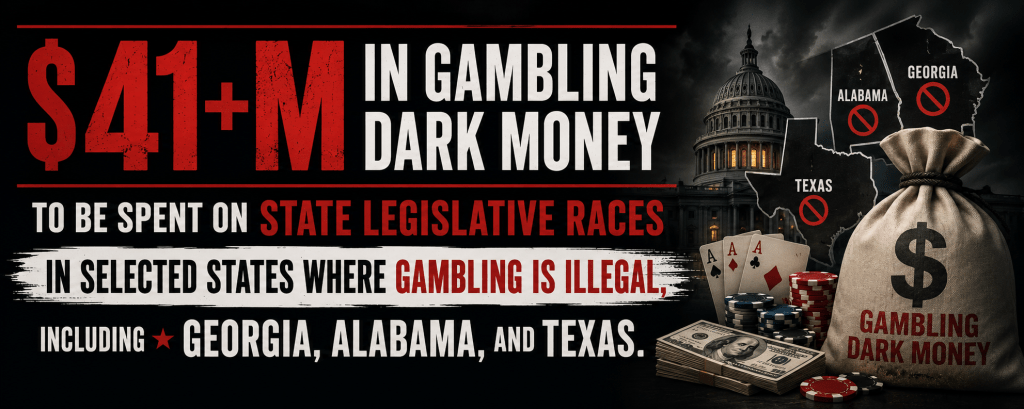
Fortunately, some watchdogs were paying attention. Sentient reporters began sounding the alarm in early February. Over a period of several weeks, the gambling corporations’ master plan was gradually revealed and exposed: $41+M in gambling dark money to be spent on state legislative races in selected states where gambling is illegal, including Georgia, Alabama, and Texas. By mid-April (before early voting started on April 27th), several excellent articles had been published by national media that shone a bright light on the Gambling Dark Money invasion. And since then, articles have abounded that expose the Gambling Industry’s plot to hijack elections. Unfortunately, in some cases, the media reports read like obituaries or post-mortems, reflecting Gambling Dark Money’s deathblows in numerous state legislative races. In Georgia, only two of the Gambling PACs’ candidates failed to win outright or else advance to the run-off. That, citizens, shows the overriding influence of this Dark Money. Hopefully, District 47 voters will more discerning . . . at least, now that they are aware of the situation and the clear-and-present dangers.
So don’t let any politician tell you that he didn’t know what was going on. Nobody is that clueless. “American Conservative Fund” (or “American Future” in Democratic races) appears on all promotional materials for the Gambling PACs’ anointed candidates. To ascertain the truth, one need only insert “American Conservative Fund” (or its variants) into one’s favorite search engine . . . or use easily searchable online state and federal campaign filing repositories . . . or both.
I could lay out the whole ugly Dark Money story for you here, but I won’t because other watchdogs have already done my work for me. Following are 37 articles plus several other useful/interesting links. I have organized the articles by geographical groupings and chronologically within a grouping. For each article, I provide the title, the publishing date, and a website link. (Unfortunately, a few articles require a subscription.) The titles of articles that I think are especially compelling are in bold, red font. The first grouping are national press articles. These provide a broader perspective from experts and experienced watchdogs; these are the best reading. The articles from Georgia provide the basics, but I would suggest instead reading the reporting from Alabama, which is deeper and more insightful. Finally, I have provided a few articles from other states.
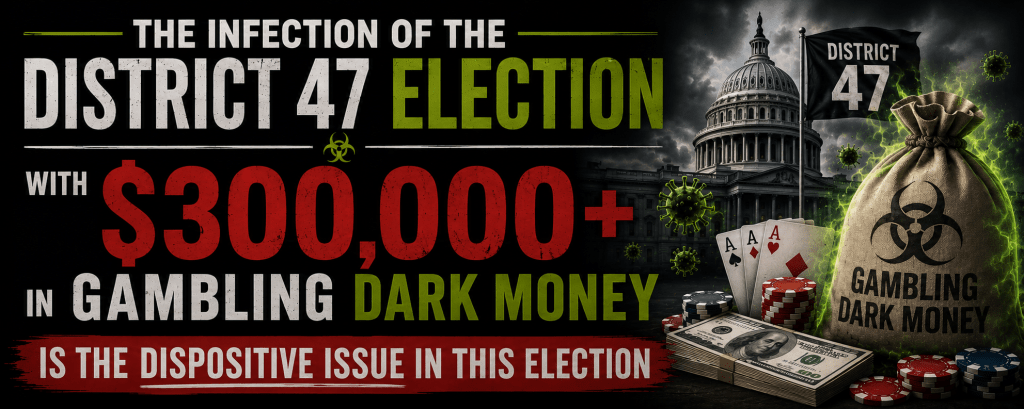
Citizens, make no mistake. The infection of the District 47 election with $300,000+ in Gambling Dark Money is THE dispositive issue in the run-off (and general election). (See Note 1.) It is a huge point of differentiation and eclipses all other candidate distinctions in the run-off.
Advocating Against Dark Money in District 47,
Tim
National Press:
These represent the most expert reporting. I suggest reading the bolded national articles first.
The first article is not about Gambling Dark Money but provides important situational context. At the end of the Georgia articles are some links to websites that provide insightful data/statistics on the Gambling PACs.
The best state reporting on gambling Dark Money is issuing from Alabama. Reporters there figured out early what was happening and have been quite astute in their coverage.
Note1: The gambling PACs have allocated $10+M to 30+ races in Georgia, so $300,000+ per race. So far, I’ve received no less than 18 mailers for Jack Miler from PACs. Another PAC, AFC Victory Fund, is also conducting a campaign for Jack Miller. So the figure of $300,000 is likely conservative. One organization that tracks PAC spending using AI has estimated about $180,000 has been spent by the American Conservative Fund on Miller. However, there are lags in the processing and reporting of data, so this is a low estimate but gives a sense of the trajectory of spending.
In my last post, I promised an analysis of the District 47 race. Here it is . . .
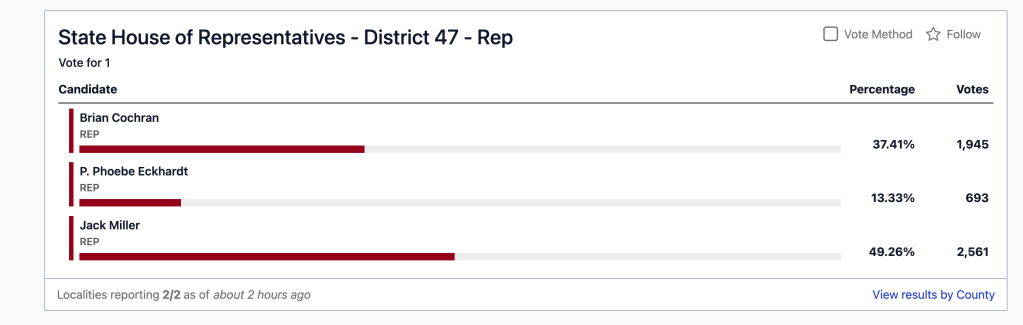
The recent District 47 Republican primary was a political shocker. Jack Miller, the heavyweight favorite and local political Wunderkind, was expected to effortlessly flatten his two (supposedly) flyweight competitors: Brian Cochran and Phoebe Eckhart. However, voters delivered a different outcome with a loud thud. Mr. Miller fell short of the 50% threshold by 39 votes and was forced into a run-off with Brian Cochran, a political newcomer. Through their ballots, voters protested gambling SuperPACs dumping upwards of $300,000 (or more) of dark money into the race and injecting divisive national politics into an otherwise civil campaign. Voters also disregarded an avalanche of endorsements from local political glitterati. Rather than a coronation, voters opted for further vetting of the candidates. That’s good for everyone, even Mr. Miller.
Left: Brian Cochran; right: Jack Miller
Before I go further, it is important to understand that both candidates—Jack Miller and Brian Cochran—are qualified to represent District 47. I knew both candidates before they announced their candidacies (See Note 1). Last week, I had extended and enlightening conversations with both candidates. Both have good character and are strong in their faith. They agree on most major issues and are (mostly) taking the right positions on these issues. It is refreshing to see two sharp young men—both still in their 20s—enter the political arena. It should engender hope in citizens for the future of our country. We need more Jack Millers and Brian Cochrans, rather than the failure-to-launch young people we too often encounter these days. It is rare for a political race to offer two qualified choices. More often, the choice is between two terrible candidates: hold your nose . . . pick the least bad candidate, and . . . hope for the best. Rinse and repeat.
The District 47 run-off not only offers two qualified candidates, but better still . . . some sharp contrastsexist between the Miller and Cochran that should make vetting easier for many voters. Only one candidate will win. Hopefully, the runner-up will remain engaged in politics and seek and win another elected position.
Unfortunately, Jack Miller has a problem . . . and it is a big problem . . . a problem that will likely dominate the debate and discussion until election day. There is a perception (and perhaps it reflects reality . . . voters must decide) that Miller is being bought with dark money (from gambling PACs) and with political endorsements. The dark money has created another problem for Miller . . . divisive national politics have unnecessarily infected the campaign, alienating many voters.
When the campaign began, I was all-in for Jack Miller. He called me soon after his announcement. I offered financial support, advice, and my endorsement. His initial mailers were professional and on message. However, as the campaign progressed, like many voters, I began to have concerns that evolved into deep reservations and eventually convinced me (and many others, it seems) to vote for Mr. Cochran. Mr. Miller’s campaign became lackluster, almost as if outsourced to a campaign consultant. (Mr. Miller is employing a consultant; Mr. Cochran is not.) Miller’s campaign seemed to be coasting on autopilot . . . perhaps based on an assumption of electoral inevitability . . . a reasonable assumption as Mr. Miller has many advantages over Mr. Cochran. However, advantages are often double-edged swords—harmful if wrongly wielded, which some were. Two factors—the corrosive influence of gambling PACs (and their dark money) in the race and a deeply flawed endorsement strategy—tipped the scales for meand many other voters. I was conflicted but ended up voting for Mr. Cochran in the primary. (However, I am an undecided voter going into the run-off . . . I am waiting to see how things play out.)
So let’s dive deeper into Mr. Miller’s loss at the polls. (See Note 2.) Let’s analyze the two primary factors in Mr. Miller’s defeat: 1) the negative impact of gambling PACs and their dark money in the race and 2) a poorly executed political endorsement strategy.
The first and much more important factor in Miller’s defeat was the flow of copious amounts of dark money into the race—most of it tied to gambling PACs. This will not play well with most local Republican voters (regardless of whether they support expansion of gambling or not). I received no fewer than 16 mailers paid for mostly by gambling PACS (See Note 3 for an explanation of dark money, PACs/SuperPACs and how this all works). At $6,000 to $9,000 per mailer, we’re talking $96,000 to $144,000 just for mailers. However, the PACs are also conducting a coordinated media campaign, including ads on Fox News. So it is fair to estimate that upwards of $300,000 (or maybe more) of dark money has been allocated to promote Mr. Miller; no dark money is being spent on Mr. Cochran. Even now, this dark money is continuing to flow in support of Mr. Miller. The main PAC supporting Miller is spending $10M ($7.8M going to Republicans and $2.2M to Democrats) statewide on 34 races . . . if you do the math, that’s nearly $300,000 per race. (Source: AJC. See Note 4 for links to articles from AJC and other news sources about the gambling industry’s intrusion into state legislative races.)
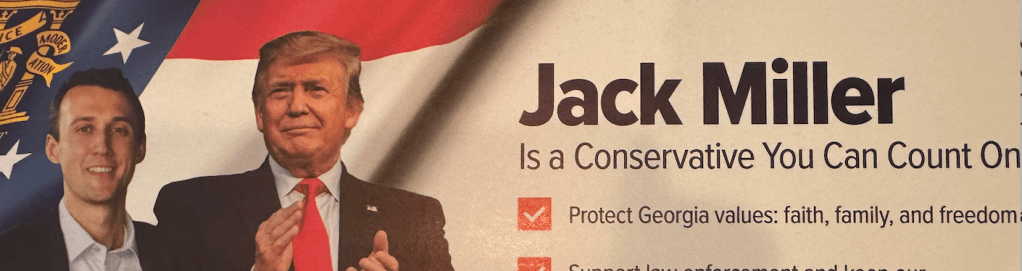
The expenditure of so much dark money is bad enough, but another big problem emerged for Mr. Miller because of this media campaign. The PACs’ messaging and presentation were often poor and off-target, especially the clear and repeated references to divisive national politics. Until the dark money appeared, neither candidate had mentioned Trump . . . and neither has ever done so in their communications. And based on my conversations with both candidates, their positions on Trump are similar and both stated they are opposed to injecting national politics into the District 47 race. District 47 is certainly a Red district but it is a nuanced sort of Red . . . the persuadable voters that decide elections in Milton (and in contiguous areas) do NOT like appeals to raw partisanship . . . so these dark money communications could be damaging Miller . . . understandably so.
Photo from PAC-financed mailer
So what does this all say and mean for Jack Miller’s candidacy? Miller asserts that he has no control over these PAC expenditures. Technically, that is true. Candidates are forbidden to COORDINATE with PACs, BUT . . . and this is important . . . candidates can COMMUNICATE with PACs. A candidate can certainly send a letter to a PAC to demand the PAC cease its efforts. The problem for Miller is that he went along with the actions of the gambling political machine; he did not protest (and still has not). While he had concerns (particularly around the messaging and presentation), my opinion is that his campaign believed the dark-money promotion would help him (or perhaps not hurt him enough that he would lose the election). They were wrong. Where I fault Miller is his not investigating the PACs’ ties and agendas and subsequently not disavowing them. Miller says he was not aware of the dark money ties to gambling interests. Perhaps that is true, but he should have known . . . that’s the crux of the matter. These PACs have been extensively exposed in the press, so it is not hard to figure out who they are and what they are promoting. (See Note 4 for links to articles detailing the activities of the primary SuperPAC and primary PAC supporting Miller.). And remember that Miller is a seasoned political operative with an extensive political network and a paid campaign consultant, so voters are likely not to accept an excuse of inexperience or ignorance from Miller.
The second but lesser factor in Miller’s loss was a poorly executed endorsement strategy. Most of the North Fulton political establishment has endorsed Miller. The gist of Miller’s endorsement strategy seems to be: the more politicians who endorse me, the better. However, with endorsements (as with most things), eventually you reach a point of diminishing returns and later a point of negative returns. Some endorsements are better than others. Others provide no benefit, so just muddle your message. And still other endorsements are just harmful . . . and there were a few of those in Miller’s endorsement portfolio. Rather than carpet-bomb voters with a dog’s breakfast of endorsements, Miller should have communicated a thoughtful and curated selection of more impactful endorsements. (See Note 5 for my advice to Miller on endorsements.)
I received one mailer from Miller that had 24 endorsements! And every endorser was a politician–several held in low regard by citizens. Not a single business leader or other type of community leader was included. For many voters, this is a huge turn-off. Voters recoil at the local political elite telling them how to vote. And the sophisticated, persuadable voters that decide elections realize that such endorsements come with lots of strings. They create obligations for Mr. Miller. Miller has issued bushels of IOUs that could limit his effectiveness. He is now beholden to these endorsers. Again, the perception (and perhaps it reflects reality . . . voters must decide) is that politicians have bought Miller with their endorsements. Don’t misunderstand. Strong and healthy relationships with current and former elected officials are beneficial. These relationships are valuable and take time to develop. Certainly, Miller can and should play the experience card and assert he can hit the ground running; Cochran cannot say this. However, the issue is NOT the political relationships; the issue IS the endorsements and associated obligations. Yes, Miller can hit the ground running, but will he trip over all the IOUs he has issued?
So did the gambling PACs and endorsements hurt Miller? It is difficult to say. Miller certainly believes the gambling PACs hurt him. To prove his point, Miller points out that he won the early vote and lost the election day vote. He logically concludes that the increasing surge of dark money mailers, ads, etc. pushed voters (including me) toward Mr. Cochran. And to make matters worse . . . in my opinion, the message that Mr. Miller was being bought was reinforced by all the endorsements he sought and was granted from the local political establishment—several from disgraced/discredited politicians.
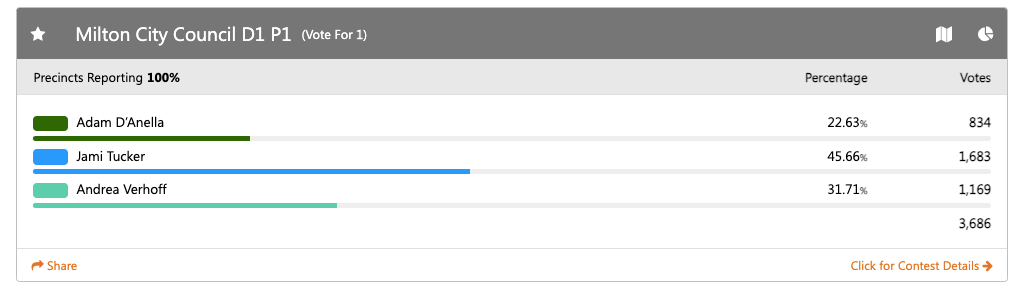
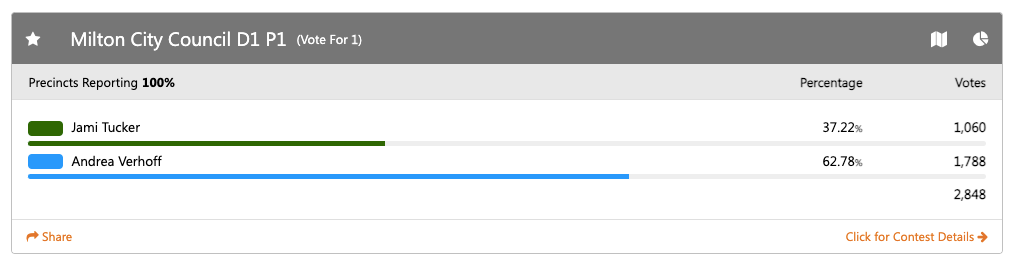
A big positive for Miller is that he came very close to winning 50% (+1 vote) in the first primary. However, the third-place finisher Phoebe Eckhart has endorsed Cochran. Cochran clearly has the momentum coming into the run-off. And Miller is on the defensive. Additionally, my sense is that fewer voters will vote in the run-off; this is typical. This could also hurt Miller, as Cochran’s voters seem more enthused so more likely to show up in proportionally higher numbers. (See Note 6 for a recent example of a Milton city council runoff where the second-place finisher handily beat the first-place finisher.)
Despite all this, I believe Miller is still the favorite to win and Cochran is still the underdog. I believe the race will be close. I give Miller a 65-75% chance of winning. However, it will depend on how Miller addresses the two factors that caused his defeat. I suspect his consultant and his political advisors will tell Miller to ignore the gambling issue . . . don’t give it any Oxygen . . . change the subject. I know some of Miller’s political advisors well and I can tell you they don’t know boo about winning elections and even less about integrity. I believe Miller will flip the odds in Cochran’s favor if he doesn’t acknowledge the gambling issue, state unequivocally his opposition to expanding gambling in Georgia, and disavow the PACs that are supporting him. This action is not only the right thing to do, but it will also maximize Miller’s chances of victory. However, time is running out . . . or maybe has run out. If Miller delays much longer in not addressing this issue, any 11th hour disavowal will be justly viewed as disingenuous. You can’t eat the steak but then refuse to pay the bill because the steak wasn’t to your liking (to quote Judge Judy).
Regarding his poorly executed endorsement strategy, there is not much that can now be done. What’s done is done. You cannot really “return” endorsements, although Miller might quietly take down controversial endorsements from his website. What Miller can do is de-emphasize endorsements in his communications and reassure voters that he is his own man and not beholden to any politician or Special Interest.
Miller needs to respect the intelligence and integrity of his North Fulton voters. They are tough but fair. Honesty and sincerity—that’s the Jack Miller I know—are the best way to finish out the Republican primary. Same goes for Mr. Cochran.
In another post, I will compare the candidates. There are several areas where there are significant contrasts that should make candidate vetting easier.
Voters, this is a hugely important election. I urge readers to share this post with fellow voters through social media or forwarding a link to the blog via e-mail.
Advocating For Election Fairness and Integrity,
Tim
Note 1: I have known Jack Miller since 2017, when we both were involved in Laura Bentley’s campaign for Milton City Council; we’ve maintained a friendly acquaintance since then. Although only 25, Jack is an experienced political operative who has worked in many political campaigns and is well-regarded. I’ve known Brian Cochran’s family for 25 years. (We were neighbors in the same subdivision. My wife and Brian’s mother were in a small Bible study group that spanned 3 years and the entire Bible.) However, I didn’t initially realize the Brian Cochran running for office was the same Brian Cochran we knew from the neighborhood where we lived 1993-2013. He’s grown into a fine young man with a great future ahead of him.
Note 2: I intentionally use the word “loss” to refer to Mr. Miller’s failure to garner more than 50% of the vote because his two challengers were both explicitly running against Mr. Miller and collectively did achieve more than 50% of the vote. Moreover, third-place finisher Eckhart has endorsed Mr. Cochran in the run-off.
Note 3: What I mean by “dark money” in the context of this blog post is money where the ultimate sources are anonymous or else difficult to trace. In some cases, the agenda of the PACs distributing such money is not mentioned in its promotional media. That is the case with most of the dark money supporting Jack Miller. The primary PAC conducting a media campaign on behalf of Miller is American Conservative Fund (ACF), which is primarily funded by Win For America, a gambling SuperPAC that doesn’t even have a public website. ACF does have a rudimentary website but nowhere is gambling mentioned. ( Link to ACF website: https://americanconservativefund.com/ ). None of their mailers (and other promotional media) for Miller mention gambling. So you can see that the efforts of these PACs and Super-PACs are non-transparent, deceptive, and manipulative. Win For America is reaching Democrat voters through a separate PAC, American Future, which also has only a rudimentary website that makes no mention of gambling. (Link to AF website: https://americanfuturepac.org/ ) So you can see that the goal here is to cynically use conservative and progressive talking points to manipulate Republican and Democrat voters to vote for candidates that the gambling interests believe will promote legalization/expansion of gambling. Ultimately, the gambling interests care nothing about conservative or liberal causes; they only care about buying politicians that will promote increased gambling.
Note 4: Following are links to articles explaining the intrusion of gambling PACs into state legislative races in GA, AL, and NC (and elsewhere). I am also including a link to the Moms Against Gambling website. MAG is putting up a valiant, but unfortunately under-funded, uphill fight against the gambling political machine. (Note: A subscription may be required to read the AJC articles.)
Note 5: I did suggest to Mr. Miller that he get all 7 Milton City Council members behind his candidacy. I believed such an endorsement would carry weight in the general election in the fall.
Note 6: Following are two screen shots of election results from the 2021 Milton municipal elections. The race went to a run-off. The leader in the general election, Jami Tucker, came close to winning; she came up 160 votes short. However, Tucker badly lost the run-off, dropping from 45.66% to 37.22%. Her challenger, Andrea Verhoff, surged more than 31 percentage points to win the run-off with a whopping 62.78% of the vote.