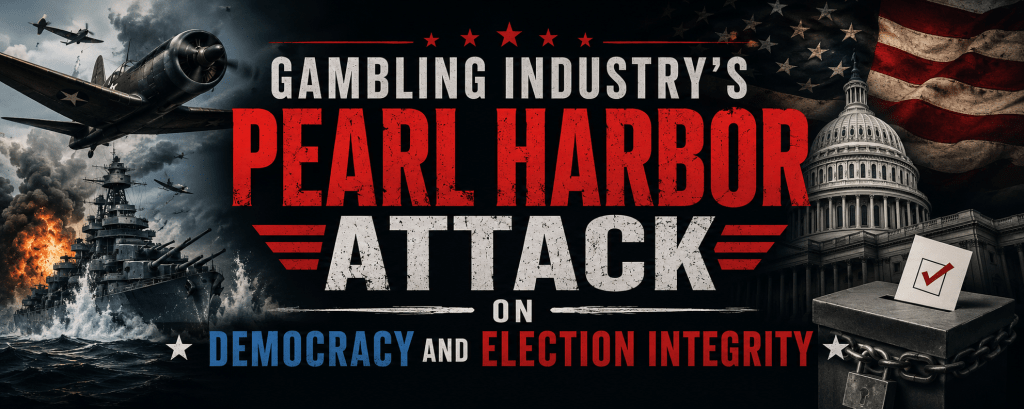
Using Dark Money, Gambling Corporations are mounting a Pearl-Harbor-style assault on our democracy . . . the likes of which we’ve never seen in Georgia. And if successful, we will see a proliferation of similar onslaughts in future elections. The consent of the governed will be effectively blotted out by the purveyors of Dark Money. Now is the time for ordinary citizens to oppose Special Interests that are using deception and manipulation to finagle their agents into the state legislature. Don’t let gambling PACs choose your representatives!
So why the Pearl Harbor analogy? Isn’t that over-the-top? Not in the least. This Gambling Industry PAC-Attack is a huge assault and it is a surprise assault. $10M+ (and growing) is being injected into 30+ selected state legislative races . . . that’s $300,000+ per race. And based on what I’ve seen (e.g., 18 PAC-financed mailers . . . so far), District 47 is seeing this level of spending. The state PAC behind this dark money attack (Republican-tilted American Conservative Fund Action Georgia) is the largest Georgia PAC in both contributions and expenditures. And when combined with the smaller Democrat-tilted American Future PAC (which traces its funding back to the same Win For America Super-PAC and the same gambling corporations as its conservative counterpart), the dark money pot tops $10M. This is nearly twice the second biggest Georgia PAC, the Georgia Democratic Party, at $5.6M. Why is this a sneak attack? First, gambling is never mentioned in any campaign promotional media for candidates. And gambling is never mentioned at the PACs’ websites. Second, you must wade through three layers of PACs before you identify the malefactors: three gambling corporations lurking at the 4th layer. Third, these PACs were all established within the past 8 months. (American Future, the Democrat gambling PAC, wasn’t registered in Georgia until April 17th.) The recency element is important because there are time lags that watchdogs (like me) must deal with. The intent of these PACs is to attack with minimal advance notice (just like a military attack) to maximize the element of surprise . . . perhaps people won’t notice or act until it’s too late.
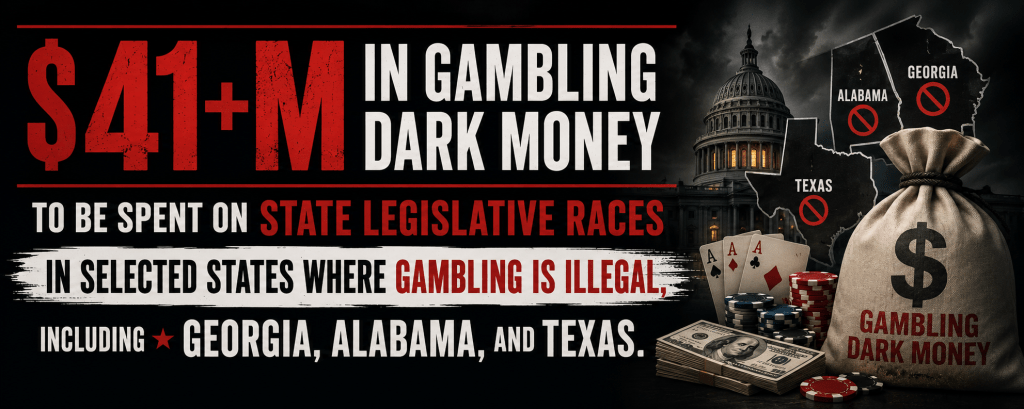
Fortunately, some watchdogs were paying attention. Sentient reporters began sounding the alarm in early February. Over a period of several weeks, the gambling corporations’ master plan was gradually revealed and exposed: $41+M in gambling dark money to be spent on state legislative races in selected states where gambling is illegal, including Georgia, Alabama, and Texas. By mid-April (before early voting started on April 27th), several excellent articles had been published by national media that shone a bright light on the Gambling Dark Money invasion. And since then, articles have abounded that expose the Gambling Industry’s plot to hijack elections. Unfortunately, in some cases, the media reports read like obituaries or post-mortems, reflecting Gambling Dark Money’s deathblows in numerous state legislative races. In Georgia, only two of the Gambling PACs’ candidates failed to win outright or else advance to the run-off. That, citizens, shows the overriding influence of this Dark Money. Hopefully, District 47 voters will more discerning . . . at least, now that they are aware of the situation and the clear-and-present dangers.
So don’t let any politician tell you that he didn’t know what was going on. Nobody is that clueless. “American Conservative Fund” (or “American Future” in Democratic races) appears on all promotional materials for the Gambling PACs’ anointed candidates. To ascertain the truth, one need only insert “American Conservative Fund” (or its variants) into one’s favorite search engine . . . or use easily searchable online state and federal campaign filing repositories . . . or both.
I could lay out the whole ugly Dark Money story for you here, but I won’t because other watchdogs have already done my work for me. Following are 37 articles plus several other useful/interesting links. I have organized the articles by geographical groupings and chronologically within a grouping. For each article, I provide the title, the publishing date, and a website link. (Unfortunately, a few articles require a subscription.) The titles of articles that I think are especially compelling are in bold, red font. The first grouping are national press articles. These provide a broader perspective from experts and experienced watchdogs; these are the best reading. The articles from Georgia provide the basics, but I would suggest instead reading the reporting from Alabama, which is deeper and more insightful. Finally, I have provided a few articles from other states.
Citizens, make no mistake. The infection of the District 47 election with $300,000+ in Gambling Dark Money is THE dispositive issue in the run-off (and general election). (See Note 1.) It is a huge point of differentiation and eclipses all other candidate distinctions in the run-off.
Advocating Against Dark Money in District 47,
Tim
National Press:
These represent the most expert reporting. I suggest reading the bolded national articles first.
- DraftKings and FanDuel spending millions on 2026 midterms, new filings reveal (February 2, 2026): https://popular.info/p/draftkings-and-fanduel-spending-millions
- FanDuel and DraftKings shift focus to D.C. amid federal efforts to legislate sports betting (March 30, 2026): https://www.opensecrets.org/news/2026/03/fanduel-and-draftkings-shift-focus-to-d-c-amid-federal-efforts-to-legislate-sports-betting/
- Report: Sportsbook Heavyweights Give $48M To Pro Sports Betting Super PAC (April 9, 2026): https://www.casino.org/news/draftkings-fanduel-others-send-48m-into-sports-betting-super-pac/
- DraftKings, FanDuel, and Fanatics Just Dropped $48 Million Into a Political Super PAC — Here’s Why the Prediction Markets Threat Is the Real Driver (April 10, 2026): https://bettorsinsider.com/sports-betting/2026/04/10/draftkings-fanduel-and-fanatics-just-dropped-48-million-into-a-political-super-pac-heres-why-the-prediction-markets-threat-is-the-real-driver/
- New York Times: Sports Betting Industry Spends $41M to Influence Elections (April 15, 2026): https://www.nytimes.com/2026/04/15/us/politics/draftkings-fanduel-midterm-elections.html
- DraftKings, FanDuel Funnel $41M Into Win for America PAC Targeting Multiple States (April 16, 2026): https://www.gamblinginsider.com/news/154623/draftkings-fanduel-41m-super-pac-state-betting-laws
- Following the Money: Political Spending by FanDuel, DraftKings, and Fanatics (April 20): https://gamingamerica.com/news/1060719/following-money-political-spending-draftkings-fanduel-fanatics
- Sports Betting Companies Pour Cash Into Potential Expansion States (May 14, 2026): https://www.legalsportsreport.com/263073/sports-betting-companies-pour-cash-into-potential-expansion-states/
- DraftKings and Sportsbook Giants Are Targeting State Legislators Who Support Stricter Betting Rules (May 29, 2026): https://bettorsinsider.com/sports-betting/2026/05/29/draftkings-and-sportsbook-giants-are-targeting-state-legislators-who-support-stricter-betting-rules/
Georgia:
The first article is not about Gambling Dark Money but provides important situational context. At the end of the Georgia articles are some links to websites that provide insightful data/statistics on the Gambling PACs.
- Georgia sports betting efforts extinguished on House floor (April 9, 2026): https://sbcamericas.com/2026/03/09/georgia-sports-betting-efforts-2026/
- Sports-betting super PAC spending big in Georgia (May 12, 2026): https://atlantaciviccircle.org/newsletter/sports-betting-super-pac-spending-big-in-georgia/
- Three Sportsbooks Have Picked Mike Dudgeon. Here’s the Money Trail. (May 12, 2026): https://georgiapoliticalinsight.substack.com/p/three-sportsbooks-have-picked-mike
- Sports betting PACs make big wagers on Georgia legislative races (May 14, 2026): https://atlantaciviccircle.org/2026/05/14/sports-betting-pacs-big-wagers-georgia-legislative-races/
- Georgia House District 62: Outside PAC spending reshapes Democratic primary field (May 14, 2026): https://atlpresscollective.com/2026/05/14/georgia-house-district-62-democratic-primary-pac-spending/
- Sports betting industry pours $10M into Georgia campaigns (May 14 ,2026): https://www.ajc.com/politics/2026/05/sports-betting-industry-pours-10m-into-georgia-campaigns/
- Heavy outside PAC spending fuels questions in Buford-area Georgia Republican primary (May 15, 2026): https://northgwinnettvoice.com/heavy-outside-pac-spending-fuels-questions-in-buford-area-georgia-republican-primary/
- Sports Betting Industry Pours $10 Million Into Georgia’s 2026 Election as Legalization Push Continues (May 18, 2026): https://bettorsinsider.com/sports-betting/2026/05/18/sports-betting-industry-pours-10-million-into-georgias-2026-election-as-legalization-push-continues/
- Georgia election races draw $10 million from betting industry (May 18, 2026): https://bettorsinsider.com/sports-betting/2026/05/18/sports-betting-industry-pours-10-million-into-georgias-2026-election-as-legalization-push-continues/
- Sports betting industry backs Georgia legislators as it seeks legal gambling (May 25, 2026): https://www.ajc.com/politics/2026/05/sports-betting-industry-backs-georgia-legislators-as-it-seeks-legal-gambling/
Following are some interesting websites that provide data/statistics on the Gambling PACs:
https://www.fec.gov/data/committee/C00927186
https://www.transparencyusa.org/ga
https://www.gafastmoney.com/independent-committee.html?committee=american-future
Alabama:
The best state reporting on gambling Dark Money is issuing from Alabama. Reporters there figured out early what was happening and have been quite astute in their coverage.
- American Conservative Fund PAC Steps Into Alabama Races With Heavy Spending and Out‑of‑State Backing (April 1, 2026): https://www.alabamagazette.com/story/2026/04/01/news/american-conservative-fund-pac-steps-into-alabama-races-with-heavy-spending-and-outofstate-backing/10702.html
- ‘Dark money’ PAC spends big on Alabama campaign mailers, TV ads without filing financial reports (April 8, 2026): https://1819news.com/news/item/dark-money-pac-spends-big-on-alabama-campaign-mailers-tv-ads-without-filing-financial-reports
- ‘Trying to hurt me more than anything else in this election’: Senate Pro-Tem Gudger disavows ‘dark money’ American Conservative Fund PAC mailers (April 18, 2026): https://1819news.com/news/item/trying-to-hurt-me-more-than-anything-else-in-this-election-senate-pro-tem-gudger-disavows-dark-money-american-conservative-fund-pac-mailers
- Sports betting giants are pouring millions into Alabama political races: Will it pay off? (April 24, 2026): https://www.al.com/politics/2026/04/sports-betting-giants-are-pouring-millions-into-alabama-political-races-will-it-pay-off.html
- Behind those flyers, gambling money and murky PACs (May 13, 2026): https://alabamareflector.com/2026/05/13/behind-those-flyers-gambling-money-and-murky-pacs/
- ‘It’s very frustrating’: Elliott rails against gambling-funded American Conservative Fund PAC for ‘hijacking’ races across state (May 14, 2026): https://1819news.com/news/item/its-very-frustrating-elliott-rails-against-gambling-funded-american-conservative-fund-pac-for-hijacking-races-across-state
- Conservative groups sound alarm over ‘massive amounts’ of gambling money influencing Alabama election (May 15, 2026): https://www.al.com/politics/2026/05/conservative-groups-sound-alarm-over-massive-amounts-of-gambling-money-influencing-alabama-election.html
- American Conservative Fund spends heavy on Facebook and Google ads, millions on ‘non federal media production’ (May 18, 2026): https://1819news.com/news/item/american-conservative-fund-spends-heavy-on-facebook-and-google-ads-millions-on-non-federal-media-production
- DraftKings, FanDuel Amass Pro-Gambling Wins in Alabama Primary (May 21, 2026): https://www.bloomberg.com/news/articles/2026-05-21/draftkings-fanduel-amass-pro-gambling-wins-in-alabama-primary?embedded-checkout=true
- DraftKings, FanDuel Back $9.3 Million Alabama Political Push (May 22, 2026): https://finance.yahoo.com/markets/stocks/articles/draftkings-fanduel-back-9-3-103030461.html
- After bitter primary, Alabama lawmakers renew push to expose dark money (May 24, 2026): https://www.al.com/news/2026/05/after-bitter-primary-alabama-lawmakers-renew-push-to-expose-dark-money.html
- Nine Alabama Groups Want an Investigation Into the Sports Betting Industry’s Dark Money (May 25, 2026): https://gamingamerica.com/news/1071472/nine-alabama-groups-want-an-investigation-into-the-sports-betting-industrys-dark-money
- DraftKings, FanDuel-backed PAC scores big wins in Alabama primaries (May 26, 2026): https://www.alreporter.com/2026/05/26/draftkings-fanduel-backed-pac-scores-big-wins-in-alabama-primaries/
- Sports Betting Giants Quietly Reshape Alabama’s Political Landscape Ahead of Gambling Vote (May 27, 2026): https://www.yahoo.com/news/politics/articles/sports-betting-giants-quietly-reshape-172900081.html
North Carolina:
- PAC funding tied to sports betting bankrolls Pless campaign ads (February 18, 2026): https://www.themountaineer.com/news/pac-funding-tied-to-sports-betting-bankrolls-pless-campaign-ads/article_b94b9548-5b23-4393-87a7-c31d8ddc1c7c.html
Pennsylvania:
- Gaming, gambling interests spend millions in Pa. (May 18, 2026): https://www.altoonamirror.com/news/local-news/2026/05/pa-gaming-gambling-interests-spend-millions/
Ohio:
- DraftKings-linked super PAC bets $1M on ads backing favorite Ohio GOP candidates (April 12, 2026): https://www.cleveland.com/news/2026/04/draftkings-linked-super-pac-bets-11-million-on-ads-backing-favorite-ohio-gop-candidates.html
- DraftKings-funded PAC backs accused sex pest Rodney Creech with ads featuring young girl (April 15, 2026): https://tiffinohio.net/posts/draftkings-funded-pac-backs-accused-sex-pest-rodney-creech-with-ads-featuring-young-girl/
- Ohio Gov. calls sports betting legalization his ‘biggest mistake (May 26, 2026): https://www.sportsbusinessjournal.com/Articles/2026/05/26/ohio-gov-calls-sports-betting-legalization-his-biggest-mistake/
Note1: The gambling PACs have allocated $10+M to 30+ races in Georgia, so $300,000+ per race. So far, I’ve received no less than 18 mailers for Jack Miler from PACs. Another PAC, AFC Victory Fund, is also conducting a campaign for Jack Miller. So the figure of $300,000 is likely conservative. One organization that tracks PAC spending using AI has estimated about $180,000 has been spent by the American Conservative Fund on Miller. However, there are lags in the processing and reporting of data, so this is a low estimate but gives a sense of the trajectory of spending.