Early voting begins October 13th. I have updated the Milton Coalition Voting Guide, which is a one-stop shop for 1) information on the candidates and 2) general election information (dates, locations, etc.). I have added several recent news stories covering the candidates as well as links to a few websites that provide detailed information on the HD-47 races, including district maps, previous election results, and financial disclosure summaries. Following is a link to the Voter Guide. I will post additional news stories as they become available.
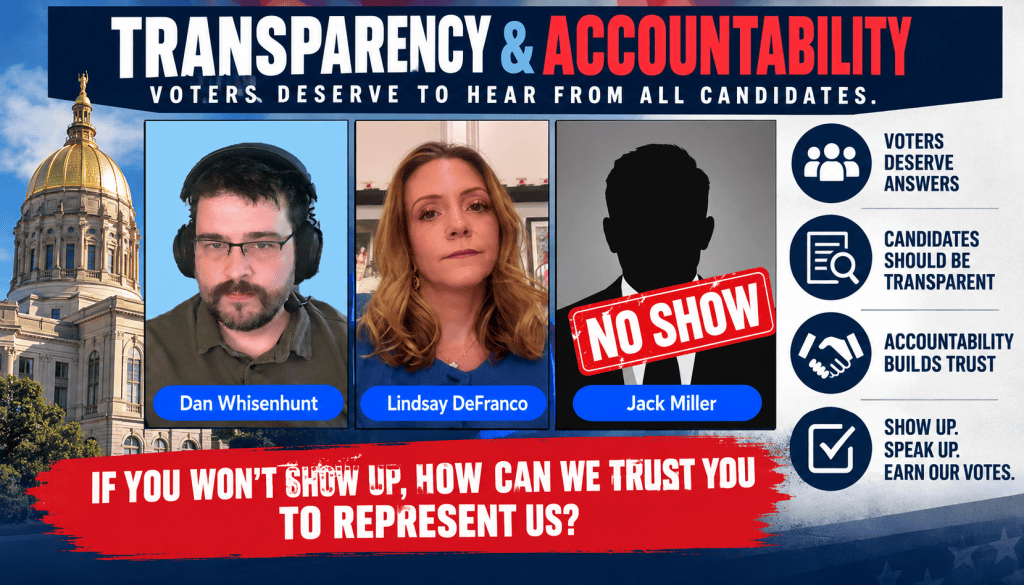
I was disheartened to learn that Republican candidate Jack Miller withdrew from a scheduled debate hosted by Appen Media. According to Ms. DeFranco, his campaign notified Appen of his withdrawal just 10 minutes before the debate was to commence. The debate proceeded without Mr. Miller, with Ms. DeFranco responding to the moderator’s questions. A link to the debate is provided at the Milton Coalition Voter Guide.
Mr. Miller also avoided debating his primary run-off opponent Brian Cochran, with his campaign stating he was “unavailable” for a debate. Voters deserve better from Mr. Miller. Why is Jack so afraid to debate his challengers? If Jack cannot show up for a candidate debate, should we assume he also won’t show up for citizens when we need him? Doesn’t Jack understand the importance to voters of demonstrating transparency and accountability? I suppose Mr. Miller knows he has much to answer for. He would rather not answer uncomfortable questions about his being tipped off about Jan Jones retirement . . . about PAC money pouring into his campaign . . . about his countenancing dark money campaigns (over $300,000 in expenditures) conducted on his behalf . . . about several sketchy endorsements he touted . . . about his flip-flopping and evasiveness on legalized gambling . . . about funding from special interests . . . about copious political IOUs he has issued . . . and about conflicts of interests inherent in his employment by Milton Mayor Jamison.
Yes, Mr. Miller has much to answer for. Right now, Miller is confining his campaign appearances to carefully orchestrated events with friendly audiences. I hope some attendees will pointedly ask Miller about these issues he seems intent on avoiding . . . and please make sure the video cameras are running. Voters, ensure that Jack earns your votes by telling us exactly where he stands on the issues that I have outlined above.
Advocating for Candidate Transparency and Accountability,
Tim
Note: I am not inclined to endorse either candidate at this time. However, I believe that voters deserve a full and fair vetting of both candidates. That requires open, honest, and substantive dialogue with citizens. And right now, Jack is avoiding such conversations with voters. We need spirited and rich discussion and debate, not pep rallies and look good/feel social media posts. Elections should not be popularity contests; we are not electing a Prom King/Queen, but rather electing a representative that understands and appreciates the serious and difficult task of governance.
July 12, 2026: I am posting a correction to this blog post. See below note in red.
Election Day for the District-47 Georgia House Seat Republican Run-off is June 16th. Please vote.
The previous Milton Coalition Blog post endorsed Brian Cochran. That post emphasized Brian’s stellar qualifications to represent D-47, only implicitly referencing his opponent Jack Miller’s missteps. This blog post will be more explicit in explaining Miller’s blunders, which strongly point to Cochran as the more pragmatic choice for Republican voters, both in terms of electability and legislative effectiveness (should he be elected).
I have known both Jack and Brian for many years. Both Jack and Brian are fine young men. However, Jack has stumbled and lost his way, although he has belatedly taken some actions to rectify his errors. Unfortunately, through his missteps, Jack has weakened his standing with voters, reducing his odds (once quite high) of winning the general election and diminishing his future legislative influence should he prevail in the elections.
When the campaign began, I was all-in for Jack. However, as Jack’s campaign progressed, I (and other voters) became increasingly troubled by several issues. While some issues were deeply concerning, individually, they were not deal-breakers: an unfair head start; copious, dubious, and entangling politician endorsements; a dull and uninspiring campaign; questionable tactics; and an injection (from PAC advertisements) of divisive national politics. Notwithstanding these other issues, one issue predominated and is disqualifying for Jack in the run-off election: Gambling Dark Money campaigns conducted on Jack’s behalf that he accepted and from which he has immensely benefited. I estimate the Gambling Dark Money expenditures to be $300,000+. Sadly, Jack’s public responses to these expenditures have been too little, too late. Gambling Dark Money is Jack’s Achilles Heel and could dog him all the way to November. The Gambling Dark Money fiasco is Exhibit A in the case for Brian Cochran being the more pragmatic choice for Republican voters. The Democrat opponent, Lindsay DeFranco, will relentlessly wield Dark Money as a cudgel against Jack. In fact, Ms. DeFranco recently sent her first mailer to voters, with a sole focus on Gambling Dark Money.
(Corrected July 12, 2026. See above introductory note in red. I have concluded that Ms. DeFranco was not behind the referenced mailer, which was anonymous.)
The Dark Money campaigns also hurt Jack by nonsensicallytying him to divisive national politics. Prudently, neither Jack nor Brian has referred to national politics in their election communications. Both occupied a right-of-center lane in the campaign. In contrast, the PAC campaigns for Jack maladroitly injected national politics into the run-off, pulling Jack’s campaign messaging unnecessarily Rightward. This is certain to hurt Jack, if he is the Republican nominee; pivoting closer to the campaign centerline (needed to win the general election) will be difficult. The explicit linkages to national politics are yet another weapon Ms. DeFranco can employ. She can now portray Jack as too extreme for D-47 . . . creating unease among Independents and more moderate Republicans needed to win the election. Conversely, Brian Cochran is unsoiled; he has wisely avoided being dirtied by national political rancor.
Lastly, Jack poorly executed his endorsement strategy. To his credit, Jack has taken down his website’s endorsement page. However, much damage has been done (and can only be partially repaired). There were several issues with Jack’s endorsement strategy. First, many persuadable voters recoil at entrenched politicians telling them how to vote. Many such voters now view Jack as just another political insider and establishment politician. Second, staring out from Jack’s bingo card of endorsements were several sketchy endorsers that Ms. DeFranco can now link to Jack. And in fact, Ms DeFranco is already citing questionable endorsements in her online posts. Third, and most-importantly, Jack’s endorsements mean he returned a lot of valuable IOUs (he had earned while working on various election campaigns) to their originators. Jack is no longer a political creditor, but rather is now a political debtor . . . deeply in debt to a bevy of politicians as well as to immensely powerful gambling corporations. And unfortunately, Jack’s accumulation of so much political debt and his entanglement with so many career politicians (plus his association with Gambling Dark Money) could limit his effectiveness in the House–should he be elected. Brian has none of this baggage. Brian’s lack of obligations makes him more electable and potentially more effective as legislator (than Jack). Brian Cochran is beholden to no one.
Jack’s self-inflicted wounds have certainly diminished his political standing, perhaps fatally. Pragmatism suggests that Brian Cochran is the more electable candidate and (potentially) more effective legislator. However, putting aside his lack of political baggage (that make him the more pragmatic candidate), Brian Cochran is a strong candidate in his own right. Brian has a demonstrated track record of fighting for our civil liberties. Brian is a man of courage, integrity, and competence. His expertise in technology is critically needed at the state house, especially in sensibly regulating AI. Brian is unequivocal in this opposition to gambling, including referenda that would pass the legislative buck to citizens. Against all odds and despite rivers of PAC money being spent for the benefit of his opponent, Brian vaulted into the run-off. Brian self-managed and (mostly) self-financed an impressive, enthusiastic, and authentic grassroots campaign. However, Brian needs your help to cross the finish line. Please join your fellow citizens in voting for Brian Cochran . . . the pragmatic choice and the best choice for District 47.
Following are some links to Brian’s campaign websites:
I am also including a letter from Brian to voters in which he makes his closing argument for your vote.
This is likely my last long-form blog post before election day. However, I will continue to publish shorter posts at the Bits and Pieces blog page; such posts do not generate emails to blog subscribers, who will need to directly access the Bits and Pieces page for the latest analysis of the D-47 election. Following is a link: Bits and Pieces
In my last post, I promised an analysis of the District 47 race. Here it is . . .
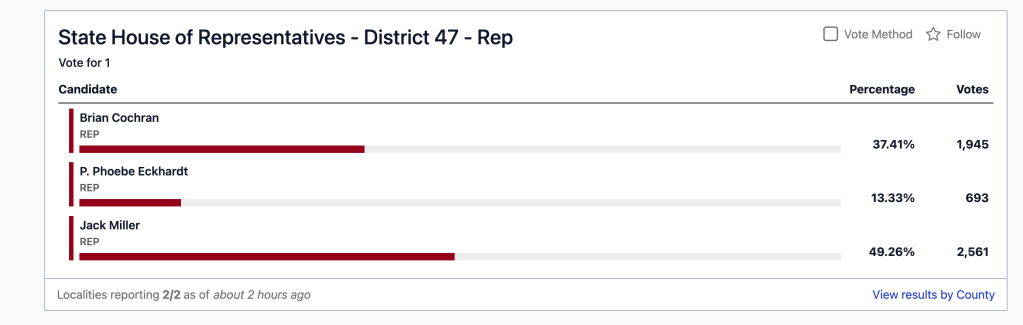
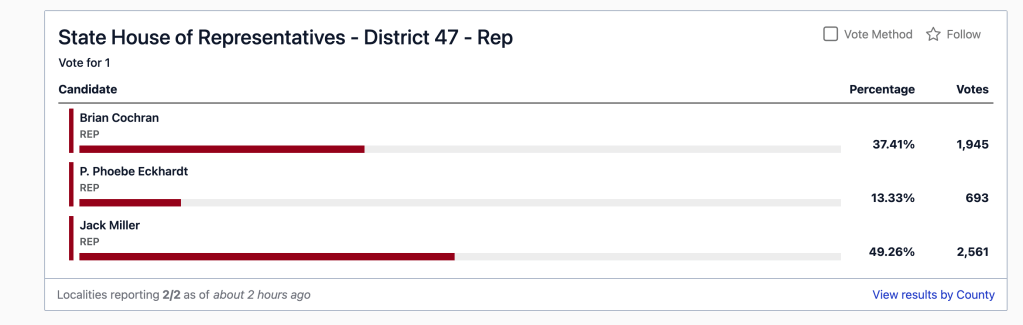
The recent District 47 Republican primary was a political shocker. Jack Miller, the heavyweight favorite and local political Wunderkind, was expected to effortlessly flatten his two (supposedly) flyweight competitors: Brian Cochran and Phoebe Eckhart. However, voters delivered a different outcome with a loud thud. Mr. Miller fell short of the 50% threshold by 39 votes and was forced into a run-off with Brian Cochran, a political newcomer. Through their ballots, voters protested gambling SuperPACs dumping upwards of $300,000 (or more) of dark money into the race and injecting divisive national politics into an otherwise civil campaign. Voters also disregarded an avalanche of endorsements from local political glitterati. Rather than a coronation, voters opted for further vetting of the candidates. That’s good for everyone, even Mr. Miller.
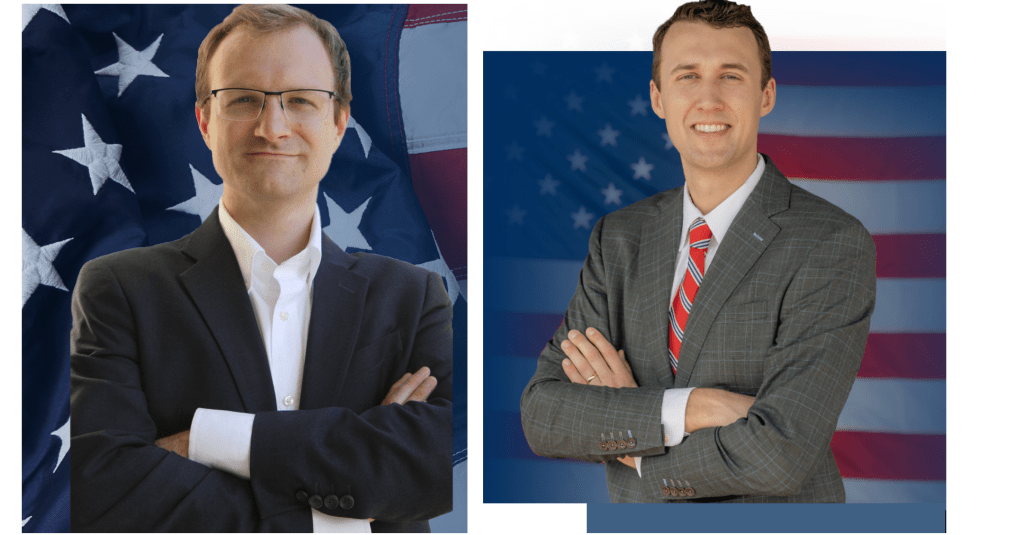
Left: Brian Cochran; right: Jack Miller
Before I go further, it is important to understand that both candidates—Jack Miller and Brian Cochran—are qualified to represent District 47. I knew both candidates before they announced their candidacies (See Note 1). Last week, I had extended and enlightening conversations with both candidates. Both have good character and are strong in their faith. They agree on most major issues and are (mostly) taking the right positions on these issues. It is refreshing to see two sharp young men—both still in their 20s—enter the political arena. It should engender hope in citizens for the future of our country. We need more Jack Millers and Brian Cochrans, rather than the failure-to-launch young people we too often encounter these days. It is rare for a political race to offer two qualified choices. More often, the choice is between two terrible candidates: hold your nose . . . pick the least bad candidate, and . . . hope for the best. Rinse and repeat.
The District 47 run-off not only offers two qualified candidates, but better still . . . some sharp contrastsexist between the Miller and Cochran that should make vetting easier for many voters. Only one candidate will win. Hopefully, the runner-up will remain engaged in politics and seek and win another elected position.
Unfortunately, Jack Miller has a problem . . . and it is a big problem . . . a problem that will likely dominate the debate and discussion until election day. There is a perception (and perhaps it reflects reality . . . voters must decide) that Miller is being bought with dark money (from gambling PACs) and with political endorsements. The dark money has created another problem for Miller . . . divisive national politics have unnecessarily infected the campaign, alienating many voters.
When the campaign began, I was all-in for Jack Miller. He called me soon after his announcement. I offered financial support, advice, and my endorsement. His initial mailers were professional and on message. However, as the campaign progressed, like many voters, I began to have concerns that evolved into deep reservations and eventually convinced me (and many others, it seems) to vote for Mr. Cochran. Mr. Miller’s campaign became lackluster, almost as if outsourced to a campaign consultant. (Mr. Miller is employing a consultant; Mr. Cochran is not.) Miller’s campaign seemed to be coasting on autopilot . . . perhaps based on an assumption of electoral inevitability . . . a reasonable assumption as Mr. Miller has many advantages over Mr. Cochran. However, advantages are often double-edged swords—harmful if wrongly wielded, which some were. Two factors—the corrosive influence of gambling PACs (and their dark money) in the race and a deeply flawed endorsement strategy—tipped the scales for meand many other voters. I was conflicted but ended up voting for Mr. Cochran in the primary. (However, I am an undecided voter going into the run-off . . . I am waiting to see how things play out.)
So let’s dive deeper into Mr. Miller’s loss at the polls. (See Note 2.) Let’s analyze the two primary factors in Mr. Miller’s defeat: 1) the negative impact of gambling PACs and their dark money in the race and 2) a poorly executed political endorsement strategy.
The first and much more important factor in Miller’s defeat was the flow of copious amounts of dark money into the race—most of it tied to gambling PACs. This will not play well with most local Republican voters (regardless of whether they support expansion of gambling or not). I received no fewer than 16 mailers paid for mostly by gambling PACS (See Note 3 for an explanation of dark money, PACs/SuperPACs and how this all works). At $6,000 to $9,000 per mailer, we’re talking $96,000 to $144,000 just for mailers. However, the PACs are also conducting a coordinated media campaign, including ads on Fox News. So it is fair to estimate that upwards of $300,000 (or maybe more) of dark money has been allocated to promote Mr. Miller; no dark money is being spent on Mr. Cochran. Even now, this dark money is continuing to flow in support of Mr. Miller. The main PAC supporting Miller is spending $10M ($7.8M going to Republicans and $2.2M to Democrats) statewide on 34 races . . . if you do the math, that’s nearly $300,000 per race. (Source: AJC. See Note 4 for links to articles from AJC and other news sources about the gambling industry’s intrusion into state legislative races.)
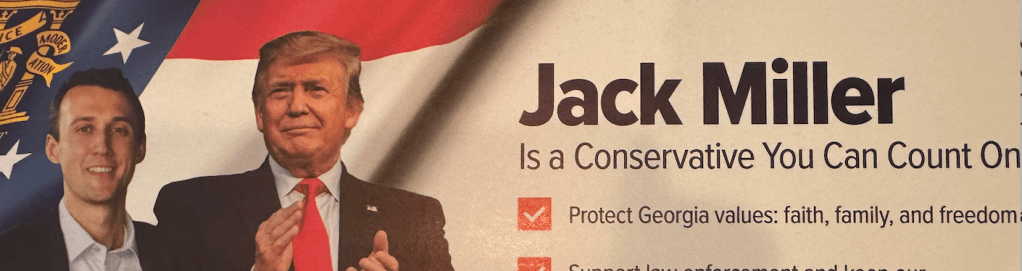
The expenditure of so much dark money is bad enough, but another big problem emerged for Mr. Miller because of this media campaign. The PACs’ messaging and presentation were often poor and off-target, especially the clear and repeated references to divisive national politics. Until the dark money appeared, neither candidate had mentioned Trump . . . and neither has ever done so in their communications. And based on my conversations with both candidates, their positions on Trump are similar and both stated they are opposed to injecting national politics into the District 47 race. District 47 is certainly a Red district but it is a nuanced sort of Red . . . the persuadable voters that decide elections in Milton (and in contiguous areas) do NOT like appeals to raw partisanship . . . so these dark money communications could be damaging Miller . . . understandably so.
Photo from PAC-financed mailer
So what does this all say and mean for Jack Miller’s candidacy? Miller asserts that he has no control over these PAC expenditures. Technically, that is true. Candidates are forbidden to COORDINATE with PACs, BUT . . . and this is important . . . candidates can COMMUNICATE with PACs. A candidate can certainly send a letter to a PAC to demand the PAC cease its efforts. The problem for Miller is that he went along with the actions of the gambling political machine; he did not protest (and still has not). While he had concerns (particularly around the messaging and presentation), my opinion is that his campaign believed the dark-money promotion would help him (or perhaps not hurt him enough that he would lose the election). They were wrong. Where I fault Miller is his not investigating the PACs’ ties and agendas and subsequently not disavowing them. Miller says he was not aware of the dark money ties to gambling interests. Perhaps that is true, but he should have known . . . that’s the crux of the matter. These PACs have been extensively exposed in the press, so it is not hard to figure out who they are and what they are promoting. (See Note 4 for links to articles detailing the activities of the primary SuperPAC and primary PAC supporting Miller.). And remember that Miller is a seasoned political operative with an extensive political network and a paid campaign consultant, so voters are likely not to accept an excuse of inexperience or ignorance from Miller.
The second but lesser factor in Miller’s loss was a poorly executed endorsement strategy. Most of the North Fulton political establishment has endorsed Miller. The gist of Miller’s endorsement strategy seems to be: the more politicians who endorse me, the better. However, with endorsements (as with most things), eventually you reach a point of diminishing returns and later a point of negative returns. Some endorsements are better than others. Others provide no benefit, so just muddle your message. And still other endorsements are just harmful . . . and there were a few of those in Miller’s endorsement portfolio. Rather than carpet-bomb voters with a dog’s breakfast of endorsements, Miller should have communicated a thoughtful and curated selection of more impactful endorsements. (See Note 5 for my advice to Miller on endorsements.)
I received one mailer from Miller that had 24 endorsements! And every endorser was a politician–several held in low regard by citizens. Not a single business leader or other type of community leader was included. For many voters, this is a huge turn-off. Voters recoil at the local political elite telling them how to vote. And the sophisticated, persuadable voters that decide elections realize that such endorsements come with lots of strings. They create obligations for Mr. Miller. Miller has issued bushels of IOUs that could limit his effectiveness. He is now beholden to these endorsers. Again, the perception (and perhaps it reflects reality . . . voters must decide) is that politicians have bought Miller with their endorsements. Don’t misunderstand. Strong and healthy relationships with current and former elected officials are beneficial. These relationships are valuable and take time to develop. Certainly, Miller can and should play the experience card and assert he can hit the ground running; Cochran cannot say this. However, the issue is NOT the political relationships; the issue IS the endorsements and associated obligations. Yes, Miller can hit the ground running, but will he trip over all the IOUs he has issued?
So did the gambling PACs and endorsements hurt Miller? It is difficult to say. Miller certainly believes the gambling PACs hurt him. To prove his point, Miller points out that he won the early vote and lost the election day vote. He logically concludes that the increasing surge of dark money mailers, ads, etc. pushed voters (including me) toward Mr. Cochran. And to make matters worse . . . in my opinion, the message that Mr. Miller was being bought was reinforced by all the endorsements he sought and was granted from the local political establishment—several from disgraced/discredited politicians.
A big positive for Miller is that he came very close to winning 50% (+1 vote) in the first primary. However, the third-place finisher Phoebe Eckhart has endorsed Cochran. Cochran clearly has the momentum coming into the run-off. And Miller is on the defensive. Additionally, my sense is that fewer voters will vote in the run-off; this is typical. This could also hurt Miller, as Cochran’s voters seem more enthused so more likely to show up in proportionally higher numbers. (See Note 6 for a recent example of a Milton city council runoff where the second-place finisher handily beat the first-place finisher.)
Despite all this, I believe Miller is still the favorite to win and Cochran is still the underdog. I believe the race will be close. I give Miller a 65-75% chance of winning. However, it will depend on how Miller addresses the two factors that caused his defeat. I suspect his consultant and his political advisors will tell Miller to ignore the gambling issue . . . don’t give it any Oxygen . . . change the subject. I know some of Miller’s political advisors well and I can tell you they don’t know boo about winning elections and even less about integrity. I believe Miller will flip the odds in Cochran’s favor if he doesn’t acknowledge the gambling issue, state unequivocally his opposition to expanding gambling in Georgia, and disavow the PACs that are supporting him. This action is not only the right thing to do, but it will also maximize Miller’s chances of victory. However, time is running out . . . or maybe has run out. If Miller delays much longer in not addressing this issue, any 11th hour disavowal will be justly viewed as disingenuous. You can’t eat the steak but then refuse to pay the bill because the steak wasn’t to your liking (to quote Judge Judy).
Regarding his poorly executed endorsement strategy, there is not much that can now be done. What’s done is done. You cannot really “return” endorsements, although Miller might quietly take down controversial endorsements from his website. What Miller can do is de-emphasize endorsements in his communications and reassure voters that he is his own man and not beholden to any politician or Special Interest.
Miller needs to respect the intelligence and integrity of his North Fulton voters. They are tough but fair. Honesty and sincerity—that’s the Jack Miller I know—are the best way to finish out the Republican primary. Same goes for Mr. Cochran.
In another post, I will compare the candidates. There are several areas where there are significant contrasts that should make candidate vetting easier.
Voters, this is a hugely important election. I urge readers to share this post with fellow voters through social media or forwarding a link to the blog via e-mail.
Advocating For Election Fairness and Integrity,
Tim
Note 1: I have known Jack Miller since 2017, when we both were involved in Laura Bentley’s campaign for Milton City Council; we’ve maintained a friendly acquaintance since then. Although only 25, Jack is an experienced political operative who has worked in many political campaigns and is well-regarded. I’ve known Brian Cochran’s family for 25 years. (We were neighbors in the same subdivision. My wife and Brian’s mother were in a small Bible study group that spanned 3 years and the entire Bible.) However, I didn’t initially realize the Brian Cochran running for office was the same Brian Cochran we knew from the neighborhood where we lived 1993-2013. He’s grown into a fine young man with a great future ahead of him.
Note 2: I intentionally use the word “loss” to refer to Mr. Miller’s failure to garner more than 50% of the vote because his two challengers were both explicitly running against Mr. Miller and collectively did achieve more than 50% of the vote. Moreover, third-place finisher Eckhart has endorsed Mr. Cochran in the run-off.
Note 3: What I mean by “dark money” in the context of this blog post is money where the ultimate sources are anonymous or else difficult to trace. In some cases, the agenda of the PACs distributing such money is not mentioned in its promotional media. That is the case with most of the dark money supporting Jack Miller. The primary PAC conducting a media campaign on behalf of Miller is American Conservative Fund (ACF), which is primarily funded by Win For America, a gambling SuperPAC that doesn’t even have a public website. ACF does have a rudimentary website but nowhere is gambling mentioned. ( Link to ACF website: https://americanconservativefund.com/ ). None of their mailers (and other promotional media) for Miller mention gambling. So you can see that the efforts of these PACs and Super-PACs are non-transparent, deceptive, and manipulative. Win For America is reaching Democrat voters through a separate PAC, American Future, which also has only a rudimentary website that makes no mention of gambling. (Link to AF website: https://americanfuturepac.org/ ) So you can see that the goal here is to cynically use conservative and progressive talking points to manipulate Republican and Democrat voters to vote for candidates that the gambling interests believe will promote legalization/expansion of gambling. Ultimately, the gambling interests care nothing about conservative or liberal causes; they only care about buying politicians that will promote increased gambling.
Note 4: Following are links to articles explaining the intrusion of gambling PACs into state legislative races in GA, AL, and NC (and elsewhere). I am also including a link to the Moms Against Gambling website. MAG is putting up a valiant, but unfortunately under-funded, uphill fight against the gambling political machine. (Note: A subscription may be required to read the AJC articles.)
Note 5: I did suggest to Mr. Miller that he get all 7 Milton City Council members behind his candidacy. I believed such an endorsement would carry weight in the general election in the fall.
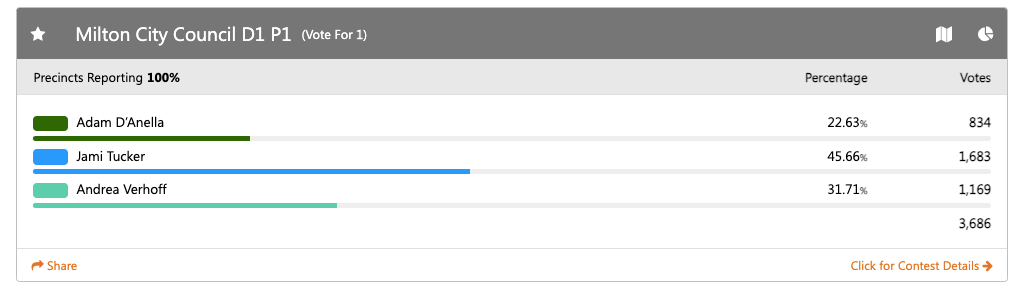
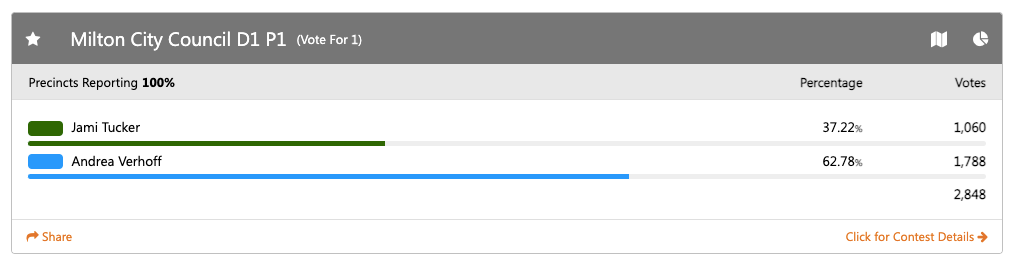
Note 6: Following are two screen shots of election results from the 2021 Milton municipal elections. The race went to a run-off. The leader in the general election, Jami Tucker, came close to winning; she came up 160 votes short. However, Tucker badly lost the run-off, dropping from 45.66% to 37.22%. Her challenger, Andrea Verhoff, surged more than 31 percentage points to win the run-off with a whopping 62.78% of the vote.
I have decided to analyze and report on the Georgia House District 47 Republican run-off election. District 47 covers all of Milton and Mountain Park and some areas of Roswell, Alpharetta, and Cherokee County.
Brian Cochran and Phoebe Eckhart–the two candidates that challenged the heavily favored Jack Miller–forced a run-off that no one anticipated. The issue for voters was $200,000+ of Special Interest dark money (mostly from gambling concerns) that financed a massive media campaign that injected national politics into the race. Voters reacted negatively and punished Mr. Miller. I will provide much more in-depth analysis in my next post.
District 47 Republican candidates (l to r): Brian Cochran and Jack Miller
Sadly, the Milton Herald has opted not to cover the District 47 race. The Herald only covered Jan Jones retirement announcement and announcements from Cochran and Miller that they were running but has been otherwise silent.
This lack of media coverage is one reason I have decided to blog on the District 47 race. Also, I want to provide voters a framework for understanding the current dynamics of the race so that they can tune out political noise and make an informed decision based on the character, background, and positions of the candidates. Finally, I live in District 47, so I have a personal interest in the outcome.
Currently, I do not plan to endorse either candidate and I am an undecided voter.
I have asked each candidate to provide their closing arguments to voters, which I will publish next week.
In the meantime, as I’ve done with municipal elections, I am providing useful links that voters can use to research the candidates:
Jack Miller:
Note: I have removed Jack Miller’s websites because I have observed a huge spike in followers, particularly at Facebook. This spike is consistent with the purchase of followers, likes, shares, etc. There is a whole industry built around creating fake grassroots support for candidates. I consider this a deceptive and manipulative tactic (not unlike the Gambling Dark Money campaign for Miller) either by Miller or organizations supporting him that confers unfair advantage with voters that are performing due diligence and consulting campaign websites.
In closing, I request that blog subscribers and blog visitors inform fellow citizens about the blog’s coverage of the run-off. Please forward the blog email and share the blog URL on social media. The District 47 seat is critical to protecting and furthering the interests of the greater Milton area.
May 2026 marks the Milton Coalition Blog’s 10th anniversary. This auspicious milestone seems a fitting occasion to reflect on the past 10 years and to discuss the blog’s future. However, before I begin, I am obliged to express my heartfelt appreciation to my readers—Milton’s citizens–for your support and your friendship, which have sustained me. Thank you. My blog’s steady North Star has always been the best interests of Milton’s citizens. Period.
When I first launched the Milton Coalition Blog, my hypothesis—really just a hunch–was that in a constitutional republic, facts and logic—even when wielded by ordinary, lowly citizens such as myself and readers of this blog—would prevail over darker forces ever lurking in politics and government. I further surmised that dependably keeping to the high road would be the best route to defeating self-serving, dishonest politicians and their affiliated Special Interests that were clogging Milton’s low road. However, I realized that facts and logic would not be insufficient; adherence to high ethical standards would not suffice. Rather, it was necessary to reach and organize citizens; catalyzing citizen engagement was essential to effecting lasting change. This required a direct communications channel to citizens . . . the Milton Coalition Blog.
The Milton Coalition Blog has been successful beyond my wildest expectations. The numbers (totals for the past 10 years) speak for themselves (See Note 1).
90,000+ views of blog posts/pages achieved through 1) direct blog visits (48,625 views) and 2) emails to blog subscribers (42,000+ views, including forwards to other citizens . . . dramatically increasing the blog’s reach).
19,780 direct visitors to the blog
799 blog shares on social media platforms (e.g., Facebook, Instagram), steering 2,452 visitors (or 12% of total visitors) to the blog.
3,148 click-throughs from the blog to external websites (e.g., Appen Media, Milton Coalition petitions, candidate websites)
2,924 video views.
2,822 signatures (and 994 associated comments) on the Milton Coalition’s two petitions
These numbers have skewed upward over time, with blog traffic especially heavy during the municipal election cycles. Blog views during the 2023 election cycle (when voters ousted Rick Mohrig) were more than double the blog views during the 2017 election cycle (when voters ousted Bill Lusk).
Clearly, the blog has reached a wide swath of Milton’s voters. However, has this reach translated to impact? Has positive change been effected? I believe the answer is certainly YES—at least, in the context of elections . . . choosing WHO governs Milton.
When the blog was launched, Milton had gone two election cycles without any competitive elections. This apathy was a result of palpable voter disillusionment and disgust with extreme dysfunction within Milton’s city government—a consequence of petty and personal infighting between Milton’s two long-warring factions. Citizens were disengaged and ill-informed; no one was watching the store, with predictable results: council members’ self-interests prevailed over citizens’ interests; arrogance flourished.
In this environment (and often to my amazement), the Milton Coalition Blog emerged as an important instrument of accountability, serving as a government watchdog and especially effective in shaping and influencing elections . . . a beacon of light shining brightly on the doings of Milton’s government and politics. Since the blog’s launch in 2016, every subsequent election has involved at least one competitive race. In two of these competitive races, long-time incumbents (Bill Lusk and Rick Mohrig) experienced lopsided losses. Just as important, four city council members (Laura Bentley, Paul Moore, Matt Kunz, and Karen Thurman) opted not to run for re-election in the face of almost certain defeat; the misdeeds of these four politicians had been extensively exposed at the blog. This phenomenon of not seeking re-election in the face of probable defeat had not previously occurred in Milton. It is a welcome development . . . not quite as a preferable as a competitive election, but nevertheless the result of competitive dynamics and an increased emphasis on accountability. The Milton Coalition Blog certainly played an influential—if not dispositive—role in much-needed turnover at council (although replacement candidates have often been disappointing and sometimes just as bad).
Besides facilitating the exit of wayward elected representatives, the blog has also yielded benefits in the form of policy changes (especially in zoning) and reforms to government’s architecture—for example, defeat of the CSO and banning of community septic (for residential purposes). I will not dwell on these victories. Rather, I suggest readers browse the blog to better understand the Blog’s impact on governmental policy and processes.
Unfortunately, these benefits for the community have often come at a personal cost to me. I have paid a steep price for my citizen/community advocacy. In the past, I have been loath to discuss the personal toll of my involvement in politics so as not to dissuade other citizens from engaging. Rather, a key blog objective has been to encourage–not discourage–citizen engagement. Thus, for the most part, I have quietly borne the burdens of community advocacy.
Citizens might be surprised by the labor (of love) involved in publishing the blog. I have literally invested thousands of hours in my research and writing. Consider the following: Since its inception, I have published 375 posts (and pages), which were crafted using 306,000+ words, averaging 816 words per post—about the length of the typical op-ed piece in a newspaper. Consider that the average non-fiction book is 60,000 to 80,000 words, so the blog’s content would fill 4 to 5 typical non-fiction books. Suffice to say, the MC Blog requires a lot of hard work.
The financial burden of advocacy—out-of-pocket expenditures and even greater opportunity costs–has been significant. I have spent $25,000+ of my own money on my advocacy. This includes $15,000 paid to attorneys to protect my First Amendment rights (of free speech, free assembly, and protest). During the 2017 election cycle, Council Member Bill Lusk and his proxies used lawfare to (try to) silence and discredit me. A total of 3 ethics complaints were filed; two were directly filed (after the election) by Lusk. These complaints backfired, with Lusk suffering the worst election defeat in Milton’s history (See Note 2).
My out-of-pocket costs have been far exceeded by my opportunity costs.For 2 ½ years, I walked away from my business to focus almost exclusively on community advocacy . . . costing me many hundreds of thousands of dollars. At the same time (and since then) I have witnessed elected officials brazenly and shamefully monetizing their council positions (while on council and after leaving). (For example, since leaving office, former council member Laura Bentley has repurposed her political Facebook page to sell real estate.)
Notwithstanding thousands of hours of labor and heavy financial burdens, the highest costs of the blog have been personal. And by this, I mean nasty (but thankfully . . . wholly unsuccessful) personal attacks–sometimes from the council dais, but just as often in the shadows (for example, posting of anonymous attack videos). Speaking truth to power means that you make yourself a target of Milton’s wackos . . . and there are many. What this lunatic fringe lacks in understanding, they more than make up for in viciousness. Citizens would be shocked by the many hate-filled communications I have received over the past decade . . . truly vile stuff . . . and always from individuals completely ignorant of the facts and usually incited by former elected officials, who trick others into doing their bidding. Recently, I even received an anonymous, veiled death threat (that I turned over to the Milton Police Department).
Fortunately, while the personal costs have been quite high, the personal benefits have been more numerous and greater. Complimentary and supportive communications from citizens have far exceeded the personal attacks. I have made many lifelong friends. I understand myself and my fellow humans much better because of my advocacy efforts. I believe I have made a big positive difference in my community. And my trust and confidence in Milton’s citizens have been bolstered. Time and again, I’ve seen you—the citizens of Milton—rise to the occasion. When required, you have written emails to council, signed petitions, and showed up to speak at council. When presented with facts and logic, Miltonites have consistently elected the better candidates to council (although often the choices are far from optimal and sometimes unsatisfactory). Kudos to you.
So in closing my 376th blog post/page, it seems fitting to peer into the future: Whither the blog?Answer: I will continue to publish blog posts. However, my focus will be more selective. I now live in Alpharetta, so in the future, I will generally not opine on emerging policy issues, unless such issues (if wrongly decided) might have spillover effects in Alpharetta. My intent is to limit my efforts to legacy issues or else to HOW of government gets done—that is, process and principles . . . my passion. I know from my 40+ years of professional experience, good results are only possible through good process and through application of sound principles. Excellent governance (e.g., transparency, accountability, rigor, fairness, honesty) is essential to excellent outcomes. In addition to addressing legacy issues and the good governance, I plan to write the story of my involvement in Milton politics, weaving in lessons learned that would make Milton’s government more responsive to citizens’ prerogatives. The blog has always been about you, the denizens of Milton . . . and always will be.
Thanks again for your friendship and support over the past 10 years,
Tim
Note 1: Included in my blog statistics are numbers for my precursor blog Say-No-To-The-CSO. However, these numbers generally account for less than 5% of the totals.
Note 2: In the 2017 election, citizens rendered a harsh–but just–judgment of Mr. Lusk (a city founder who had served on council for 11 years since the city’s founding). Lusk was handed the worst election defeat in Milton’s history. Lusk garnered the lowest percentage ever (29%) of votes in a local election. Lusk also had the most votes (3,164) ever cast against a candidate in the highest ever turnout (4,442) municipal election (that did not include other ballot items) in Milton’s history. Mr. Lusk blames me, but alas . . . I was just the messenger.
Better late than never. I had promised commentary on the 2025 District 3 election. Here it is . . .
Capturing lessons learned is important, because in politics, the past is prologue (Shakespeare, The Tempest). Following are six takeaways from the 2025 election . . . somewhat of a dog’s breakfast, but here goes . . .
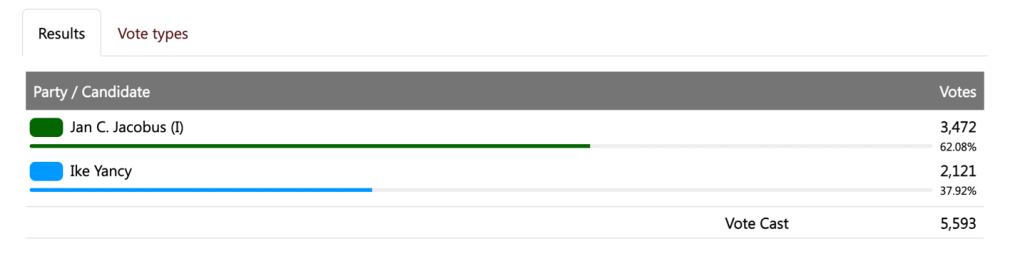
Takeaway #1: Yancy Was Spared a Historic and Embarrassing Loss Because of Additional Ballot Items.
Yes, Ike Yancy’s 62-38 defeat was lopsided. However, Yancy likely would have suffered a much larger margin of defeat but for additional items on the ballot. The 2025 municipal election vote count was around 5,600. A typical municipal election—that is, one with only council elections and no additional ballot items—averages about 3,600 votes (about 10% of registered voters) and ranges between 2500 and 4500 votes depending on the number of races and campaign intensity. Unfortunately, the 2025 campaign was a low-energy affair between two lackluster candidates. Accordingly, it is reasonable to assume that around 2,500 voters would have cast ballots if the only ballot item was the Jacobus-Yancy match-up. That means around 3,100 voters were likely drawn to Milton’s polling places because of the (highly contested) Public Service Commission race, the senior exemption ballot initiative, or both. We can assume these voters are relatively uninformed about municipal politics and therefore the vote differential between Jacobus and Yancy would be narrower with this voter group. Assuming a generous incumbency advantage of 10% (I normally assume only 5% based on previous elections), Jacobus and Yancy would respectively garner 55% and 45% of these 3,100 low-involvement voters.Therefore, to achieve the 62%-38% final outcome means that Jacobus would have garnered 70+% of the remaining 2500 voters that would have turned out just for the city council election. That implies that Yancy would have experienced a historic election defeat only matched by Bill Lusk’s 2017 loss.
Note: I never believed Yancy had even a remote chance of winning but did not want to dissuade voters from casting ballots with predictions of his demise.
Takeaway #2: Gimmicks and Trickery Don’t Work.
Yancy’s campaign failed on both a strategic and tactical level . . . so much so that Jacobus’ lame and inauthentic campaign (clearly outsourced to a consultant) appeared brilliant by comparison. Unfortunately, Yancy seems to have fell under the spell of a few ex-council members and wacko political operatives. Former council member Laura Bentley pitched especially hard for Mr. Yancy . . . probably to his detriment (as I’ll explain more later). The skullduggery of Milton’s long-suffering opposition has become tedious and tiresome. In 2025, Milton’s political malcontents predictably resorted to the same old tricks and gimmicks: fake candidate forums; sham endorsing organizations; and meaningless PAC endorsements. Not only are their antics petty and dishonest, but they’re also singularly ineffective. These clumsy attempts to dupe Milton’s voters have never worked. Milton’s political tricksters might instead consider respecting the intelligence of Milton’s voters and engaging in honest and thoughtful debate about issues that matter most to citizens.
Takeaway #3: A Stronger, Independent Candidate Could Have (easily) Defeated Jacobus.
Let’s be honest. Jan Jacobus is the weakest member of council and that weakness carried over to his campaign. Jacobus held few meet-and-greets, did not knock on doors, effected no election-day ground game, etc. Additionally, Jacobus’s record left him dangerously exposed—for example, his inexplicable and inexcusable support for Rick Mohrig in the 2023 election. Currently, serious issues lurk in Milton’s city government that are not being acknowledged, much less addressed . . . issues that might have been easily and justifiably exploited by Yancy for electoral gain. Jacobus was supremely beatable; the right challenger could have easily won election. Ike Yancy was not that challenger. Yancy’s campaign was doomed from the get-go. Yancy faced two insurmountable obstacles: his cluelessness, which I’ve discussed in other blog posts, and his association with discredited former council members (and Milton’s political wackos). More about the former in Takeaway #4.
Takeaway #4: Three Strikes . . . You’re Out. Milton’s Political Factions Should Allow a Worthy Opposition to Emerge in Milton.
Former council member Laura Bentley has emerged as the de facto leader of the opposition (to the current city council). Bentley was Yancy’s strongest backer (although she seemed stingy with her monetary support). Accordingly, Yancy’s defeat was Bentley’s defeat and, more generally, yet another defeat for Milton’s two long-warring political factions. Since 2021, both factions’ candidates have consistently lost (Tucker, Mohrig, Gordon, Yancy) at the polls or chosen not to run (Bentley, Kunz, Moore) for re-election in the face of strong public opposition and probable defeat. Milton’s factions are batting 0.000
Milton’s political history has been plagued by continuous childish skirmishes between two middle-school-like factions: Bentley-Moore-Bailey (BMB) vs. Lusk-Kunz-Thurman (LKT). (For over a decade, Mohrig aligned with the LKT faction–and was despised by the BMB faction–but eventually entered into a bromance with Paul Moore and was backed by both the BMB and LKT factions in his failed 2023 re-election bid.) Personal and petty disputes took precedence over citizen priorities. However, beginning with the 2021 election, citizens have repeatedly rejected factional politics. In 2021, council members Bentley and Kunz both exited council. In 2023 Council Member Moore exited council; Council Member Mohrig was defeated; and faction-backed proxy Helen Gordon was defeated. In 2025, BMB’s proxy Yancy was defeated.
Considering Bentley’s pivotal role in the 2025 election, let’s focus on the BMB faction. In 2021, BMB’s District 1 candidate finished third; Bentley bowed out of her District 2 re-election bid in the face of strong public opposition. In 2023, the BMB faction (and LKT faction) supported Rick Mohrig’s re-election (District 3); nevertheless, Mohrig only managed to capture 40% of the vote; faction-backed District 1 challenger Helen Gordon lost by an even greater margin (to incumbent Carol Cookerly). In 2025, BMB’s proxy Ike Yancy captured only 38% of the vote against Jan Jacobus, arguably the weakest incumbent in Milton’s electoral history. And as discussed in Takeaway #1, the margin of victory would have been much larger but for the presence of other items on the ballot. Clearly, Yancy’s BMB association hurt–and probably doomed–his candidacy.
Let me be blunt. The discredited BMB and LKT factions need to accept their clear and consistent rejection by voters. Miltonites obviously want to leave behind the past to focus on the future. There are serious issues in Milton that need to be debated and resolved. Unfortunately, the BMB (and LKT) factions are blocking the emergence of a worthy and effective opposition that might expose these issues and offer compelling alternative solutions. Bentley, et al. would best serve the community by stepping aside to allow a new generation of city leaders to enter the arena.
Takeaway #5: Yancy’s Candidacy Ironically Undermined His Advocacy About Highway 9 Widening.
Challenger Yancy’s number one issue was the Highway 9 widening project—more specifically, his preference for narrow (4 foot) vs. wide (8 foot) sidewalks. Go figure! I’m stupefied that he would make this issue the centerpiece of his campaign. It is not an issue that can take you to the promised land. Moreover, Yancy’s obsession with sidewalk widths effectively placed the sidewalk width issue front-and-center on the ballot. The city council election, in part, was made a referendum on Highway 9 sidewalk widths. Accordingly, Yancy’s lopsided loss could reasonably be inferred to be a vote for wider sidewalks. Even most (all but one) precincts encompassing Highway 9 rejected Mr. Yancy. So irony of ironies, Yancy (unwittingly) hurt the cause he most cares about.
Note: To his credit, Mr. Yancy has been a frequent and loud critic of the Highway 9 project, bringing much needed scrutiny to a sometimes troubled project. For this, he deserves plaudits from citizens. Hopefully, Yancy will continue to serve as a citizen watchdog for the Highway 9 project . . . although he likely needs to avoid the issue of sidewalk widths to maintain credibility.
Takeaway #6: Council Should Not Interpret the Election Outcome as a Mandate or Endorsement
The current city council might be tempted to interpret Jacobus’ lopsided election win as a mandate, a rousing endorsement of their record, or both. It was neither, and it would be a (big) mistake to assume otherwise. Citizens were faced with an unappetizing choice between two unpalatable candidates . . . they unenthusiastically chose the better of the two. That’s the long-and-short-of-it. Based on the above discussion, Jacobus’ election (or more accurately, Yancy’s non-election) might best be interpreted as a rejection of Milton’s factions, which Yancy represented, rather than a loving embrace of the current council. If any policy conclusions are to be drawn from the election, I would suggest citizens endorsed 1) the current Highway 9/Deerfield (renewal) master plan, which even Yancy supports, and 2) wider (vs. narrower) sidewalks along Highway 9.
Rather than patting themselves on the back, council would be well-advised to work on creating and executing a positive agenda for Milton’s future. Unfortunately, for the past two years, the current council has had to expend much time, money, and effort on cleaning up messes from previous councils (particularly the 2022-23 council). The biggest of these messes has been the Chang case.
Most importantly—and I cannot overemphasize this—the current council needs to understand that Milton will forever wallow in problems of its own making if it does not devote more attention to good governance . . . my passion since I began my advocacy 10+ years ago. Good governance relates to HOW policy gets made and implemented. Process and principles are essential to good policy outcomes. Council must redouble its commitment to the core elements of good governance: accountability, fairness, rigor, responsiveness, integrity, transparency, and respect for the rule of law. Good governance is not accomplished through window dressing: meaningless resolutions and the collection of phony awards. Rather, council must focus on fundamentally reforming the architecture of local government and implementing better processes and procedures that incorporate the elements of good governance.
Advocating For Good Governance,
Tim
Note: I am currently writing a blog post on former council member Laura Bentley. Because Bentley has become the de facto leader of the opposition (to Milton’s current council), it is important for citizens to better understand Ms. Bentley and her politics. This is especially important because of Ms. Bentley’s lack of written documentation of her current political positions, thus requiring reliance on other sources of information, particularly Ms. Bentley’s four-year record while on council.
More importantly, the rise and subsequent fall of Ms. Bentley as a political influencer is the most important thread in the story of Milton’s politics over the past decade. In fact, it is impossible to understand Milton’s politics without understanding the arc of Ms. Bentley’s political career.
As promised, I am providing a web page (without opinion) that is a one-stop shop for campaign and elections information for the 2025 Milton municipal elections. This includes links to various candidate campaign websites, Facebook pages, etc.
Milton’s qualifying period for the 2025 Milton municipal elections ended Friday August 22nd. Three Council seats and the mayorship were contestable. However, only 1 seat will be contested. Challenger Isiah “Ike” Yancy is challenging incumbent Jan Jacobus for District 3/Post 1. Two incumbents, Mayor Peyton Jamison and Juliette Johnson (District 2/Post 1), are running unopposed and will return to council for second terms. Andrea Verhoff opted not to run for re-election to District 1/Post 1 and will be replaced by newcomer Brian Dolan, who is running unopposed.
A hearty thanks to Ike Yancy, who is challenging incumbent Jan Jacobus, for District 3/Post 1. Competitive elections foster much-needed, critical debate about important issues facing the community. (See below note.) Running for council involves a lot of sacrifice. Campaigning is difficult, time-consuming, and costly.
(Photo: Yancy on left; Jacobus on right)
I have no strong impressions of the Yancy-Jacobus race (yet) and am inclined not to get terribly involved (although I might offer some modest and hopefully informative analysis). It is worth noting that I have never had any two-way communications with either Mr. Yancy or Mr. Jacobus. I am familiar with Mr. Jacobus’s record. And I have surveyed Mr. Yancy’s online postings on various government/political topics and have read media reports that cite him. I will keep vigilant and see how the race plays out. I am open to meeting with either candidate and might be willing to allow them to submit a letter to readers pleading their case for election to city council. I wish both candidates the best and may the best candidate win . . . as they usually do in Milton. Stay tuned . . .
Advocating for Good Governance,
Tim
Note: When I first engaged in Milton politics 10 years ago, two election cycles (2013 and 2015) had passed without any competitive races. Voters were so thoroughly dispirited by the middle school antics of Milton’s two long-warring political tribes that no self-respecting citizen was motivated to run for office. However, in 2016-17, citizens finally rebelled against Milton’s arrogant, self-serving political establishment. Beginning with the 2017 elections, Milton has seen 1 or 2 competitive races in each of the past 4 regular elections. Just as important, 4 incumbents (one in each of the past 4 regular elections: 2017 – 23) chose not to run in the face of almost-certain defeat. Such incumbent withdrawals had never previously occurred in Milton. So although these 4 incumbents did not compete in elections, intense debate typical of campaigns did occur in the run-up to qualification that likely persuaded these 4 wayward incumbents not to seek re-election. Moreover, in 2017 and again in 2023, two other long-time incumbents, who would have been wise not to seek re-election, suffered the two worst electoral defeats in Milton history. And despite joining forces in the last election, Milton’s long-warring tribes suffered an ignominious defeat and were finally (and hopefully forever) purged from city council (although a few members—some operating in stealth mode–continue to sow discord). All the credit goes to Milton’s wise and ever-sentient voters. Suffice to say, Milton’s voters have not been shy about throwing the bums out . . . a total of six removals in the past 4 regular election cycles. That’s impressive. (Of course, I am proud of the small role I have played in exposing Milton’s misbehaving politicians.)