Uncategorized

Milton Coalition Rezoning Petition Tops 1700

Milton Citizens:

Thank you for your ongoing support for the Milton Coalition’s efforts to reform zoning in Milton to make it more citizen-centric.  Today, our petition crossed 1,700 signatures, with nearly 600 signers leaving comments.  And importantly, our petition has now garnered twice as many signatures as the anti-CSO petition garnered late last year.  Our Milton Coalition blog has received over 1200 page views.  This has all been accomplished in the less than 4 weeks, since we launched our latest campaign.  Our movement is gaining strength.

Citizens are recognizing that developers have too much sway over our zoning process.  Citizens are realizing that developers are cynically using environmentalism as a marketing ploy to achieve higher density housing in Milton and to open up marginal land to development.  Citizens are understanding that many practical land conservation solutions that citizens can unite behind have been ignored in favor of impractical and/or developer-promoted solutions, like “conservation” cluster home developments, that virtually no one wants.

One City Council member described this passionate upsurge in citizen involvement as a “movement.”  And certainly the signatures on the Milton Coalition zoning petition support this notion.

Please continue to sign our petition and to write to City Council members to oppose the rezoning of 745 Ebenezer Road.  And most importantly, please attend the June 20th City Council meeting to express your opposition to the Ebenezer Rezoning.  Don’t let a developer, his council member allies, and his small band of supporters bully the residents of Ebenezer, who want to preserve the rural character of their street.  Let’s say NO once and for all to cluster housing in rural Milton.  Let’s free land-use policy from those who have held it hostage now for over two years and accomplished almost nothing.  We can do better and with your help, we will.

Citizens of Milton, thank you!  We appreciate your support and are happy to be your voice for change in Milton.

The Milton Coalition

A non-partisan movement of concerned citizens advocating for clean, competent, courageous, and citizen-centric government

Uncategorized

Ebenezer Road Residents Strongly Oppose Rezoning

Below is a letter from Mike and Monica Chambers, which was published today in the Milton Herald.  Mike and Monica live on Ebenezer Road and like nearly every other nearby resident, they strongly oppose the proposed rezoning of 745 Ebenezer Road.

You would think the nearly unanimous local opposition to the rezoning would matter to every member of our City Council.  Well, you would be wrong.  In fact, the 2 Council members, Kunz and Lusk, who are heavily promoting the rezoning, have never reached out to residents to solicit their opinions.  However, both these politicians are frequently down on Ebenezer.  They have been accompanying the builder and a contiguous landowner (who wants to also cash in on “conservation” cluster housing) on marketing tours of the property, heavily promoting the developer’s subdivision.

Now, citizens may not realize it, but a rezoning is a judicial proceeding.  City Council members are akin to judges in the these proceedings.  And the rezoning applicant, the developer, is akin to a litigant.  Are you getting the picture here?  What would we think of a judge promoting a litigant’s cause in advance of that litigant’s appearance before him in court?

Furthermore, Milton City Code also has something to say about this:

Section 2.15. – Prohibitions.

(a) No elected official, appointed officer, or employee of the city or any agency or political entity to which this Charter applies shall knowingly:

(1)  Engage in any business or transaction or have a financial or other personal interest, direct or indirect, which is incompatible with the proper discharge of official duties or which would tend to impair the independence of his or her judgment or action in the performance of official duties;


So given Mr. Kunz’s and Mr. Lusk’s promotion of the interests of a developer who is days away from appearing before them on a judicial matter, can we say that they are properly discharging their duties and that their judgment is not impaired?  Could any reasonable citizen make such an inference based on their full-throated promotion of Brightwater’s rezoning?  The answer is NO.  Milton citizens, we have a serious governance problem in Milton.

Milton Herald:  Ebenezer Road Residents Oppose Cluster Housing

Posted Wednesday, June 15, 2016 12:00 am

Ebenezer Road is a quiet country road right now. We left the hustle and bustle of a large Milton neighborhood to build our dream home on four acres just down the street from what is now the proposed BrightWater rezoning and variance request. As a young family, we invested in buying land and building our dream home in Milton. All the land around our investment was zoned AG-1, one home per acre. We knew the land on our street would someday be developed but we never thought a rezoning for ¼ lots with experimental community septic would become an option. It seems unfair that the residents of Ebenezer Road should be faced with this change of zoning when we are the true conservationists. We purchased the green space that makes this area so beautiful.

We chose to become part of Milton rather than Roswell when Milton became a city in 2006. We thought that our investment would be best protected by the city that claimed to preserve our rural heritage. BrightWater seeks to use “conservation” as a means to increase density, decrease lot sizes and implement an experimental sewage system for 48 homes a few hundred feet from our home and our well for drinking water.

On June 20th, our city council will decide the fate of our investment along with all of our neighbors. We are not opposed to the land being developed within the restrictions of the current AG-1 zoning. We are opposed to ¼ lots that allow houses placed 15 feet apart. This sort of rezoning has no place in the Agriculture, Equestrian Estate district as specified in our city’s Comprehensive Land Use Plan. Most of all, opposition to this development is almost unanimous by the residents of Ebenezer Road. For everyone in Milton that invested in our community by purchasing homes or parcels on or near AG-1 land, this rezoning request will certainly set a precedent. Your voice in opposition on Monday, June 20th would be greatly appreciated.

Mike and Monica Chambers

Ebenezer Road, Milton

Uncategorized

Council Needs to Follow the Comprehensive Land Use Plan (Repost from June 2016)

Following is a republished post from June 2016.  It provides insight into Milton’s Comprehensive Land Use Plan (CLUP), which lays out a detailed design for how different parts of Milton are to be developed.  It is not legally binding (vs. Milton’s zoning laws); however, the CLUP is an important guide to City staff and to Council, and it frequently referenced in land use battles.

*************************************************************************************************************

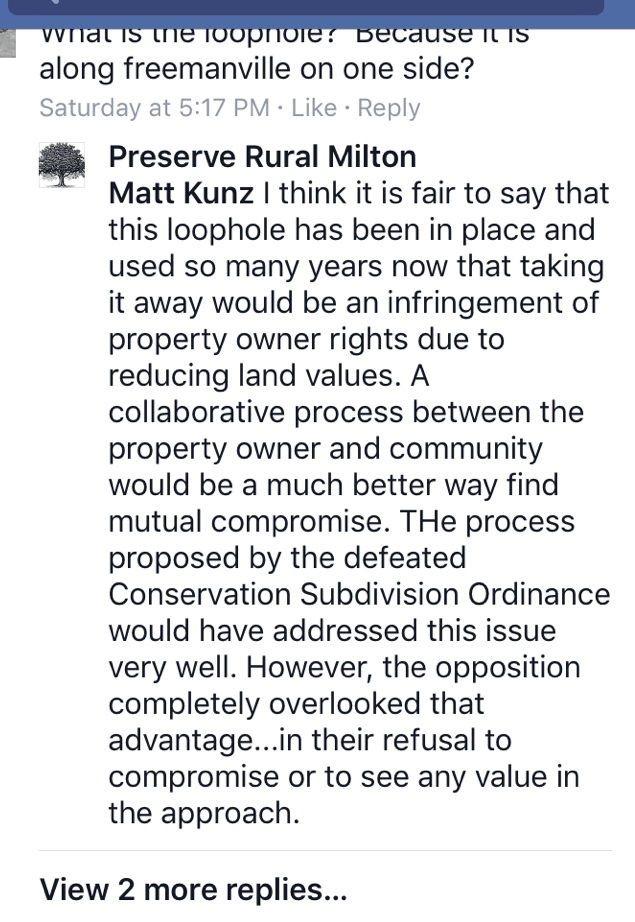
For months, two Council Members, Kunz and Lusk, and their vanishingly small band of sycophants have been claiming that cluster housing is consistent with Milton’s Comprehensive Land Use Plan (CLUP).  Council member Kunz gave a 20-minute PowerPoint presentation claiming that the CLUP justifies homes on lots of <1/4 of an acre on a beautiful country road.  And this was recently posted on-line by one of Mr. Kunz’s admiring fans:

BTW there is nothing in the Comp plan about LOT SIZES

This is simply not true.  The CLUP has a section for each area of Milton.  Sweetapple, where Ebenezer is located, is a designated area under the CLUP.  For each area, the appropriate land uses are designated and then the “Appropriate Zoning Districts in this Area” are designated.  See below table cut and pasted from the CLUP.

CLUP table for Sweet Apple

Well, AG-1 specifies lot sizes of >1 acre.  R1 designates lot sizes of >2 acres.  Those are the facts.  The underlying zoning does not support homes on less than 1/4 acre.  That’s right, folks.  Eight of Brightwater’s lots in its proposed subdivision are <1/4 acre.  And remember that during the whole debate over the CSO on December 7th of last year, 5 out of 7 council members were opposed to lots < 1/2 acre.  So this proposal is worse than what was being proposed in the CSO and much worse than than the minimum half acre lots that were being proposed by the council members that were seeking a compromise in the run-up to the CSO vote.

Proponents of the 745 Ebenezer Road rezoning are also pointing to the CLUP to justify “conservation” subdivisions.  They claim that “conservation subdivisions” are mentioned in the CLUP “at least 10 times.”  It is actually only 7 times in a 116 page document, but we won’t quibble.  But here is the important point.  The CLUP only directs the city  to “consider” conservation subdivisions.  CONSIDER is the operative word.  Well, the city did consider it.  In fact, the City has been obsessed with “conservation subdivisions” for 2 years, to the exclusion of many land-use solutions (like a tougher tree ordinance) that citizens can actually rally behind.  And in December 2015, City Council rejected “conservation” cluster housing by a vote of 7-0.  So the City has considered “conservation subdivisions” and rejected them.

Unfortunately, Special Interests and the two most pro-development members of Council won’t take NO for an answer.  They are seeking to implement the CSO by misusing Milton’s zoning laws.  They have held Milton’s land-use planning hostage for two years now.  They are bound and determined to shove “conservation subdivisions” down the throats of Milton citizens.  They are bound and determined to provide builders a means to profitably develop land that is currently uneconomic to develop.  Folks, so-called “conservation” subdivisions have been used to open up marginal lands to development across the Atlanta area.  Conservation of land that is unbuildable or uneconomic to develop is traded for density.  This is the reason that at every meeting on this issue, it is citizens on one side and Special Interests (developers, lobbyists, community septic vendors, landowners, consultants) on the other side.  It is a complete SCAM.  And the vast majority of Milton citizens know it.

Uncategorized

A Modest Proposal: Build an AG-1 Conservation Subdivision (Repost from June 2016)

I am re-publishing a blog post from June 2016.  The issue was the rezoning of a property on Ebenezer Road to create a “conservation” subdivision.  I proposed a superior alternative for developing the Sweet Apple conservation concept under AG-1 zoning . . . and this is how the developer actually developed the property!!!!  And my estimate of 38 homes vs. the planned 34 homes was a fairly accurate estimate.  I have visited Sweet Apple (the first phase is mostly complete) and it is actually quite nice . . . much nicer than the 45+ cluster home community (with its 12+ acres of septic drip lines) originally proposed by the developer.

**************************************************************************************************************

Replication of Brightwater’s Concept Under AG-1:  A Superior Alternative

OK Citizens, here is a bold proposition:  An AG-1 conservation subdivision can be built that is superior to the current one proposed under CUP rezoning.

The truth is that Brightwater can replicate its concept (actually improve upon it) by building under existing zoning laws (i.e., AG-1).  It is fairly simple, and following is a description of how it could be done.

The overall assemblage at 745 Ebenezer Road is 64 acres.  50 acres is on the western side of the property and another 14 acres is across a stream and abuts Sweetapple Road, which is a gravel road.  For now, let’s focus on the 50 acres and building 38 homes on that 50 acres.  Why 50 acres and 38 homes?  Because on the April 25th, BW said it was ok with developing just the 50 acres if it was allowed to build 38 homes.  In fact, BW indicated it had an alternate site plan for this very possibility.  So here is how BW could replicate its environmental objectives under AG-1.

  • BW could create 38 deep (i.e., narrow width and long length) AG-1 one-acre lots.  BW could make each lot only 100 feet wide, which is the minimum width for AG-1.  This would create the clustering/community effect that BW seems to desire.
  • The front part of each lot (near the street) is where the homes would be placed.  The rear portion (the back approximately 60%) of each lot would be the green space.  This greenspace would have a conservation easement on it.  The HOA would maintain and insure it.  The homeowner would own it (and pay taxes on it), but could do nothing to it.  BW could also have a strict covenants (e.g., on tree cutting) that restricts changes that homeowners can make to the front portion of their lots not maintained/insured by the HOA.  Additionally, a single company could be hired to install and maintain the landscaping on all lots; this has been implemented in many communities, especially “empty nester” oriented subdivisions.
  • The homes would take up approximately 38 acres, leaving another 12 acres for roads, amenities, a community garden, detention ponds, a pasture, and community-owned greenspace.
  • Each home would have its own septic system.  In some cases, BW might have to install technology (e.g., above ground septic) to make this work, but BW has expressed confidence that it can accomplish this (in a letter to the City).
  • The individual septic systems would have a benefit both for BW and for the community.  First, BW would save $400,000 it claims is the difference between the higher cost of installing a community septic system and installing individual septic systems.  The community would benefit by not having a two-acre drain field in the 14 acre greenspace area on the other side of the creek.  The community would avoid the risk and worry of these systems.  A win-win for everyone.

So what would happen to the additional 14 acres that is across the stream on the eastern side of the property:

  • Option 1:  BW could still buy it and offer it as a community amenity.  Coming off a gravel road (lots must be 3+acres) and given its steep grade, this land is not worth a lot (perhaps $450,000 to $600,000).  The $400,000 saved on community septic could be applied toward the purchase of the land.  Repeatedly, “conservation” cluster home proponents have claimed greenspace, walking trails, etc. are prized by consumers above all other amenities, including golf courses.  So it would seem that adding this amenity is a no-brainer.  We would think people would pay an extra $1500 to $4000 in their purchase price to have such an amenity.  And one nice element of this option is that the community drain field is no longer smack dab in the middle of the conserved area, as with a CUP conservation subdivision
  • Option 2:  The land remains undeveloped.  We think non-development is a distinct possibility if BW does not buy this land.  The topography of the land and the stream running through it make it unlikely any developer will find it attractive to build on this land any time soon.
  • Option 3:  The property gets built out with a maximum of 4 homes.  The lower density is a result of Milton’s zoning which requires that homes accessed from a gravel road must be on minimum 3 acre lots.  Because of the geometry of the parcel, we believe only 3 homes are possible.  In our opinion, from a conservation standpoint, it seems like 3 homes on this property is equivalent to having 14 acres with at least 2 acres of septic drain fields.

This replication of Brightwater’s conservation concept under AG-1 strikes us as a win-win for everybody concerned with this issue.  It is a creative solution.  True out-of-the box thinking.  If some minor variances were needed to make it work, we would be okay with such variances.  We have broached this concept with quite a few people, including 2 Councilmen, and none have identified a flaw in it.

We see no reason why anyone interested in conservation would not embrace this concept of an AG-1 Conservation Subdivision . . . unless their true goals are to achieve higher density, smaller (<1 acre) lot sizes, and community septic.

Uncategorized

Density, Cluster Homes, and Private Sewer (Republished from June 2016)

Following is a republished post from June 2016.  It provides additional insight into so-called “Conservation” Subdivisions.  The Lahkapani property referenced in The Milton Herald article was later purchased by the City using greenspace bond funds.  (I am re-posting some previous blog posts to help educate City Council candidates and citizens on issues facing the Milton community.)

***********************************************************************************************************

Milton Citizens:

There is a reason that 745 Ebenezer Road has not been developed.  The reason is that it is currently uneconomic to develop, as is true of much of the contiguous property in the area.  This was admitted in the Milton Herald by one of the nearby property owners who stated his land was considered “trash” by developers.  The property owner admitted he needed cluster housing to make his land economic to develop.

Click here for link to article:  Cluster Housing Needed to Profitably Develop Marginal Land in Milton

It was this article that got many of us energized about this issue.

The truth is that many of the larger tracts of profitable land in Milton have been developed or are being developed.  To keep the building boom going, developers are increasingly looking at more marginal land.  This is land with steep slopes, soils that do not support septic, lots of flood-able area, poor geometry, etc.  These are properties that cannot be profitably developed under AG-1.

So builders are pushing a scheme that has been used across the Atlanta metro area:  so-called “conservation” subdivisions.  Under this scheme, the builder clusters his homes in the most easily developed areas of the property.  The remainder of the land–much of it unbuildable or uneconomic to develop–is claimed as green space.  Most of it would have been conserved anyway.

So what do Milton citizens get from this cluster housing?  Milton citizens get higher density cluster homes that do not fit the rural aesthetic.  We get risky community septic.  Think about the wisdom of letting a small HOA operate and maintain a private sewer system.  We get even more development occurring at an even faster pace.  We get lowered property values.  We get more crowding on our roads, in our schools, and at our parks.  More pollution.  More stress on our infrastructure.  More strain on amenities.

You get our point.  Developers reap the profits and citizens pay the price.

The truth is that developers need the following three things to make their schemes work:

  1. Higher density.  Builders want higher density than can be achieved under current zoning.  More houses, more money.  As part of the zoning process, developers must create a theoretical yield plan to show the number of homes that might be possible on the property under current zoning (i.e., AG-1).  Brightwater Homes developed such as yield plan.  The Milton Coalition’s experts evaluated the plan and found numerous flaws that grossly inflated the theoretical yield.  In the theoretical yield plan, which is still in Brightwater’s rezoning application, Brightwater sited numerous septic systems in soils that will not support septic.  Brightwater’s own soil maps show that 50% of the 50-acre western parcel will not support septic!  This resulted in Brightwater submitting a letter that essentially admitted the errors but stated that it could spend a lot of money to buy technology to fix all the septic issues.  Additionally, Brightwater is including a 14-acre parcel off a gravel road that geometry and Milton’s zoning (developments along gravel roads must have lots of 3+ acres) would only yield 3-4 homes.  But because BW can access this parcel through its assemblage of 2 other parcels on a paved road, it is claiming it could build at least 12 homes on this property.  We consider this an exploitation of a loophole/technicality.  It is a slimey tactic that belies the builder’s supposed conservation intentions.
  2. Cluster homes.  Brightwater Homes benefits from clustering homes.  BW’s costs are lower with shorter utility runs, less roads to build, etc.  Eight of BW’s homes are on less than 1/4 acre.  Such clustering allows a builder to significantly lower its costs.
  3. Private sewer.  AG-1 requires lots be >1 acre for individual septic systems.  Accordingly, for BW to get higher density and to cluster homes on lots of less than 1 acre, BW must install a private sewer system.  This is a sensitive subject for Council as every member has run on a platform of not extending private sewer.  A community septic system is private sewer.  Sewage is collected from multiple homes, put into a common pipe, and sent to a common treatment facility (in this case, a septic drain filed).  We are fundamentally opposed to deployment of this technology.  Quite a few local professional engineers and construction experts have questioned the maturity of these technologies.  Risk is also an issue.  Is it really prudent to trust an HOA to operate and maintain a private sewer system?  The City has already acknowledged that it would have to assume financial risk if a private sewer system failed and the HOA could not or would not repair it.  Additionally, community septic “puts all our eggs in one basket.”   That is, risk is concentrated vs. the risk diversification that occurs with individual septic systems.  If a system for 50 homes (vs. a single home) fails, it could have disastrous results.  And do not believe the falsehoods about the regulation of these systems.  One of the reasons that the City so far has resisted community septic is that state/county regulation is inadequate.

If approved, the Sweetapple rezoning would set a dangerous precedent for Milton.  We should expect a raft of similar applications for hundreds of acres of “trash” land in Milton.  This precedent will make it easier for Brightwater and other builders to develop marginal properties.  We even see this with AG-1.  Builders are increasingly coming hat-in-hand to Council to obtain variances for lots they knew (or should have known) were unbuildable.  In a recent DRB meeting, the City Architect acknowledged that the issue of marginal land is going to increasingly come up.  And BW’s Sweetapple rezoning is only the latest example.

Uncategorized

Morning in Milton

It is said that in the realm of government affairs “Sunlight is the best disinfectant.”  As one citizen said at last night’s boisterous Design Review Board meeting “Citizens are now watching.”  And those in our government that are pushing developers’ agendas need to take heed of our message:  A new day is dawning in Milton.  Citizens are engaged and they are showing up.  And they are going to continue to show up.  We are demanding a citizen’s (not a developers’) agenda for Milton.  Following is a photo taken on King Lake this morning that symbolizes our hopes for Milton.  And symbolizes what we want to preserve.  Thanks, citizens for your fine efforts on behalf of Milton.  You are making a positive difference.

IMG_4455 (1)
Sun Rising Over King Lake


Uncategorized

Over 160 Petition Signatures in Last 24 Hours

Milton Citizens:

Once again, you are rising to the occasion!  In the last 12 hours, more than 160 citizens have signed our petition.  At last count, we were at 1344 signatures.

Once again, you are sending a strong message to our local government that we are fed up with reckless rezonings that are destroying Milton.  We are fed up with our government changing the rules to increase the profits of Special Interests.  We do not want cluster housing in rural areas of Milton.  We do not want higher density housing in un-sewered areas of Milton.  We do not want HOAs running private sewer systems.  We want the Council to close loopholes in our zoning laws.  We want the principle of LOCAL CONTROL to extend to rezonings.  We want Council to listen to our zoning experts, the Planning Commission, which voted 7-0 to recommend denial of the Ebenezer Road rezoning.  We want a fair, rigorous zoning process that considers the prerogatives of citizens.  We do not want rezonings that accelerate already overheated development in Milton.  We do not want rezonings that open up marginal land to development.  We want Council members to honor their campaign promises not to extend sewer.  We do not want any more rezonings that result in the abomination that we see across from Cambridge High School.

Citizens, please help us to get our petition to 2,000 signatures.  Please enlist your friends, neighbors, and family to support our cause:  sign the petition, e-mail Council, and speak at the June 20th City Council meeting against the 745 Ebenezer rezoning.  Citizens, it is your Milton, let’s put government back in our hands.  Thank you.  With deep civic pride,

Click here for our Citizen Action Guide:  What You Can Do To Stop Reckless Rezonings

The Milton Coalition – a non-partisan group of concerned citizens advocating for clean, competent, courageous, and citizen-centric government.

Uncategorized

Rezoning . . . Coming to a Parcel Near You (Republished from June 2016)

I am re-publishing a post from June 2016.  This post re-publishes a letter by Laura Bentley to The Milton Herald.  This letter emphasizes an important outcome of poor zoning decisions in Milton:  they can quickly metastasize across Milton.  The rapid replication of poor zoning choices is why citizens need to engage on issues that might seem faraway (and therefore irrelevant).  If citizens engage on issues only when a zoning decision is on their doorstep (i.e., it involves a neighboring property), then they are probably too late to do anything about the issue.  Once legal precedent is set, the die is cast.

Advocating For Citizen Engagement,

Tim

**********************************************************************************************************

Following is an excellent letter from Laura Bentley about rezonings in Milton.  It was published in the Milton Herald.  Unfortunately, the rezoning of the property across from Cambridge High School is Exhibit A for Reckless Rezoning in Milton.  In justifying his vote, one Council member bragged that he had saved 50% of the property’s green space.  Really? Unfortunately, a few misguided local “environmentalists” seem to think this development is a good compromise.  Really?

Click the following link to go to the Milton Herald article, or read below.   Rezoning . . . Coming to a Parcel Near You

June 20th is an important day for our city. The controversial Ebenezer rezoning will again come forward for City Council review. It appears that a majority of Council supports smaller lot sizes, experimental community septic and a roll of the dice with regard to precedence. This was evidenced by their 4 to 2 approval on April 25th.

Thankfully, Mayor Lockwood exercised his veto authority after overwhelming community outrage and pending legal action resulting from significant procedural errors. The hearing lasted 6 ½ hours, during which a majority of Council Members negotiated with BrightWater homes to secure approval. One Council Member even suggested omitting much of the green space to which the developer readily agreed, contradicting his professed conservation goals. Even more troubling, a majority of our City Council approved conditions submitted by the developer that had not been reviewed by Council, Staff or the City Attorney. Blind acceptance of the developer’s conditions left citizens stunned and unprotected.

Our City Attorney assures us that precedent will not be set with this rezoning, yet the City Council in Roswell recently rejected a rezoning due to the probable “domino effect.” Furthermore, the Milton City Attorney’s explanation of precedent is inconsistent with a broader interpretation commonly used by attorneys for developers.

So what does Milton-style rezoning look like? Look no further than the parcel across from Cambridge High School. This parcel was originally zoned AG-1 and would have only allowed 8 homes on 9 acres. In December of 2013, the parcel was rezoned to a Neighborhood Unit Plan, allowing for a density of 27 homes. During rezoning negotiations, the narrow strip of trees along Cogburn Road was touted as “green space” in exchange for density that required clear cutting of all trees on the remaining parcel.

Our Planning Commission and City Staff have been hard at work to enhance our AG-1 standards to insure that it provides the flexibility to accommodate working farms while offering protection should the land become an AG-1 neighborhood. Our tree ordinance will soon be made more robust to conserve even more green space on AG-1 parcels. Rezoning to allow the clustering of homes on ¼ acre lots utilizing community septic under the guise of “conservation” leaves Milton’s treasured AG-1 land vulnerable to ongoing rezonings. If changing Milton’s recipe for uniqueness concerns you, I encourage you to come voice your opinion June 20, 6:00 at City Hall.

Laura Bentley – Milton

Uncategorized

Petition Tops 1,000 Signatures!

Milton Citizens:

You rock!  At 5:08 pm today, our petition hit the 1,000 signature milestone!  This is incredible given that we launched our petition less than 1 week ago.

Our new goal is 2,000 signatures.  Reaching this new milestone should send a clear and strong message to our City Council that citizens are adamantly against the currently proposed rezonings at 745 Ebenezer Road and Donegal Lane.  We do not want cluster homes on AG-1 land!  We do not want higher density housing!  We do not want private sewer!  Period!  Why are 2000 signatures important?  A petition with 2,000 signatories is more than all votes cast in Milton in last Tuesday’s election.

Citizens, thanks for your ongoing efforts to preserve the Milton we love.  We have 1 more request for you.  Every citizen that signed the petition needs to get just one more person to sign.  It might be someone else in your household . . . or a good friend . . . or your next door neighbor.  Just one person.  Thanks citizens.

(Note:  Today, our blog also surpassed 600 page views.)

Uncategorized

Milton Coalition Letter to Citizens

Dear concerned citizen:

Join the over 1600 citizens and that have signed our petition since last Monday!

STOP CLUSTER HOUSING IN RURAL MILTON!  We need your help in stopping developers and other Special Interests from abusing Milton’s zoning laws to maximize their profits by cramming homes into rural areas of Milton, leaving Milton citizens to pay the price:  lower property values, overcrowded schools, congested roads, stressed amenities, and strained infrastructure.

We have created a blog with information and a petition you can sign.  We also recommend that citizens write to City Council to express their opposition; instructions are provided below.

***********************************************************************

Failing to get the Conservation Subdivision Ordinance (CSO) passed, developers are using rezoning and variances to achieve the goals of the CSO on land currently zoned AG-1 by Milton’s Comprehensive Land Use Plan, including:

  • Cluster homes on ¼ acre lots
  • Higher density of homes
  • 50% lot coverage of homes (a variance is needed to permit this vs. 20% lot coverage allowed under current zoning)
  • Community septic

A new cluster housing subdivision has been proposed on Ebenezer Road.  It seems not to matter that over 800 citizens signed a petition against “conservation” cluster housing.  And even though staff and the Planning Commission (in a 7-0 vote) have recommended denial of this rezoning, a majority of City Council members have voted to approve the Ebenezer Road rezoning allowing cluster housing at the end of a remote rural road in Milton.  Fortunately, the Mayor vetoed the approval (which was upheld by Council in a 3-2 vote) and the rezoning is set for another vote on June 20th.

Approval of such cluster housing will accelerate already overheated development in Milton.  This means more strain on overcrowded schools, congested roads, and overstressed infrastructure.  Approving cluster housing through rezoning and variances is actually worse than the CSO because the protections and restrictions of a CSO are absent.  Such rezonings are an abuse of our zoning laws, representing an end-run around our zoning code.

The truth is that developers are proposing cluster home developments to make unattractive land profitable to develop.  A developer crams homes on the most hospitable areas of the property, claiming the remaining areas as “greenspace”–much of it unbuildable or uneconomic to develop.  Environmentalism is used as a cynical ruse to achieve rezoning and variances.  In a sad irony, approval of such “green” cluster home subdivisions actually accelerates loss of “greenspace” and is the antithesis of conservation.

Approval of the Ebenezer application would set a very dangerous precedent in Milton.  If approved, Milton citizens should expect a flood of similar applications as builders rush to develop land in Milton that is currently unprofitable to develop.  The developers cash in and the citizens of Milton pay the price.  A new proposal to rezone another property (Donegal Lane) to allow cluster housing was submitted last week.

Unfortunately, developers have many advantages:  time, money, connections, zoning expertise, and paid attorneys.  So once again we have to mobilize citizens in opposition.  We need for citizens to again speak out against cluster housing in un-sewered areas of Milton.  We ask that you take the following actions:

  1. Sign our petition at Milton Coalition Petition Against Cluster Housing or paste the following link into your browser: http://www.ipetitions.com/petition/i-oppose-permitting-less-than-1-acre-lots-in Please leave a comment to let council know your thoughts.  Please have each member of your household sign separately.
  2. Write to City Council and the City Manager to express your opposition. Their addresses are provided below.
  3. Express your opposition at the June 20th City Council meeting (6 pm at Council Chambers) when the Ebenezer application is going to be considered.
  4. Please forward this e-mail to family, friends, HOAs, etc. in Milton, so they can also express their opposition.
  5. Contact us at miltoncoalition@outlook.com if you would like to receive occasional updates on this issue or if you have questions/comments.
  6. Post our blog and petition to your social media.

Following are the e-mail addresses of City Council members and the City Manager:

Interim City Manager:  Steven Krokoff, steven.Krokoff@cityofmiltonga.us, 678-242-2570

Mayor and City Council members: joe.lockwood@cityofmiltonga.us,karen.thurman@cityofmiltonga.us,matt.kunz@cityofmiltonga.us,bill.lusk@cityofmiltonga.us,burt.hewitt@cityofmiltonga.us,joe.longoria@cityofmiltonga.us,rick.mohrig@cityofmiltonga.us

If you want more information, go to the Milton Coalition blog.  It is your one-stop shop for all information on current re-zonings.  Click on this link Milton Coalition Stop Cluster Housing Website or paste the following URL into your browser:  https://miltoncoalition.wordpress.com/  You can also contact us at miltoncoalition@outlook.com

The Milton Coalition’s longer term aim is to work with City Council to find land-use solutions (e.g., tightening our current zoning laws) that citizens can unite behind (and there are many of them) as opposed to developer-submitted solutions that are divisive and that citizens do not want.

Thank you for your efforts on behalf of Milton.  They are appreciated.

With deep civic pride,

The Milton Coalition

A non-partisan group of concerned citizens advocating for clean, competent, courageous, and citizen-centric government.

miltoncoalition@outlook.com